Bihar Sabki Yojana Sabka Vikas Campaign for Panchayat Planning
Source:indianmasterminds ↗
Why It Matters
Important for understanding grassroots governance, decentralized planning, and rural development schemes specific to Bihar under the Panchayati Raj framework.
Summary
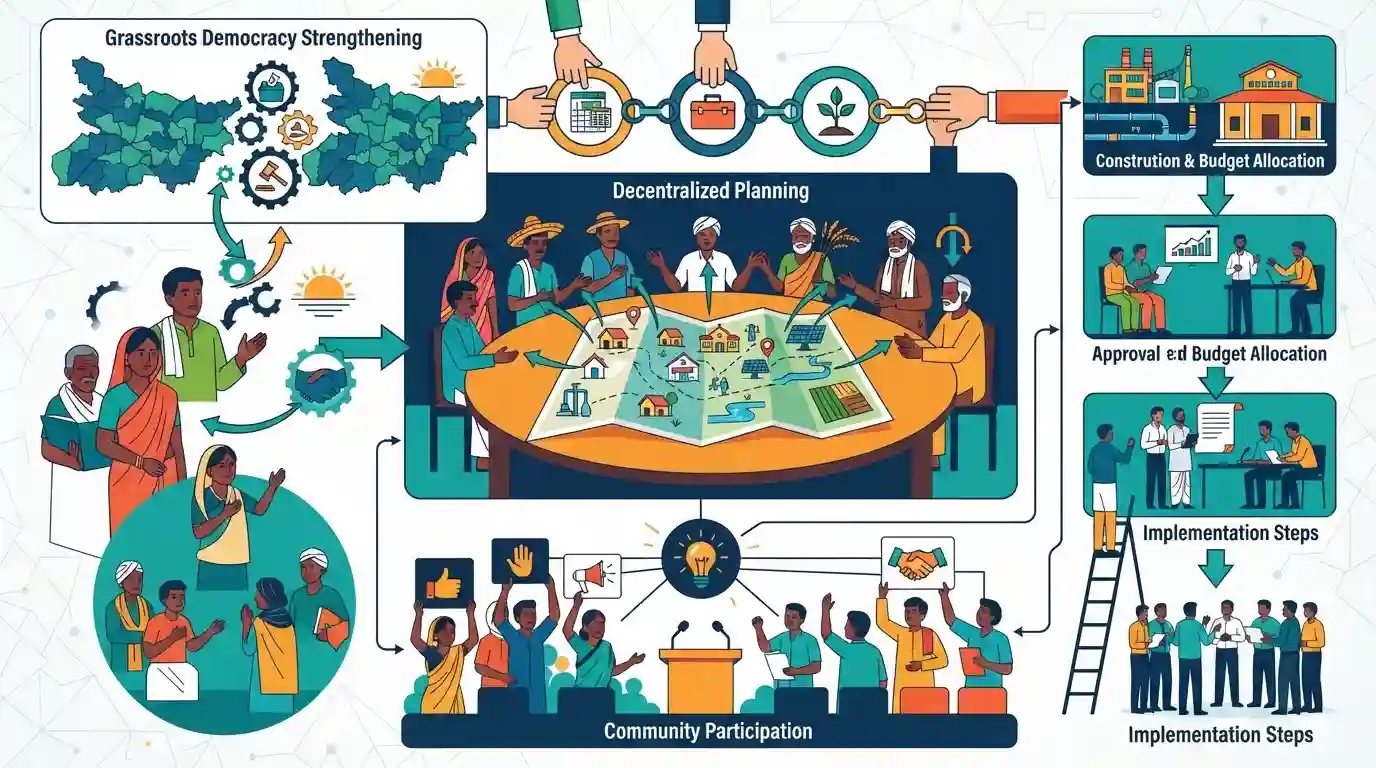
An overview of the 'Sabki Yojana Sabka Vikas' initiative and Panchayat Development Plan (GPDP) implementation in Bihar, focusing on strengthening grassroots democracy, decentralized planning, and community participation through local self-government institutions.
Key Points
- Bihar is actively implementing the 'Sabki Yojana Sabka Vikas' campaign for formulation of comprehensive Panchayat Development Plans (GPDP).
- The campaign aims to foster decentralized planning, democratic participation, and inclusive socio-economic development at the grassroots level.
- It ensures community involvement in identifying local priorities, efficient resource allocation, and execution of developmental programs through local bodies.
Important Terms
Sabki Yojana Sabka Vikas

A nationwide campaign launched by the Ministry of Panchayati Raj for participatory planning, formulation, and execution of inclusive Gram Panchayat Development Plans (GPDPs) through Gram Sabhas.
UPSC context
BPSC Paper II (Polity & Governance): Tests decentralized planning, government welfare interventions, and grassroots participatory democracy.
Panchayat Development Plan (GPDP)
An annual comprehensive development blueprint prepared by each Gram Panchayat through community participation, addressing local infrastructure, social justice, and economic growth.
UPSC context
BPSC Paper II (Polity & Governance): Important for questions on rural development administration and local self-government execution.
73rd Constitutional Amendment Act
Landmark 1992 legislation that added Part IX to the Constitution, giving constitutional status to a three-tier Panchayati Raj system and the Eleventh Schedule (29 functional items).
UPSC context
BPSC Paper II (Polity & Governance): Essential for understanding the constitutional framework and devolution of power to local bodies.
Panchayati Raj Department Bihar
The nodal department in the Government of Bihar responsible for administering Panchayati Raj Institutions, implementing decentralization policies, and managing local grants.
UPSC context
BPSC Bihar-specific questions: Tests administrative implementation of rural governance schemes and state-level policy execution.
Ministry of Panchayati Raj Government of India
The central ministry responsible for formulating policies, overseeing legislation, and providing capacity building for Panchayati Raj Institutions across India.
UPSC context
BPSC Paper II (Polity & Governance): Evaluates institutional frameworks and central schemes for strengthening rural local governance.
Static Concepts Connected
What are the key financial components and institutional tiers of Panchayati Raj in Bihar under the 73rd Amendment?
- Three-Tier Structure: Bihar operates on a three-tier structure: Gram Panchayats (8,053), Panchayat Samitis (533), and Zila Parishads (38).
- Grant Allocation: Central Finance Commission grants are split into Tied Grants (~40% for water/sanitation) and Basic/Untied Grants (~60%) for discretionary local needs.
- Digital Planning: The People's Plan Campaign (PPC) and eGramSwaraj portal ensure transparent digital planning and community participation.
Cross-Topic Patterns
GPDP Decentralisation and Fiscal Federalism
Decentralised local governance under the 73rd Amendment directly impacts grassroots socio-economic development and targeted fund allocation under various central and state schemes.

Expect assertion-reasoning or multi-statement questions on GPDP tiers, fund allocations (tied vs untied grants), and the 73rd Amendment in BPSC.
Linked PYQs · 2
Linked PYQs · 2
- 2024-IBPSC_PRELIMSGS1
What is the system of governance in the Panchayat Raj set-up?
- 2025BPSC_PRELIMSGS1
What is the main purpose of Panchayati Raj?
