Bihar Plans Greenfield Satellite Townships with HUDCO Support
Source:orfonline ↗
Why It Matters
Bihar's strategic push for urbanization directly intersects with BPSC Prelims topics involving Census demographic data, urban development schemes, and state-specific geographic and economic initiatives.
Summary
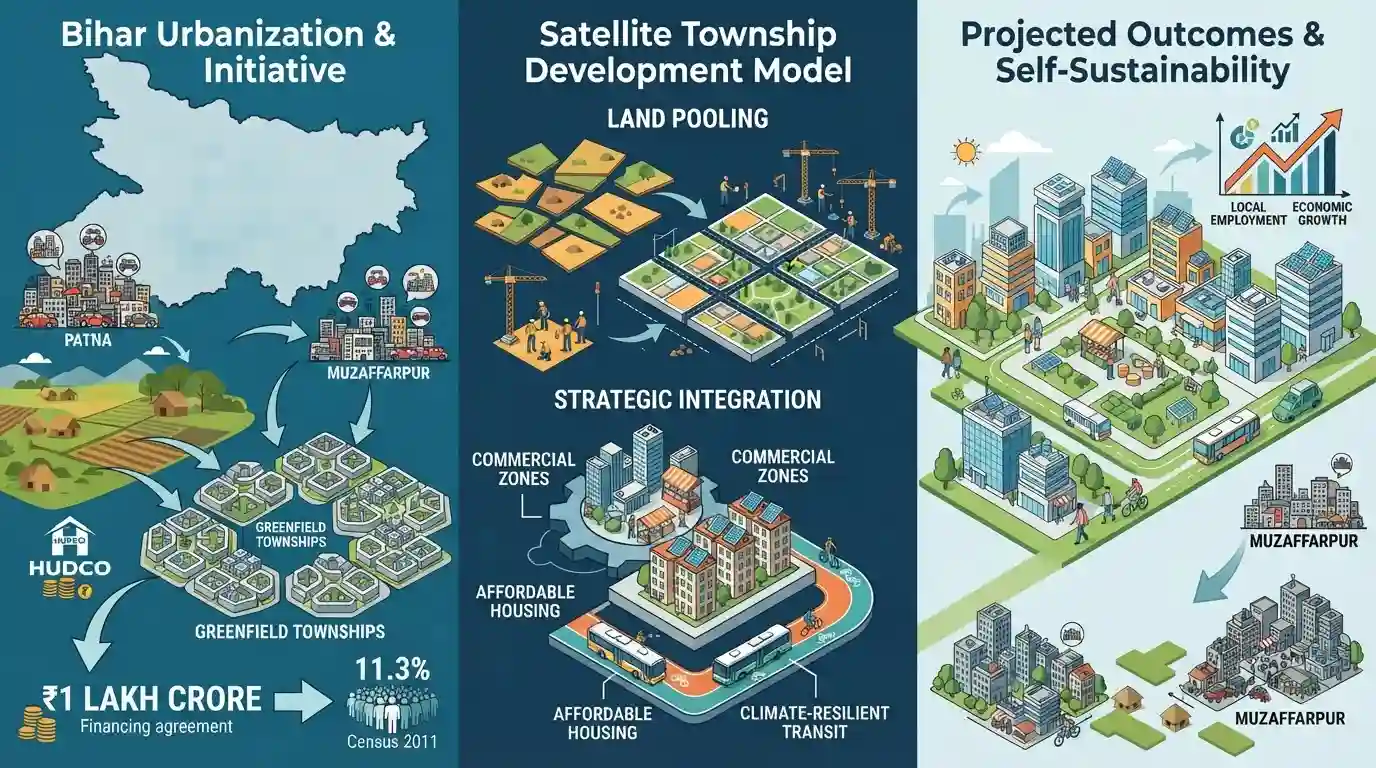
Bihar is embarking on a major urban development initiative to construct 12 greenfield satellite townships across the state, supported by an INR 1 lakh crore financing agreement with the Housing and Urban Development Corporation (HUDCO). With an urbanization rate of just 11.3% according to the 2011 Census, Bihar aims to use these townships to absorb rural outmigration, alleviate infrastructural pressure on existing cities like Patna and Muzaffarpur, and generate local employment. The initiative will employ a land pooling model to streamline development. Crucially, the long-term success of these satellite cities depends on integrating commercial zones, affordable housing, and climate-resilient transit infrastructure to ensure they become self-sustaining economic engines rather than mere commuter towns.
Key Points
- The Bihar government is developing 12 new greenfield satellite townships, backed by INR 1 lakh crore in financial assistance from HUDCO.
- Aiming to boost the state's low urbanization rate (11.3% as per the 2011 Census), the project seeks to decongest primary cities and create self-sustaining economic hubs.
- Land acquisition will be executed through a 'land pooling model', mitigating upfront capital costs by turning landowners into stakeholders, inspired by frameworks in Maharashtra and Gujarat.
- To prevent these from becoming 'dormitory towns', planners must ensure the integration of industrial zones, affordable housing, public transit, and climate-resilient infrastructure to foster local employment and curb outmigration.
Important Terms
Housing and Urban Development Corporation (HUDCO)

A Miniratna public sector enterprise under the Ministry of Housing and Urban Affairs that provides long-term financing for housing and core urban infrastructure projects across India.
UPSC context
Important for GS-3 (Infrastructure, Investment Models); highlights the role of institutional financing in driving state-level urbanization projects.
Land Pooling Model
An urban expansion strategy where landowners voluntarily aggregate their land for a government agency to develop, later receiving a proportionate, fully-serviced plot back instead of cash compensation.
UPSC context
Crucial for GS-3 (Land Reforms, Urban Planning); tested as a sustainable, participatory alternative to coercive land acquisition for smart cities.
Atal Mission for Rejuvenation and Urban Transformation (AMRUT)
A flagship national scheme ensuring basic civic amenities like household tap connections, sewerage systems, storm-water drainage, and green spaces to improve the quality of life in statutory towns.
UPSC context
Relevant for GS-1 and GS-2 (Urbanization); addresses severe infrastructure deficits in rapidly expanding tier-1 and tier-2 Indian cities.
Pradhan Mantri Awas Yojana (PMAY)
A centrally sponsored scheme comprising Urban and Gramin components that aims to provide affordable, permanent houses with basic amenities to economically weaker sections and lower-income groups.
UPSC context
Key for GS-2 (Welfare Schemes, Poverty); addresses the massive housing deficit, rural-urban migration challenges, and the 'Housing for All' objective.
Smart Cities Mission
An urban renewal initiative promoting sustainable, citizen-friendly cities by integrating core infrastructure with technology-driven 'smart' solutions, competitive urban governance, and area-based development.
UPSC context
Important for GS-1 (Urbanization) and GS-3 (Infrastructure); represents a shift toward technology-enabled, competitive federalism in Indian urban planning.
Prelims Trap
"Under the land pooling model, landowners receive direct upfront monetary compensation based on the Land Acquisition Act of 2013."
Land pooling avoids direct monetary compensation. Instead, landowners voluntarily surrender their land and receive a smaller, developed, higher-value plot in return, making them stakeholders.
Static Concepts Connected
What differentiates a Satellite Town from a Dormitory Town?
- Satellite Towns: They possess independent economic engines, local Central Business Districts, and distinct municipal governance separate from the core city.
- Dormitory Towns: They are primarily residential suburbs where inhabitants commute to the core city for work, lacking robust local economies.
How does the Land Pooling mechanism function in urban development?
- Voluntary Contribution: Landowners voluntarily hand over their parcels to a government authority rather than facing forced state acquisition.
- Proportional Return: Instead of cash, owners receive back a smaller, fully serviced plot whose market value exceeds the original raw land.
- Cost Mitigation: It eliminates heavy upfront capital requirements for the state and bypasses delays associated with traditional land acquisition.
Cross-Topic Patterns
Outmigration and local urbanization models
Bihar's highly disproportionate low urbanization (11.3%) drives massive interstate outmigration. Greenfield satellite towns represent a spatial strategy to absorb this demographic dividend locally instead of relying on overloaded megacities.
Central financing for state infrastructure
CPSEs like HUDCO funding massive state-level greenfield projects highlights the evolving role of central financial institutions in bridging state capacity gaps for urban infrastructure.

Expect a GS1 Mains question comparing Satellite Towns vs Smart Cities, or a Prelims statement testing Land Pooling vs Land Acquisition.
Linked PYQs · 2
Linked PYQs · 2
- 2023BPSC_PRELIMSGS1
The urbanization of the State has increased very rapidly in the last ten years. According to the 2011 Census, the level of urbanization in Bihar was just __ percent, which has increased to __ percent at present.
- 1998BPSC_PRELIMSGS1
'HUDCO' means:
