Bihar sugarcane investment incentive policy and land lease offer
Source:chinimandi ↗
Why It Matters
The sugar industry is a vital agro-based sector in Bihar. This policy introduces aggressive state-level land and fiscal incentives, representing a key trend in Bihar's industrialization efforts. Questions regarding industrial incentives, agro-based industry dominance in Bihar, and the 'Saat Nischay' schemes are frequently asked in BPSC Prelims.
Summary
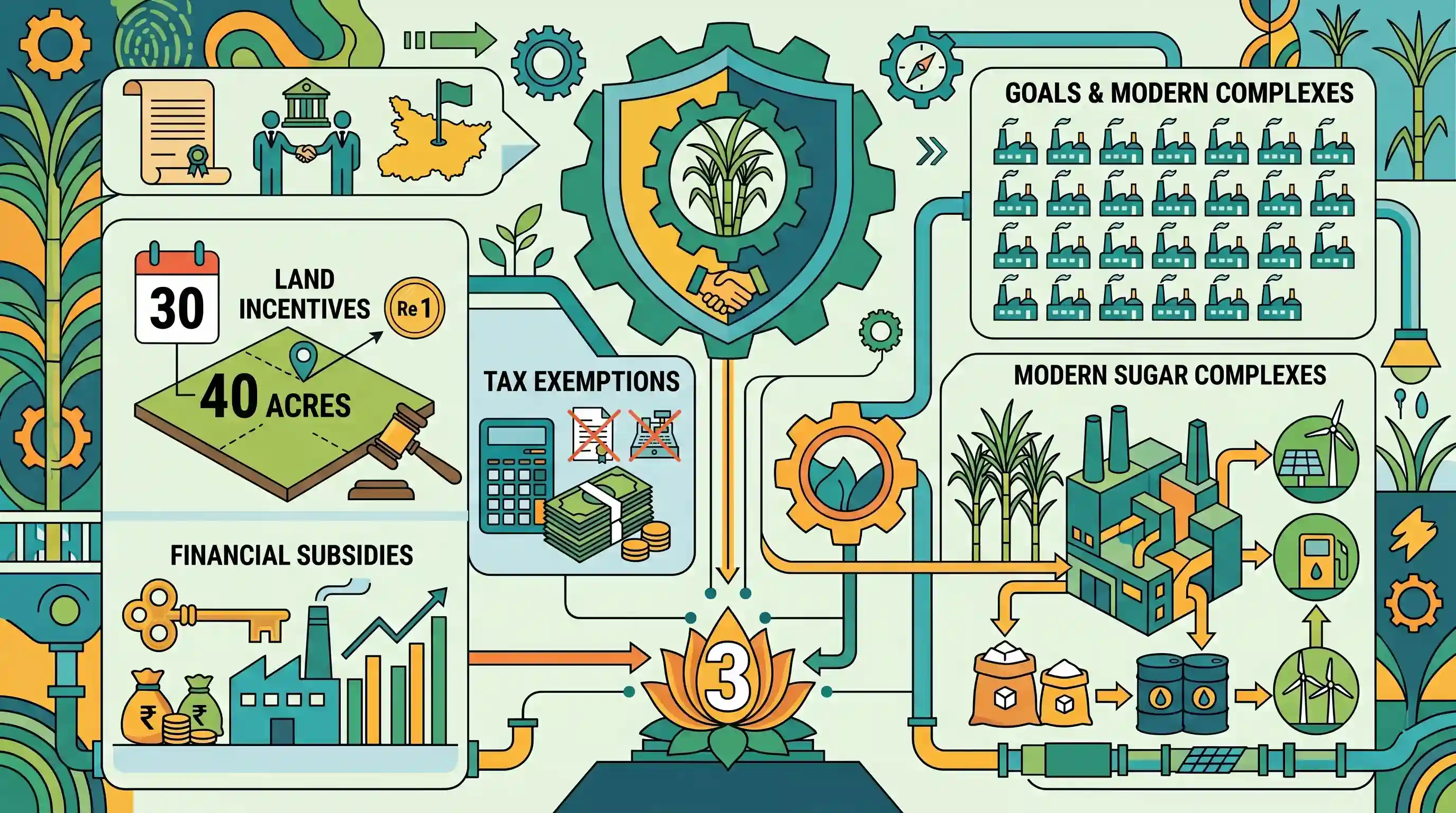
The Bihar Government has rolled out the 'Sugarcane Industries Investment Incentive Policy 2026' to attract investments and revitalize the state's sugar sector. As the first Indian state to offer such a broad, dedicated framework, Bihar is providing lucrative land and financial incentives. This includes a 30-year lease of up to 40 acres of government land for a nominal Re 1, full stamp duty and SGST exemptions, and major financial subsidies for new and expanding sugar mills based on crushing capacity. Integrated with the state's 'Saat Nischay-3' program, the policy aims to establish 25 new mills and promote 'Modern Sugar Complexes' linking sugar, ethanol, and green energy.
Key Points
- Bihar has launched the 'Sugarcane Industries Investment Incentive Policy 2026', making it the first state in India to introduce a dedicated and comprehensive incentive framework for the sugar sector.
- Under the policy, investors can lease up to 40 acres of government land for 30 years at a nominal token lease rate of Re 1 for setting up new sugar mills.
- The policy provides a 100% reimbursement of registration and stamp duty on land purchases, and a 100% State GST (SGST) reimbursement on sugar production for five years.
- Financial assistance is graded by capacity: up to Rs 100 crore for mills with a crushing capacity of 5,000 tonnes of cane per day (TCD), and up to Rs 70 crore for mills with 3,500 TCD capacity. This also extends to the expansion of existing mills.
- The policy promotes a 'Modern Sugar Complex' ecosystem integrating sugar production with allied industries like ethanol distilleries, power co-generation, and compressed biogas (CBG) units.
- The scheme is a key component of Bihar's 'Saat Nischay-3' programme, aiming to revive closed sugar mills and facilitate the establishment of 25 new sugar mills.
Important Terms
Sugarcane Industries Investment Incentive Policy 2026

A Bihar government policy offering extensive incentives—including 30-year land leases for Re 1, SGST reimbursements, and capital subsidies—to attract investments and revitalize the state's sugar and bio-energy sectors.
UPSC context
GS Paper III (Agro-based industries and state industrial policies).
Saat Nischay-3
Bihar's flagship development roadmap (2025–2030) featuring seven resolves—such as doubling employment/income and fostering prosperous industries—aimed at achieving inclusive growth and elevating Bihar to a developed state.
UPSC context
GS Paper II & III (Welfare schemes and state-led growth roadmaps).
Modern Sugar Complex
An integrated industrial model combining sugar manufacturing, ethanol distilleries, power co-generation, and compressed biogas (CBG) production in a unified campus to maximize resource efficiency and promote sustainable green energy.
UPSC context
GS Paper III (Upstream and downstream integration in agro-processing).
Agro-based Industries
Manufacturing sectors that utilize agricultural produce as their primary raw materials, vital for bridging rural and urban economies, generating local employment, and adding value to agricultural outputs.
UPSC context
GS Paper III (Location and significance of food processing industries).
Prelims Trap
The state policy allows unilateral 100% waiver of both Central GST (CGST) and State GST (SGST) on sugar production to attract investors.
States can only offer incentives or reimbursements on State GST (SGST). Any exemption or waiver of CGST requires the mandate and approval of the GST Council.
Static Concepts Connected
How is sugarcane pricing regulated in India?
- FRP determination: Set by the Cabinet Committee on Economic Affairs (CCEA) based on recommendations of the Commission for Agricultural Costs and Prices (CACP).
- SAP mechanism: Declared by individual state governments (e.g., UP, Punjab), which is typically higher than the Union's FRP to benefit local farmers.
- Statutory framework: Governed under the Sugarcane (Control) Order, 1966, issued under the Essential Commodities Act, 1955.
Cross-Topic Patterns
Sugar complexes + National Biofuel Policy
Bihar's integrated sugar-ethanol model directly aids India's 20% ethanol blending target, showing how state industrial policies reinforce national green energy security goals.
Cooperative sector vs. Corporate agro-industries
While Maharashtra and Karnataka rely on cooperative models for sugar, eastern states are transitioning to private-capital-led models using land and tax incentives.

Mains 2026 may evaluate how integrated 'modern sugar complexes' combining biofuels and CBG resolve structural delays in farmer cane payments.
Linked PYQs · 2
Linked PYQs · 2
- 2023BPSC_PRELIMSGS1
Which food industry dominates among the agro-based industries in Bihar?
- 2018BPSC_PRELIMSGS1
Which type of industries has potentials and prospects in Bihar?
