Bihar Toll Tax Framework and Road User Fee Rules
Source:patnapress ↗
Why It Matters
This is Bihar's first comprehensive, state-specific toll policy framework for state highways, marking a major shift in public-private partnerships, infrastructure financing, and transport administration. BPSC frequently tests transport infrastructure, road lengths, and economic policies of Bihar.
Summary
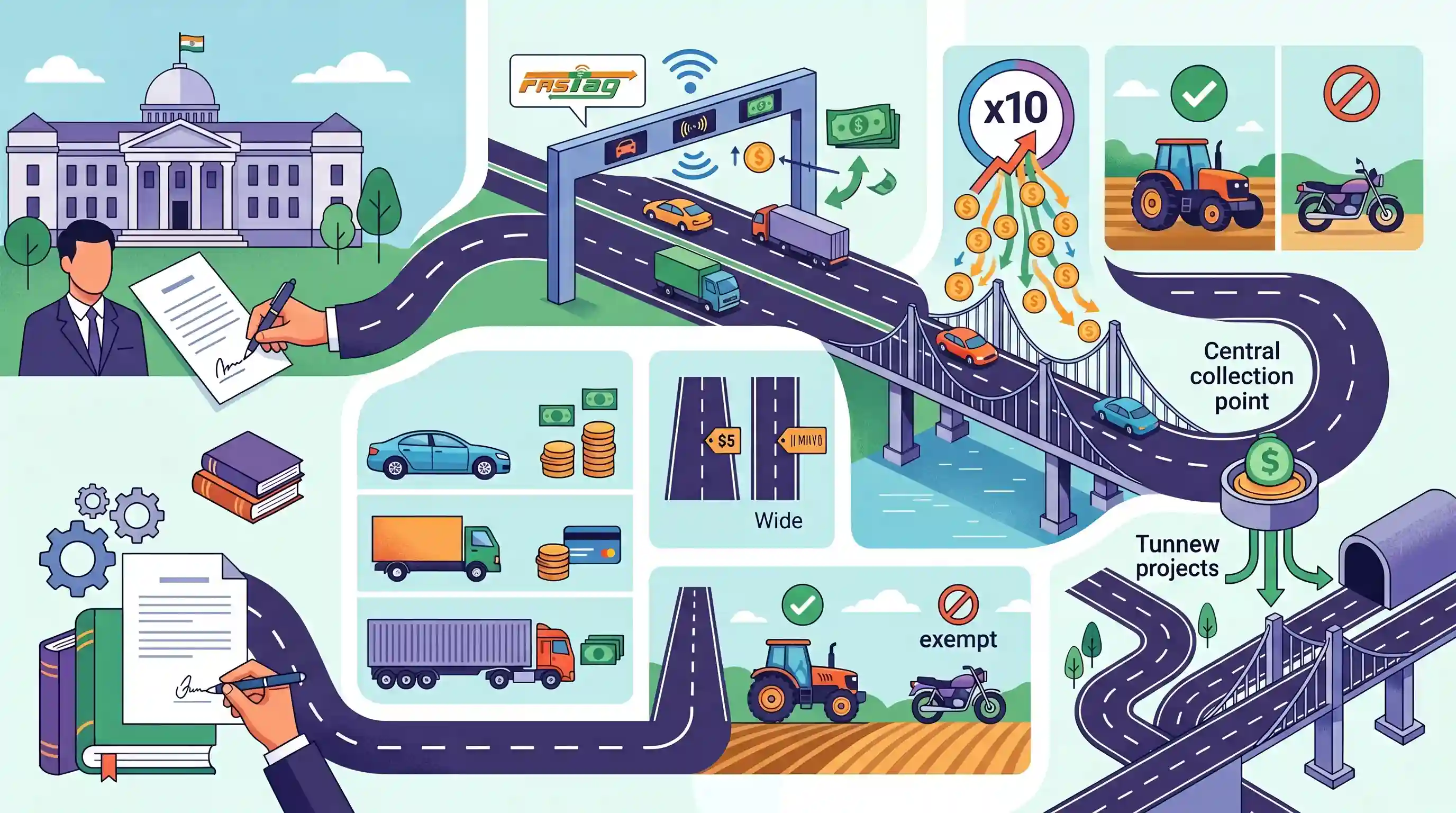
The Bihar government has notified the Bihar Road User Fee Rules, 2026, defining a new electronic tolling framework for selected state highways, bridges, bypasses, and tunnels. The rules peg toll rates directly to road width and vehicle category, introduce a 10x travel-distance multiplier for bridge segments, integrate digital payment via FASTag, and exempt basic agrarian and light passenger vehicles like tractors and two-wheelers.
Key Points
- The Road Construction Department of Bihar has notified the Bihar Road User Fee Rules, 2026, establishing a legal framework for toll collection on state highways, major bridges, bypasses, and tunnels.
- Toll rates are linked to road width: four-lane or wider roads are charged at 100% of the toll rate; roads between two and four lanes are charged at 60%; and roads with a width of 5.5 metres are charged at 50%.
- A unique 'Bridge Toll Multiplier' formula is introduced: ten times (10x) the length of the bridge is added to the route distance to calculate the total chargeable distance (e.g., 45 km road + 5 km bridge yields a 95 km chargeable toll distance).
- The per-kilometre base rates are specified by vehicle class: ₹1.25/km for cars/jeeps/LMVs; ₹2/km for light commercial vehicles; ₹4.25/km for two-axle buses/trucks; ₹4.60/km for three-axle vehicles; ₹6.65/km for heavy construction machinery (6 axles); and ₹8.10/km for oversized vehicles (7+ axles).
- Toll collection will use electronic systems like FASTag. Evasion or failure to pay will attract a penalty of three times (3x) the applicable toll.
- Two-wheelers, three-wheelers, tractors, combine harvesters, and animal-drawn vehicles are exempted from tolls, unless they use designated service roads.
- The specific routes and bridges where the toll will be collected are to be identified and notified separately after carrying out traffic assessments.
Important Terms
Bihar Road User Fee Rules, 2026

Rules notified by the Bihar government implementing electronic toll collection on state-owned road assets (highways, bridges, bypasses) based on road width and vehicle category, to fund local infrastructure development.
UPSC context
GS Paper II (Government Policies) and GS Paper III (Infrastructure); tests state-level regulatory frameworks for transport infrastructure funding.
Road Construction Department, Government of Bihar
The nodal state government department responsible for planning, construction, and maintenance of the road network, bridges, and bypasses within Bihar, including implementing state-level toll frameworks.
UPSC context
GS Paper II (State Administration) and GS Paper III (Infrastructure); tests institutional mechanisms for state public works execution.
User Fee (Public Finance)
A fiscal tool based on the user-pay principle, where individuals pay a fee directly to the government for using specific public goods or infrastructure, enabling cost recovery and asset maintenance.
UPSC context
GS Paper III (Economy and Infrastructure); tests concepts of sustainable fiscal policies and non-tax revenue mobilization models.
FASTag
An electronic toll collection system in India operated by NHAI, using Radio Frequency Identification (RFID) technology to enable direct toll payments from a linked prepaid or savings account.
UPSC context
GS Paper III (Infrastructure & Technology); tests digital application efficiency in optimizing public utility management.
State Highways (SH)
Arterial roads within an Indian state connecting district headquarters, major towns, and national highways, constructed and maintained under the jurisdiction of the respective state government.
UPSC context
GS Paper III (Infrastructure: Roads); tests knowledge of road networks classification and administrative divisions of infrastructure.
Prelims Trap
Under the Constitution, only the Union Government can mandate or implement FASTag-based electronic toll collection systems.
States hold legislative powers over state highways and tolls (Entry 59, List II) and can independently adopt national digital systems like FASTag for state roads.
Static Concepts Connected
How are roads and toll collection constitutionally divided in India?
- Union List: Entry 23 of the Union List (List I) gives the Parliament exclusive jurisdiction over National Highways.
- State List: Entry 13 (roads/bridges) and Entry 59 (tolls) of the State List (List II) empower state governments.
How does the National Electronic Toll Collection (NETC) system function?
- RFID Technology: Employs Radio Frequency Identification (RFID) passive tags affixed to vehicle windscreens for automatic deduction.
- Clearinghouse: Operated by the National Payments Corporation of India (NPCI) to enable interoperable digital tolling across nationwide networks.
Cross-Topic Patterns
Federalism in digital infrastructure
State integration into the national FASTag framework showcases unified digital governance where state-level infrastructure relies on a centralized Union-led clearinghouse.
User-fee models vs Welfare
Exempting agricultural machinery highlights the policy challenge of balancing infrastructure capital recovery through user-pays models with agrarian welfare priorities.

Constitutional division of highway jurisdiction (7th Schedule) combined with NETC architecture is highly probable for analytical MCQs.
Linked PYQs · 3
Linked PYQs · 3
- 2016BPSC_PRELIMSGS1
Total length of National Highways in Bihar is:
- 2017BPSC_PRELIMSGS1
The road length per lakh of population in Bihar is
- 2002BPSC_PRELIMSGS1
The total lengths of National Highways in Bihar is:
