Bihar Emerges as Promising Textile Hub with Major Investments
Source:thestatesman ↗
Why It Matters
The textile and handloom sector is a key driver of employment and industrial growth in Bihar. Understanding Bihar's performance as a Partner State at national-level events like Bharat Tex, and its emerging role as a textile hub, is essential for BPSC Prelims economic and state geography questions.
Summary
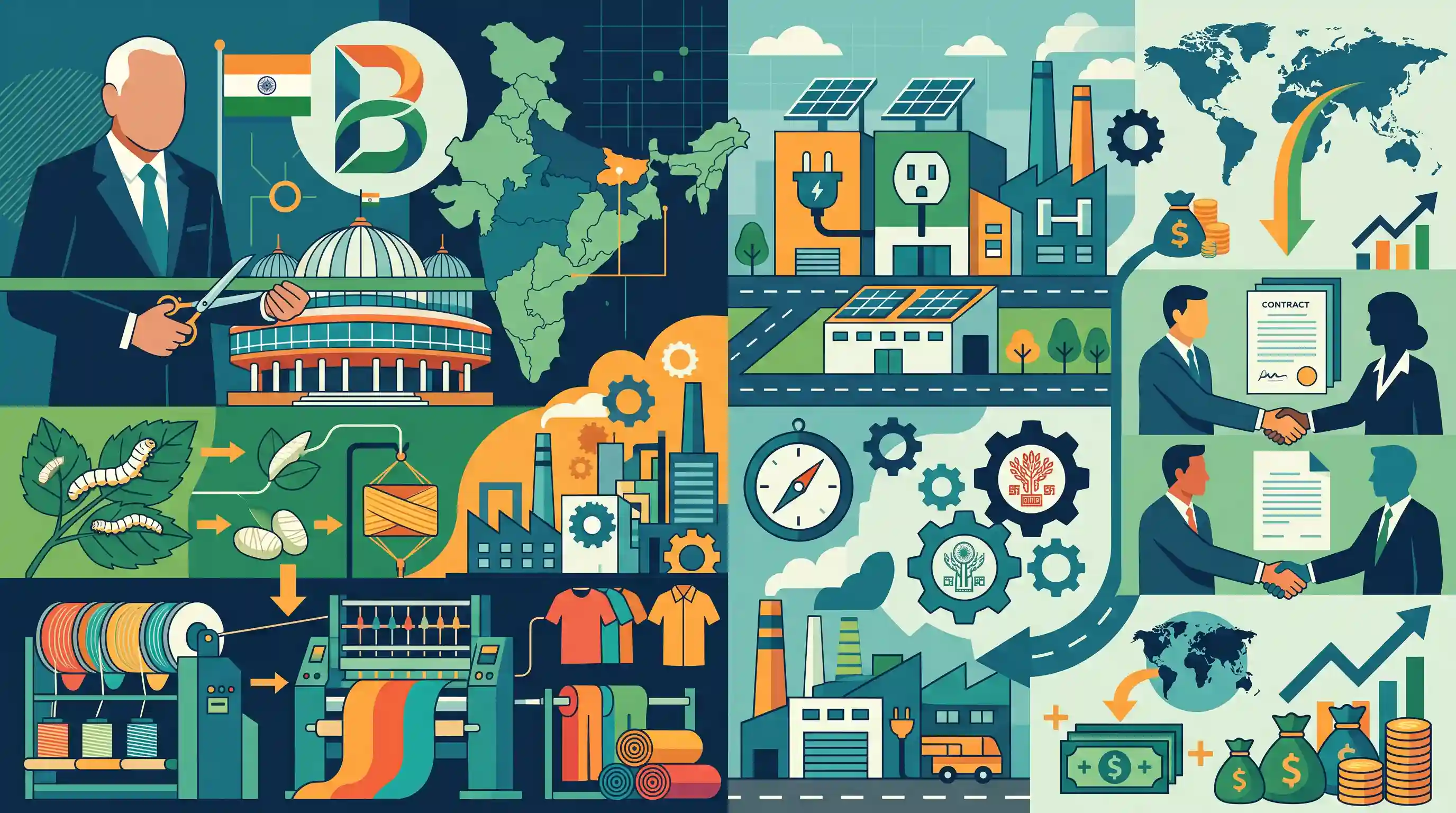
Union Minister of Textiles Giriraj Singh inaugurated Bharat Tex 2026 at Bharat Mandapam, New Delhi, where Bihar participated as the Partner State. Demonstrating its emergence as a major textile hub, the Bihar government signed investment MoUs worth over Rs 1,400 crore on the inaugural day. State-of-the-art infrastructure, including plug-and-play facilities and investor-friendly ecosystems under Bihar's industrial policies, were showcased to global investors.
Key Points
- Bharat Tex 2026, the world's largest integrated textile value chain event, was inaugurated at Bharat Mandapam, New Delhi, by Union Minister of Textiles Giriraj Singh.
- Bihar participated as the 'Partner State' at the event, showcasing its growing prowess in apparel manufacturing, traditional crafts, and sericulture.
- On the very first day of the exhibition, the Bihar Government signed MoUs worth over Rs 1,400 crore with various investors.
- The Bihar pavilion was jointly opened by Union Minister Giriraj Singh and Bihar Industries Minister Shreyasi Singh.
- Key officials in attendance included Kundan Kumar (Secretary, Industries Dept, Bihar), Manoj Kumar Singh (Resident Commissioner), Dr. Bidya Nand Singh, and Mukul Kumar Gupta (Director of Industries).
- The event highlighted Bihar's progress in creating modern industrial infrastructure, such as plug-and-play facilities, to enhance investor confidence and promote traditional textile hubs.
Important Terms
Bharat Tex 2026

India's premier global textile trade fair held in New Delhi, bringing together the complete textile value chain to showcase India's manufacturing, sustainability, and export capabilities to international buyers.
UPSC context
GS Paper III (Economic Development); tests knowledge of export promotion strategies and the textile sector's macroeconomic role.
5F Vision
A developmental framework of the Government of India designed to integrate the textile supply chain seamlessly, representing: Farm to Fibre, Fibre to Factory, Factory to Fashion, and Fashion to Foreign.
UPSC context
GS Paper III (Industrial Policy); tests understanding of value-chain integration and global export competitiveness.
Ministry of Textiles
The nodal ministry of the Government of India responsible for the formulation of policies, planning, development, and promotion of the textile, handloom, and apparel sectors.
UPSC context
GS Paper II (Government Policies); tests awareness of administrative frameworks driving key employment-generating industries.
Bharat Tex Trade Federation (BTTF)
An umbrella consortium of India's major textile-related Export Promotion Councils and industry associations, collaborating with the government to organize the global-scale Bharat Tex trade fairs.
UPSC context
GS Paper III (Economic Development); tests understanding of institutional mechanisms and public-private partnerships in trade.
Directorate of Handloom and Sericulture
A specialized administrative division under Bihar's Department of Industries, tasked with developing the handloom and silk-farming sectors, promoting traditional crafts, and supporting weavers and artisans.
UPSC context
GS Paper III (Rural Livelihoods); tests knowledge of state-level decentralized industrial growth and traditional heritage revival.
Prelims Trap
The 5F Vision includes 'Finance' and 'Fabric', and the Chanpatia Startup Zone was a flagship central scheme of the Ministry of Textiles.
Aspirants often confuse '5F' components with business terms like 'Finance' or 'Fabric' and misidentify grassroots district models (Chanpatia) as centrally-launched schemes rather than state/district-led initiatives using PMEGP funds.
Static Concepts Connected
What is the '5F' Vision and how does it map India's textile value chain?
- Core Definition: Comprehensive policy blueprint to integrate the fragmented textile sector from raw material sourcing to global exports.
- The 5 Pillars: Stands for Farm (raw cotton/silk), Fibre (spinning), Factory (weaving/garmenting), Fashion (design/apparel), and Foreign (global export market).
- Policy Objective: Aims to reduce domestic logistics bottlenecks, build scale, and enhance structural global export competitiveness.
What are the geographical features of Bihar's sericulture and handloom industry?
- Tussar Silk Hub: Bhagalpur is globally known as the 'Silk City' of India, specializing in wild Tussar silk produced from silkworms on Arjun and Asan trees.
- Sericulture Diversity: Bihar cultivates three major varieties: Mulberry, Tasar, and Eri silk, supporting large rural and marginalized communities.
- Structural Shift: Traditional handlooms are gradually shifting to organized powerloom clusters and plug-and-play industrial parks to lower high initial capital barriers.
Cross-Topic Patterns
Reverse Migration & Decentralized Growth
Explores how localized industrial clusters (like West Champaran's Chanpatia model) absorb returning migrant labor, shifting industrial growth from metro hubs to tier-2/3 regions.
Textile Value Chains & Trade Agreements
India's '5F' vision intersects directly with trade policy; securing tariff-free access via bilateral FTAs (with UK/EU) remains critical to converting local factory output into global fashion.

Regional manufacturing hubs and district-led migrant models (Chanpatia) likely to feature in 2026 GS3 industrial development questions.
Linked PYQs · 2
Linked PYQs · 2
- 2016BPSC_PRELIMSGS1
Which of the following is a silk textile producing centre in Bihar?
- 2024-EBPSC_PRELIMSGS1
After elections to the 18th Lok Sabha, who was appointed as the Union Minister of Textiles in the Modi government?
