Universal Health Coverage Expansion and Database Integration
Source:The Hindu ↗
Why It Matters
The shift from SECC to NFSA databases for healthcare targeting, combined with grassroots community mobilization (ASHA incentives), provides a practical case study for GS2 answers on expanding Universal Health Coverage, reducing out-of-pocket expenditure, and improving the implementation of national welfare schemes.
Summary
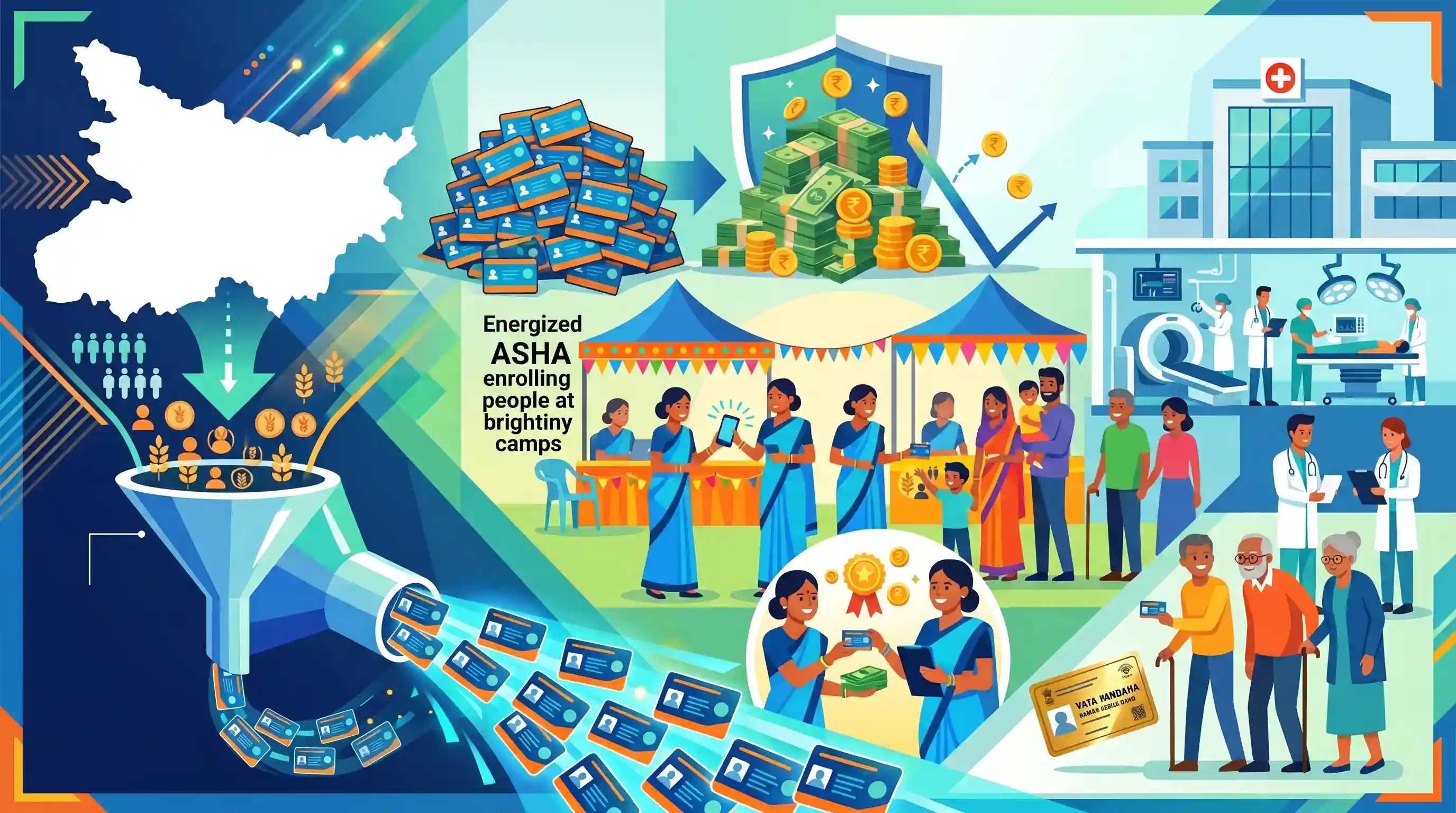
Bihar has significantly expanded its Ayushman Bharat Pradhan Mantri Jan Arogya Yojana (AB-PMJAY) coverage by transitioning to the National Food Security Act (NFSA) database, generating 3.94 crore cards and saving beneficiaries ₹1,000 crore in out-of-pocket health expenditure. Through grassroots mobilization—including enhanced incentives for ASHA workers and targeted enrollment camps—the state aims to deliver cashless secondary and tertiary healthcare to its vulnerable populations, including senior citizens via the Ayushman Vaya Vandana card.
Key Points
- Bihar has generated 3.94 crore Ayushman cards, helping beneficiaries save over ₹1,000 crore in out-of-pocket medical expenses in a single year.
- The State government transitioned from using SECC 2011 data to the National Food Security Act (NFSA) database in early 2024 to widen the beneficiary base, covering all NFSA-registered family members.
- Coverage expansion initiatives include raising the cash incentive for ASHA workers from ₹5 to ₹15 for verified enrolments, setting up camps at railway stations, and conducting door-to-door campaigns.
- Over 2.82 lakh senior citizens (70 years and above) have been enrolled under the newly launched Ayushman Vaya Vandana card in the State.
- Currently, over 1,100 hospitals are empanelled under the scheme in Bihar, 50% of which are private healthcare facilities.
Important Terms
Ayushman Bharat Pradhan Mantri Jan Arogya Yojana (AB-PMJAY)

World's largest government-funded health insurance scheme, providing ₹5 lakh annual coverage per family for secondary and tertiary hospitalisation to vulnerable populations.
UPSC context
GS II (Government Policies) & GS III (Health). Tests knowledge of welfare architecture and universal health coverage goals.
National Food Security Act (NFSA)
A 2013 legal framework entitling roughly 67% of India's population to subsidized foodgrains; its database was used by Bihar to expand health scheme enrollment.
UPSC context
GS II (Food Security) & GS III (PDS). Tests understanding of rights-based welfare and subsidy targeting.
Ayushman Vaya Vandana Card
A PM-JAY extension providing ₹5 lakh annual health coverage specifically to all citizens aged 70 and above, irrespective of their income or socio-economic status.
UPSC context
GS II (Vulnerable Sections). Tests awareness of geriatric care policies and social security for the elderly.
Bihar Swasthya Suraksha Samiti (BSSS)
The nodal agency under Bihar’s Health Department responsible for the implementation and monitoring of Ayushman Bharat and state-specific health assurance schemes.
UPSC context
GS II (Governance). Tests understanding of state-level institutional frameworks for implementing central welfare schemes.
Ayushman Bharat Digital Mission (ABDM)
A national initiative to build an integrated digital health infrastructure, including unique Health IDs (ABHA) and digitized medical records for seamless data exchange.
UPSC context
GS II (E-governance) & GS III (S&T). Tests knowledge of digital health ecosystems and data privacy.
ASHA (Accredited Social Health Activist)
Grassroots community health workers who mobilize rural populations for health services, including enrollment in insurance schemes and maternal-child health monitoring.
UPSC context
GS II (Social Sector/Health). Tests the role of grassroots institutions in community-led welfare delivery.
Prelims Trap
"Ayushman Vaya Vandana card is strictly limited to BPL senior citizens aged 70 and above."
The Ayushman Vaya Vandana card provides a dedicated annual health cover of ₹5 lakh to all senior citizens aged 70+, irrespective of their income.
Static Concepts Connected
What are the core design features of Ayushman Bharat PM-JAY?
- Financial Cover: Provides ₹5 lakh per family per year for secondary and tertiary care hospitalization.
- Beneficiary Targeting: Originally based on SECC 2011 deprivation criteria, but states have flexibility to broaden the base using NFSA or state databases.
- Funding Model: It is a Centrally Sponsored Scheme, not Central Sector, with costs generally shared 60:40 between Centre and States.
Who are Accredited Social Health Activists (ASHA) and how are they compensated?
- Honorary Volunteers: Instituted under the National Rural Health Mission, they act as community health volunteers and mobilizers.
- Remuneration: They are not regular government employees; they receive task-based/performance-based incentives for specific health outcomes (e.g., immunizations, enrollments).
Cross-Topic Patterns
PDS integration with Health Data
Transitioning from the static SECC 2011 list to the dynamic NFSA database solves data staleness, demonstrating effective cross-sectoral e-governance and beneficiary targeting.
Catastrophic OOPE & Poverty traps
Cashless tertiary care directly addresses Out-Of-Pocket Expenditure (OOPE), which remains the primary driver pushing vulnerable Indian households back below the poverty line.

Expect a 2026 Prelims question contrasting the income-agnostic 70+ Vaya Vandana cover with the targeted SECC/NFSA base of general AB-PMJAY.
Linked PYQs · 5
Linked PYQs · 5
- 2024MainsGS2
In a crucial domain like the public healthcare system the Indian State should play a vital role to contain the adverse impact of marketisation of the system. Suggest some measures through which the State can enhance the reach of public healthcare at the grassroots level.
- 2018MainsGS2
Appropriate local community-level healthcare intervention is a prerequisite to achieve 'Health for All' in India. Explain.
- 2015MainsGS2
Public health system has limitations in providing universal health coverage. Do you think that the private sector could help in bridging the gap? What other viable alternatives would you suggest?
- 2019MainsGS2
Performance of welfare schemes that are implemented for vulnerable sections is not so effective due to absence of their awareness and active involvement at all stages of policy process. Discuss.
- 2012PrelimsGS1
With reference to National Rural Health Mission, which of the following are the jobs of 'ASHA'; a trained community health worker? 1. Accompanying women to the health facility for antenatal care checkup 2. Using pregnancy test kits for early detection of pregnancy 3. Providing information on nutrition and immunization 4. Conducting the delivery of baby Select the correct answer using the codes given below:
