Bihar Police Arrests Constable in Fake Encounter Case
Source:The Hindu ↗
Why It Matters
Highlights critical issues regarding police accountability, human rights violations via extra-judicial killings, and the practical application of the newly implemented Bharatiya Nyaya Sanhita (BNS) in prosecuting law enforcement officers.
Summary
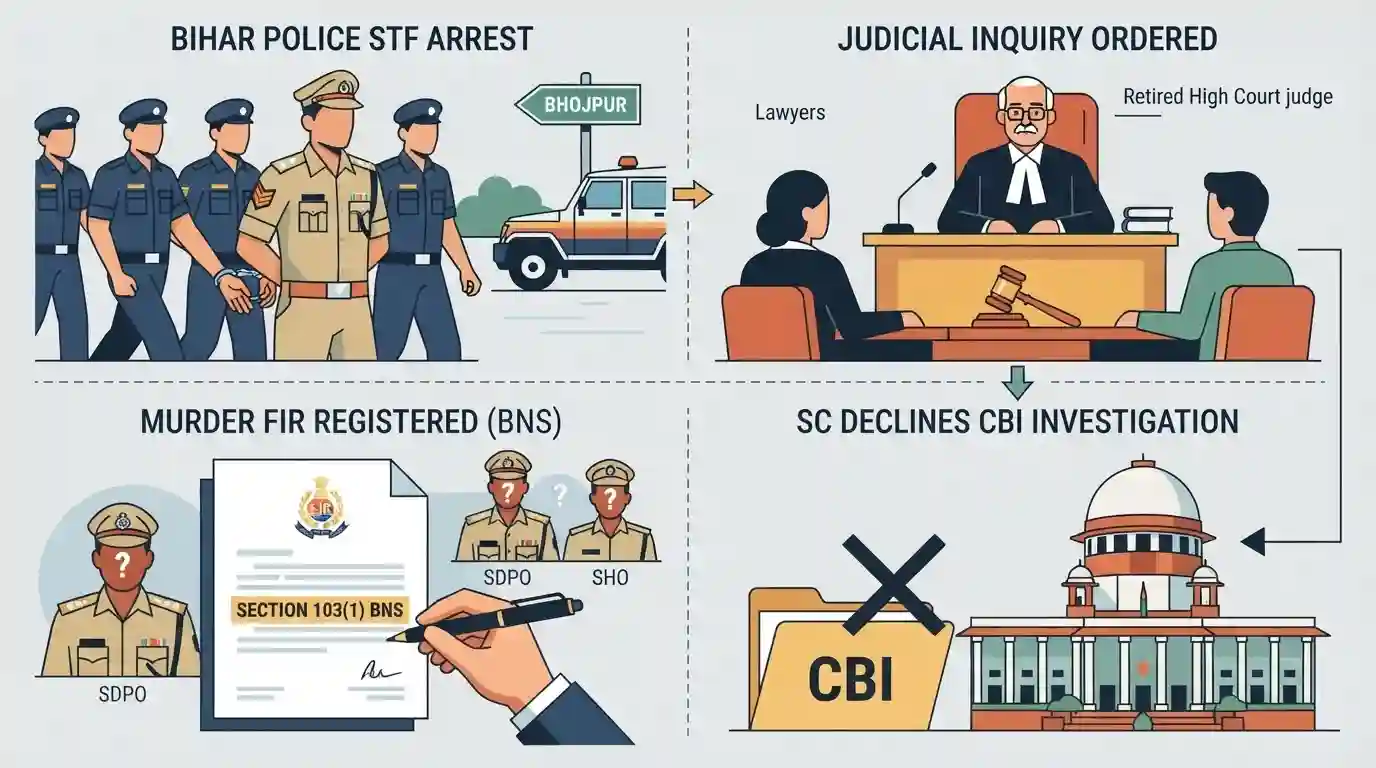
Bihar Police arrested an STF constable for his alleged role in the extra-judicial killing of social worker Bharat Bhushan Tiwari in Bhojpur. The state has ordered a judicial inquiry led by a retired High Court judge. A murder FIR has been registered under Section 103(1) of the Bharatiya Nyaya Sanhita (BNS) against multiple police officers, including a local SDPO and SHO. The Supreme Court earlier declined a request for a CBI investigation into the matter.
Key Points
- Bihar Police arrested an STF constable in connection with the alleged fake encounter of social worker Bharat Bhushan Tiwari in Bhojpur district.
- The state government has ordered a judicial inquiry into the incident, to be headed by a retired High Court judge.
- A murder case was registered against several police officers under Section 103(1) of the newly implemented Bharatiya Nyaya Sanhita (BNS).
- The Supreme Court had recently refused to entertain a plea seeking a CBI probe into the extra-judicial killing.
Important Terms
Bharatiya Nyaya Sanhita

India's comprehensive new criminal code that replaced the colonial-era Indian Penal Code (IPC) in July 2024. It aims to modernize the criminal justice system with revised penalties and contemporary legal frameworks.
UPSC context
GS-II (Polity). Highly relevant for questions evaluating criminal justice reforms, recent legal legislation, and the modernization of India's constitutional framework.
Central Bureau of Investigation (CBI)
India's premier federal investigating agency under the Ministry of Personnel. It derives its powers from the Delhi Special Police Establishment (DSPE) Act, 1946, and investigates major corruption and multi-state crimes.
UPSC context
GS-II (Statutory Bodies). Frequently tested regarding its autonomy, federal jurisdiction, and the requirement for state government consent under the DSPE Act.
Special Task Force (STF)
An elite, specialized unit within state police departments in India. STFs are formed to tackle specific complex threats like organized crime, terrorism, or insurgencies requiring advanced intelligence and tactical operations.
UPSC context
GS-III (Internal Security) & GS-II (Governance). Important for topics on police reforms, state police modernization, and addressing organized crime networks.
Supreme Court
The apex judicial body in India's integrated legal system, established under Article 124 of the Constitution. It functions as the ultimate interpreter of the Constitution and the highest appellate court.
UPSC context
GS-II (Polity). Essential for analyzing judicial review, fundamental rights enforcement, separation of powers, and the overall structure of the Indian Judiciary.
High Court
The highest appellate court at the state level in India, governed by Article 214 of the Constitution. High Courts possess broad original and appellate jurisdiction, including extensive writ powers.
UPSC context
GS-II (Polity). Key to understanding state-level judicial administration, judicial federalism, and the protection of civil liberties via writ jurisdiction.
Prelims Trap
A State Government can independently set up a parallel inquiry commission even if the Centre has already appointed one on the same subject.
Under Section 3 of the 1952 Act, if the Central Government has already set up a commission, no State Government can set up a parallel commission without prior Central approval.
Static Concepts Connected
What are the key SC PUCL (2014) encounter guidelines?
- Mandatory FIR: An FIR must be registered immediately, and forwarded to the court without delay under the criminal code.
- Independent Investigation: The probe must be done by the State CID or an independent police team from another police station.
- Magisterial Inquiry: A magisterial inquiry must be conducted in all cases of death during police action.
What is the legal status of Commissions of Inquiry?
- Civil Court Powers: The commission possesses powers of a Civil Court under the CPC, including summoning witnesses and requisitioning records.
- Advisory Nature: Its findings are purely recommendatory; the government is not legally bound to implement its recommendations.
- Parallel Jurisdictions: If the Centre sets up a commission, states cannot establish a parallel commission without prior Central approval.
Cross-Topic Patterns
Encounter Guidelines + Article 141
Supreme Court guidelines on extra-judicial killings in the PUCL case operate as binding law nationwide under Article 141, filling critical legislative gaps in police accountability.
Inquiry Commissions + Cooperative Federalism
The joint jurisdiction of Centre and States over inquiries (under Concurrent List Entry 45) creates unique constitutional frictions when local law enforcement excesses are probed.

GS-2 is likely to test the binding nature of PUCL guidelines on encounters alongside the civil court powers of the Commissions of Inquiry Act.
Linked PYQs · 2
Linked PYQs · 2
- 2015BPSC_PRELIMSGS1
Justice J. S. Verma Committee's Report, 2013 deals with:
- 2024-EBPSC_PRELIMSGS1
Manvi Madhu Kashyap recently became Bihar’s first transgender
