PMCH Patna Upgrades Healthcare with Advanced Research MRI Facilities
Source:indianmasterminds ↗
Why It Matters
PMCH is Bihar's premier and largest government medical facility (originally established in 1925 as the Prince of Wales Medical College). Upgrades to its infrastructure are highly relevant for BPSC Prelims, both from a state governance/economy perspective (BMSICL, health service delivery) and a General Science perspective (the underlying technologies of CT scans using X-rays versus MRIs using magnetic fields and radio waves).
Summary
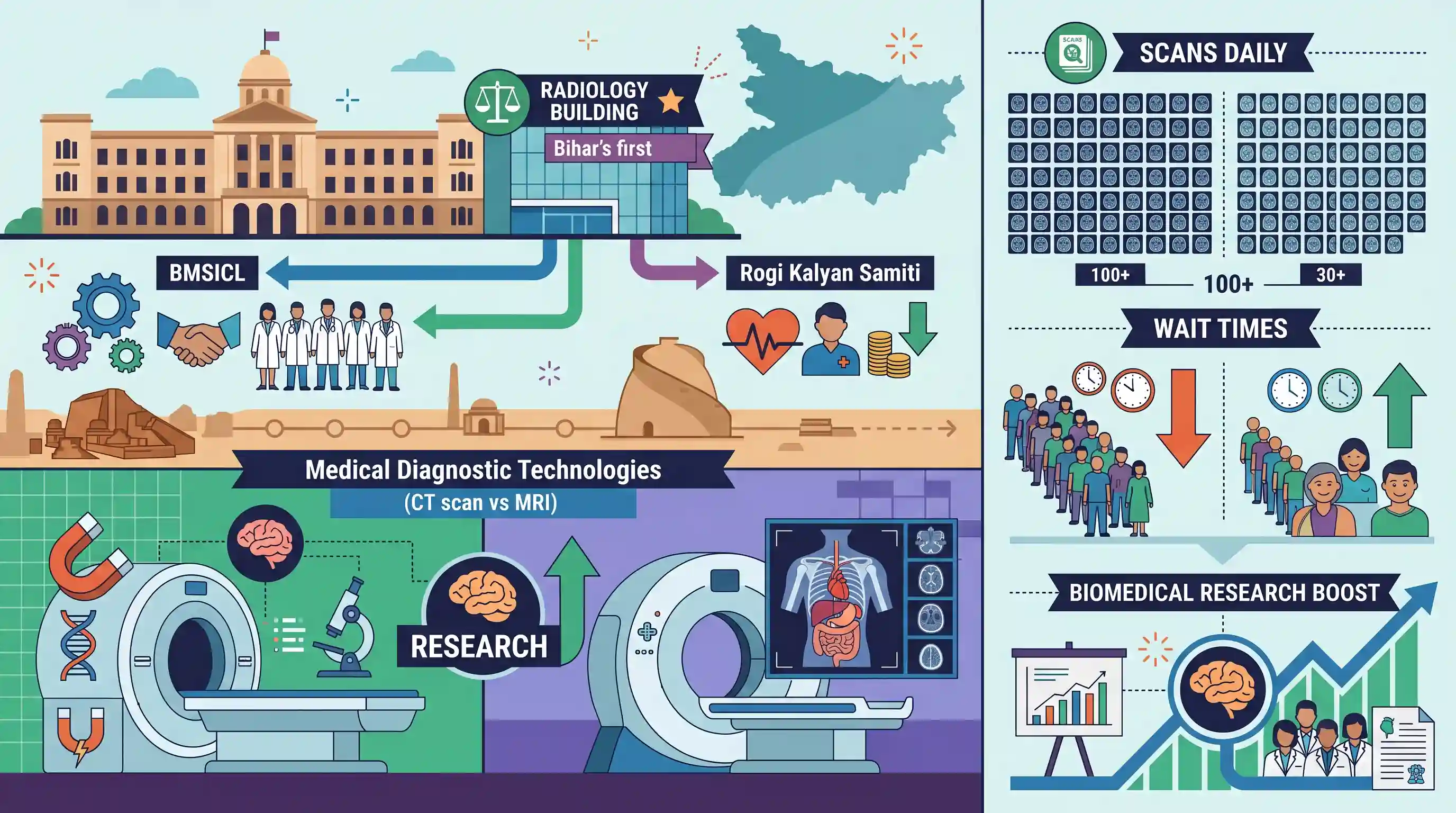
Patna Medical College and Hospital (PMCH) is upgrading its diagnostic facilities with the installation of Bihar's first government-sector research-oriented MRI and advanced CT scan machines in its newly built Radiology Building. Supported by BMSICL for manpower and Rogi Kalyan Samiti for affordable pricing, the facility aims to perform over 100 scans per machine daily, dramatically cutting patient wait times and boosting biomedical research in the state.
Key Points
- Patna Medical College and Hospital (PMCH), Bihar's largest government hospital, is setting up two modern CT scan machines and one research-based MRI machine at its newly constructed Radiology Building.
- These will be the first research-oriented MRI and CT scan diagnostic facilities installed in any government hospital in Bihar.
- Each machine will possess a diagnostic capacity of executing more than 100 patient scans within 24 hours, significantly reducing waiting times.
- The Bihar Medical Infrastructure Corporation Limited (BMSICL) will support the facility by providing outsourced manpower, while the Rogi Kalyan Samiti will determine subsidized rates for patients to keep services affordable.
- During June 2026, PMCH's pathology department successfully conducted 2,34,018 tests, highlighting the immense patient footprint at the state's apex medical college.
Important Terms
Patna Medical College and Hospital (PMCH)

Established in 1925 as Prince of Wales Medical College, PMCH is a historic and premier public tertiary referral hospital and medical education institute in Patna, Bihar.
UPSC context
GS Paper II: Issues relating to development and management of Social Sector/Services relating to Health.
Bihar Medical Services and Infrastructure Corporation Limited (BMSICL)
Established in 2010, BMSICL is the sole procurement, distribution, and construction agency for drugs, medical equipment, and health facility infrastructure under the Government of Bihar.
UPSC context
GS Paper II: State public health administration, infrastructure development, and institutional mechanisms for welfare.
Rogi Kalyan Samiti (RKS)
A registered society acting as a hospital management committee to ensure public participation, accountability, and affordable healthcare services within public health facilities under the National Health Mission.
UPSC context
GS Paper II: Governance, citizen participation, and health service delivery mechanisms under the National Health Mission.
Magnetic Resonance Imaging (MRI)
A non-invasive diagnostic technique that uses strong magnetic fields and radio waves to generate detailed, high-resolution three-dimensional anatomical images of the body's internal soft tissues.
UPSC context
GS Paper III: Science and Technology — developments and applications in everyday life and medicine.
Computed Tomography (CT) Scan
A medical imaging procedure that combines a series of X-ray images taken from different angles to create cross-sectional detailed views of soft tissues, bones, and blood vessels.
UPSC context
GS Paper III: Science and Technology — advancements in medical diagnostics and imaging technologies.
Prelims Trap
Funds collected by Rogi Kalyan Samiti (RKS) as clinical user fees must be deposited directly into the Consolidated Fund of the State.
RKS is an autonomous registered society under the National Health Mission, allowing it to retain and spend user fees locally without depositing them into the state treasury.
Static Concepts Connected
How do MRI and CT scans differ in their imaging physics and radiation risks?
- CT Scan Physics: Employs ionizing X-ray beams that rotate to generate cross-sectional 3D slices, making it highly effective for dense structures like bones.
- MRI Physics: Utilizes powerful magnetic fields and non-ionizing radiofrequency pulses to realign hydrogen protons in water molecules, offering superior soft-tissue resolution.
- Radiation Risk: CT scans carry ionizing radiation risks, whereas MRI uses completely non-ionizing radiation, posing no radiological hazard to the patient.
What is the institutional structure and financial mandate of the Rogi Kalyan Samiti?
- Institutional Nature: RKS is an autonomous, registered society introduced under the National Health Mission to manage public hospital administration and improve community accountability.
- Financial Mandate: Authorized to collect and retain local user fees in independent bank accounts, bypassing state exchequers for rapid, decentralized reinvestment.
Cross-Topic Patterns
Colonial institutional legacies & modern healthcare
Tracing institutions like PMCH (est. 1874) highlights how colonial-era tertiary infrastructure remains the administrative and clinical backbone of modern state health systems.
Centralized procurement & cooperative federalism
Bihar’s BMSICL, modeled after Tamil Nadu’s TNMSC, demonstrates how states adapt successful southern procurement designs to resolve northern healthcare bottlenecks.

UPSC may contrast the diagnostic physics of MRI, CT, and Ultrasound with the financial autonomy rules of NHM's Rogi Kalyan Samitis.
Linked PYQs · 3
Linked PYQs · 3
- 2024-IBPSC_PRELIMSGS1
One of the properties associated with X-rays is that they can be deflected by
- 2022BPSC_PRELIMSGS1
Which of the following rays/waves are used to know the growth of fetus in the womb?
- 2024-IBPSC_PRELIMSGS1
When was the Patna College established?
