PMAY Urban 2.0: Bihar releases funds and fast-tracks complaints
Source:indianmasterminds ↗
Why It Matters
This news highlights key state-level implementation of central welfare schemes (PMAY-U 2.0) and administrative measures taken by Bihar to improve governance, curb corruption, and streamline public complaint handling.
Summary
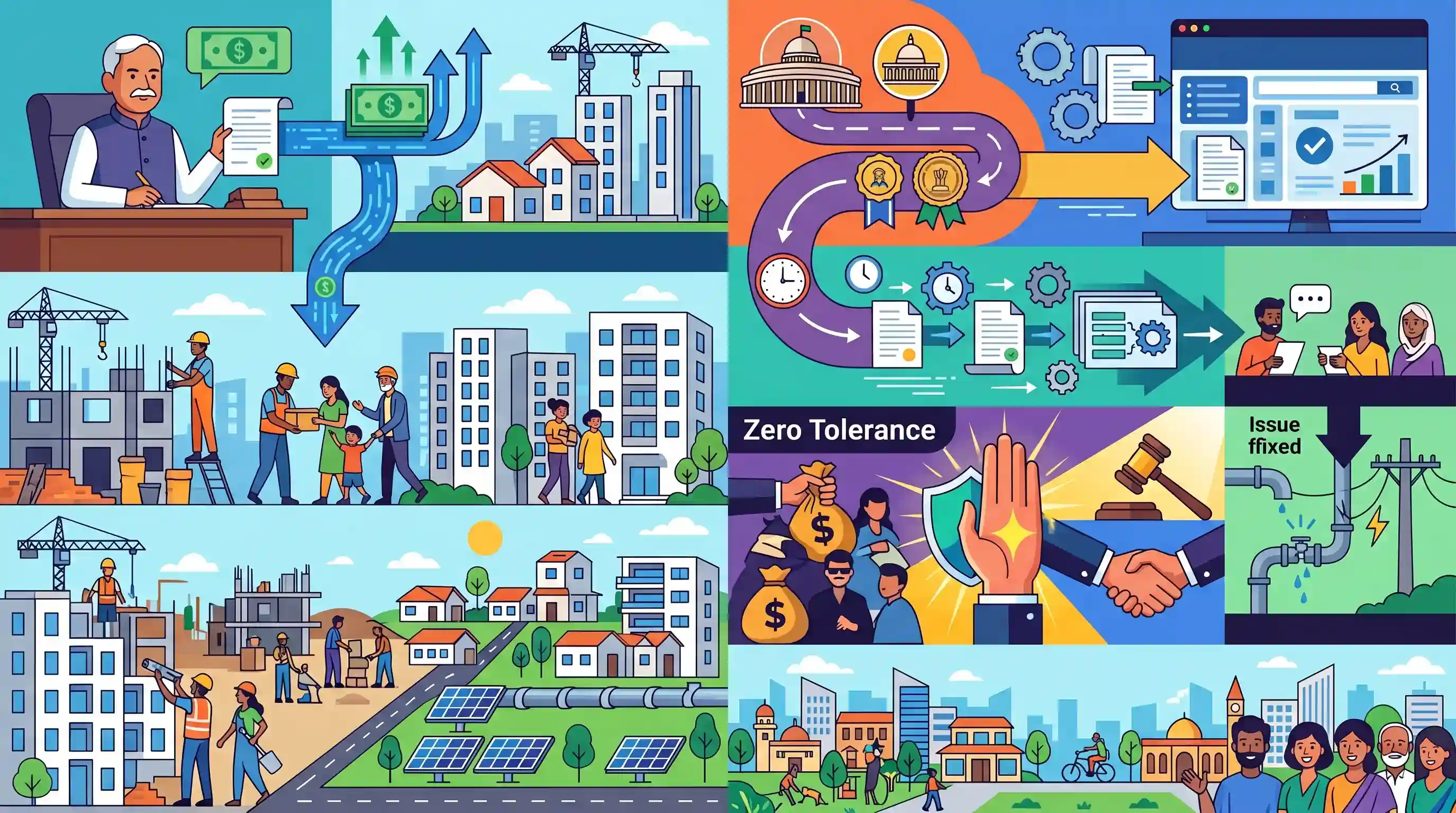
Bihar's Urban Development and Housing Minister Nitish Mishra approved the release of ₹262.37 crore as the second installment under the Pradhan Mantri Awas Yojana (Urban) 2.0 for 200 beneficiary-led projects across the state. Concurrently, he directed the formulation of an SOP to fast-track public grievance redressal, prioritize complaints from legislators (MPs/MLAs/MLCs), and strictly enforce a zero-tolerance policy against administrative corruption and negligence.
Key Points
- Bihar government approved ₹262.37 crore as the second installment under the Pradhan Mantri Awas Yojana (Urban) 2.0 (PMAY-U 2.0) to accelerate construction.
- The released amount will support 200 beneficiary-led construction projects across various urban centers in the state.
- PMAY-U 2.0, launched on September 1, 2024, mandates that each beneficiary house must feature a minimum of two rooms, a kitchen, and a separate toilet and bathroom.
- Bihar Urban Development and Housing Minister Nitish Mishra directed the implementation of a fast-track mechanism for handling and investigating public grievances.
- The department will formulate a Standard Operating Procedure (SOP) to prioritize and systematically dispose of complaints raised by legislators (MPs, MLAs, and MLCs).
- The administration reiterated its zero-tolerance policy against corruption and negligence while emphasizing the protection of honest officers from false allegations.
Important Terms
Pradhan Mantri Awas Yojana (Urban) 2.0 (PMAY-U 2.0)

A flagship Central scheme launched in 2024 to provide financial assistance to 1 crore urban poor and middle-class families to construct, purchase, or rent affordable, all-weather pucca houses over five years.
UPSC context
GS Paper II: Welfare Schemes for Vulnerable Sections. Tests knowledge of socio-economic schemes, target demographics, and cooperative federalism in urban housing.
Beneficiary-Led Construction (BLC)
A PMAY-U 2.0 vertical providing direct central financial assistance to Economically Weaker Section (EWS) families to build new pucca houses on their own available land with adherence to safety standards.
UPSC context
GS Paper II: Welfare Schemes & GS Paper III: Infrastructure. Tests delivery of social welfare and decentralized implementation through Direct Benefit Transfer.
Public Grievance Redressal
The institutional mechanism of receiving, processing, and resolving citizens' complaints against administrative lapses, delays, or corruption to ensure administrative transparency, accountability, and citizen-centric governance.
UPSC context
GS Paper II: Governance, Transparency, and Accountability. Tests concepts of good governance, bureaucratic responsiveness, and the implementation of Citizens' Charters.
Bihar Urban Development and Housing Department
The nodal administrative department responsible for executing urban planning, providing municipal infrastructure, accelerating economic growth, and implementing state and centrally sponsored housing programs in Bihar's cities.
UPSC context
GS Paper II: State Legislature and Administration. Tests understanding of the role of state departments in executing national policy and regional urban development.
Prelims Trap
Pradhan Mantri Awas Yojana - Urban (PMAY-U) 2.0 is designed as a Centrally Sponsored Scheme across all its core implementation verticals.
Only three of the four verticals (BLC, AHP, ARH) are Centrally Sponsored. The Interest Subsidy Scheme (ISS) vertical is executed as a Central Sector Scheme with 100% central funding.
Static Concepts Connected
What is the operational difference between Central Sector and Centrally Sponsored Schemes?
- Funding split: Central Sector Schemes are 100% funded by the Union government, while Centrally Sponsored Schemes are co-funded by the Centre and States (e.g., 60:40 or 90:10).
- Implementation agency: Central Sector Schemes are implemented directly by Union ministries/agencies, whereas Centrally Sponsored Schemes are executed by State government machinery.
- Syllabus domain: Central Sector typically targets Union List subjects, whereas Centrally Sponsored Schemes address State or Concurrent List subjects to meet national development goals.
How do statutory Grievance Redressal Acts differ from traditional Citizens Charters?
- Legal enforceability: Traditional Citizens Charters are voluntary, non-justiciable commitments, whereas statutory Acts (like Bihar's 2015 Act) create a legally enforceable right to redress.
- Quasi-judicial power: Statutory grievance acts empower designated officers with quasi-judicial powers to summon records and enforce compliance, which standard administrative charters lack.
- Penal provisions: Unlike standard charters, grievance acts impose statutory penalties or disciplinary actions on public servants for unjustified delays or failure to resolve complaints.
Cross-Topic Patterns
Fiscal federalism in urban housing
Examines how Centrally Sponsored Schemes like PMAY-U 2.0 rely on state-level executive machinery and co-funding, testing cooperative fiscal federalism.
Codified grievance vs. discretionary governance
Shows how statutory redressal acts shift the administrative paradigm from discretionary state benevolence to codified, legally enforceable citizen rights.

PMAY-U 2.0 income eligibility thresholds and its hybrid Central Sector/Sponsored vertical structure will likely feature in Prelims 2026.
Linked PYQs · 2
Linked PYQs · 2
- 2022BPSC_PRELIMSGS1
The new ministry proposed in the Bihar Budget for the year 2021-22 focuses on
- 2018BPSC_PRELIMSGS1
Which scheme was recognized as world's largest insurance scheme launched in India in September 2018?
