Plant Protection Inputs Scheme: 75 Percent Subsidy on Pest Traps
Source:indian-masterminds ↗
Why It Matters
The scheme reflects an ongoing shift toward sustainable agricultural practices and the reduction of chemical pesticide usage, key focal points for state-level welfare initiatives and environmental policies in BPSC examinations.
Summary
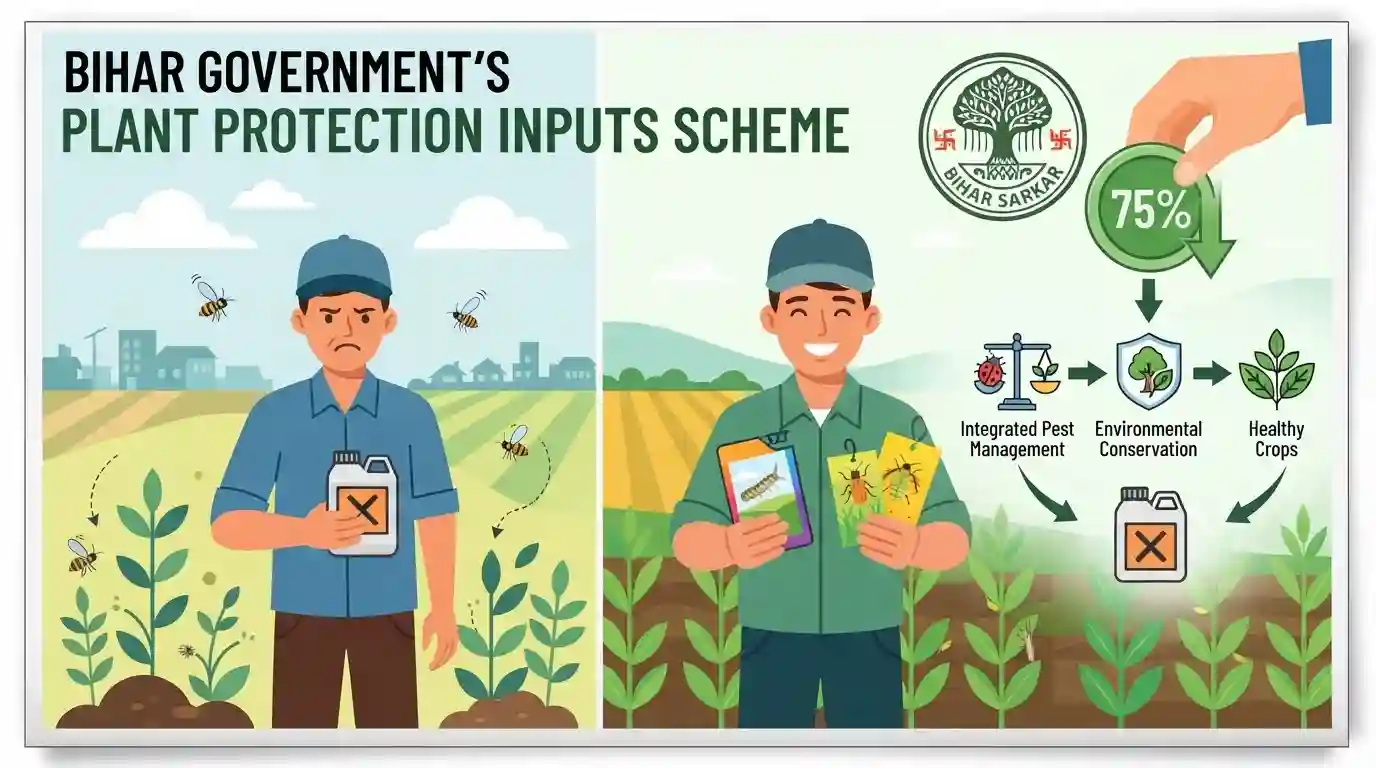
Under the Plant Protection Inputs Scheme, the Bihar government is providing a 75% subsidy to farmers for purchasing eco-friendly pest-control traps, such as pheromone and sticky traps. This initiative promotes Integrated Pest Management (IPM), aiming to decrease the environmental impact of chemical pesticides while effectively managing pests like the fall armyworm and paddy stem borer.
Key Points
- The Bihar government offers a 75% subsidy on pest-control traps under the Plant Protection Inputs Scheme.
- The initiative covers pheromone traps, sticky traps, and fruit fly traps to reduce reliance on chemical pesticides.
- Pheromone traps utilize species-specific chemical signals to disrupt the mating process of agricultural pests.
- Targeted pests include the gram pod borer, brinjal stem and fruit borer, paddy stem borer, and fall armyworm in maize.
Important Terms
Plant Protection Inputs Scheme

A Bihar government initiative providing farmers a 75% subsidy on eco-friendly pest-control devices, like pheromone traps, aiming to reduce reliance on chemical pesticides and improve crop health.
UPSC context
Vital for BPSC GS Paper 2 (Agriculture) and Prelims for questions on state-specific sustainable farming schemes.
Integrated Pest Management (IPM)
An ecological approach combining biological, cultural, mechanical, and minimal chemical methods to manage crop pests sustainably while minimizing risks to health and the environment.
UPSC context
Highly relevant for GS Paper 2 assessing sustainable farming practices, eco-friendly agriculture, and reducing soil pollution.
Fall Armyworm
An invasive and highly destructive caterpillar pest that severely damages various crops, particularly maize and sugarcane, posing a major threat to agricultural yield.
UPSC context
Tested in Prelims and GS Paper 2 regarding crop diseases, invasive species, and agricultural challenges in Bihar.
Pheromone Traps
Eco-friendly agricultural devices that use synthesized insect hormones to attract and trap specific male insects, disrupting their mating cycles without toxic chemicals.
UPSC context
Relevant for GS Paper 2 (Science & Tech / Agriculture) topics on eco-friendly innovations and sustainable crop protection.
Prelims Trap
"Pheromone traps utilize broad-spectrum chemical pesticides to eradicate all insect populations in the crop field."
Pheromone traps do not use toxic chemicals. They rely on species-specific, non-toxic synthetic scents mimicking female insects to attract males and disrupt the mating cycle.
Static Concepts Connected
What are the core components of Integrated Pest Management (IPM)?
- Biological Control: Utilizing natural predators, parasites, or pathogens to keep pest populations in check.
- Cultural Practices: Modifying farming practices such as crop rotation, intercropping, and altering planting dates to disrupt pest life cycles.
- Mechanical Control: Using physical barriers, pheromone traps, sticky traps, or manual removal to directly target pests.
- Chemical Control: Applying chemical pesticides judiciously and only as a last resort when pest levels cross the economic injury threshold.
Why is the Fall Armyworm (FAW) a severe threat to crops in Bihar?
- Invasive Nature: It is a highly invasive pest native to the Americas that rapidly spread across India (including Bihar) since 2018.
- Polyphagous Diet: It feeds on over 80 different crop species, though it causes the most devastating damage to maize, a crucial crop in Bihar.
- Rapid Dispersal: Adult moths can fly up to 100 km per night, enabling rapid geographical spread and making containment difficult.
Cross-Topic Patterns
Jal-Jeevan-Hariyali & Soil Health
IPM aligns with Bihar's broader Krishi Karman and Jal-Jeevan-Hariyali initiatives, focusing on reducing soil and water toxicity caused by excessive agricultural chemical runoff.
GMOs vs. Biological Interventions
While genetic modifications like Bt Cotton alter the plant's internal biology to resist pests, pheromone traps offer an external, non-GMO biological intervention to manage pest populations.

Expect a multi-statement question combining the 75% subsidy under this scheme with the biological mechanism of pheromone traps.
Linked PYQs · 4
Linked PYQs · 4
- 2024-EBPSC_PRELIMSGS1
When did Bihar State introduce the Green Budget for the first time?
- 2020BPSC_PRELIMSGS1
Bihar Government launched a new scheme 'Satat Jivikoparjan Yojana' in August 2018. The objective of this scheme is
- 2023BPSC_PRELIMSGS1
What is the policy measure adopted by the Government of India to improve the system of agricultural marketing?
- 2018BPSC_PRELIMSGS1
Which one of the following is the pathway to increase productivity in agriculture?
