Crowd Management Infrastructure Upgrades at Major Temples in Bihar
Source:etv-bharat ↗
Why It Matters
Crowd management at religious congregations is a critical disaster management challenge in India. This development is highly relevant for BPSC Prelims as it involves administrative reforms by the state trust board and highlights the geographical locations of numerous culturally significant temples across Bihar districts.
Summary
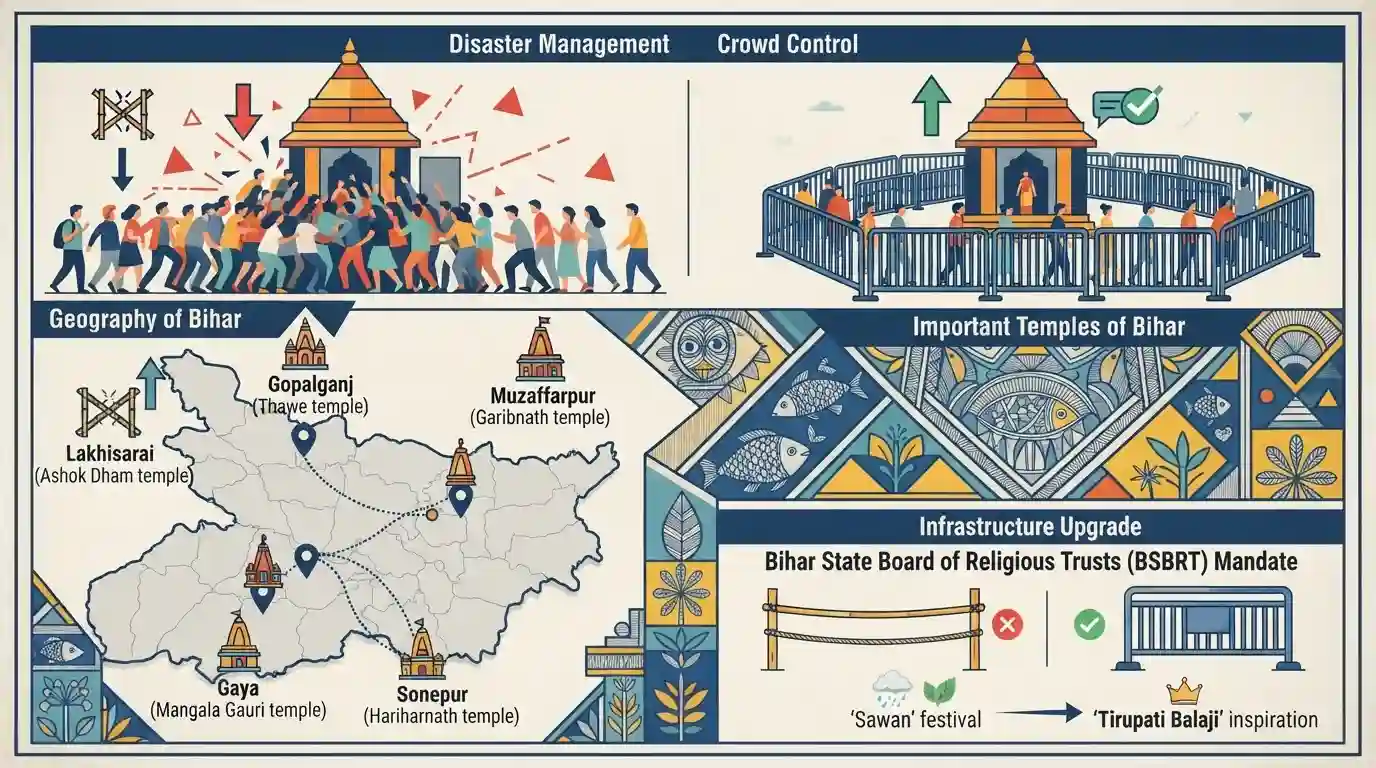
In response to a recent fatal stampede at the Ashok Dham temple in Lakhisarai, the Bihar State Board of Religious Trusts (BSBRT) is planning to upgrade crowd management infrastructure across major state temples. Moving away from temporary bamboo structures, the board will mandate permanent iron barricades to enforce single-file queues, inspired by the system at Tirupati Balaji. The safety upgrades will be implemented at prominent religious sites including the Thawe temple in Gopalganj, Garibnath in Muzaffarpur, Mangala Gauri in Gaya, and Hariharnath in Sonepur, ensuring devotee safety during heavy footfalls in festivals like Sawan.
Key Points
- A recent stampede at the Ashok Dham temple in Lakhisarai during the holy month of Sawan prompted the Bihar government to rethink crowd management at religious sites.
- The Bihar State Board of Religious Trusts (BSBRT) plans to instruct major temples to construct permanent iron barricades to enforce single-file queuing, replacing fragile temporary bamboo structures.
- The permanent crowd-control infrastructure is modeled on the orderly queue systems seen at major shrines like the Tirupati Balaji temple.
- Key temples slated for these safety upgrades include Thawe temple (Gopalganj), Garibnath (Muzaffarpur), Mangala Gauri (Gaya), Hariharnath (Sonepur), and other historic shrines in Patna and Rohtas.
Important Terms
Bihar State Board of Religious Trusts (BSBRT)

A statutory body constituted under the Bihar Hindu Religious Trusts Act, 1950, responsible for administering, regulating, and protecting properties of registered Hindu temples, mutts, and trusts in Bihar.
UPSC context
GS Paper 2 (Governance). Tests knowledge of state statutory bodies managing religious institutions, land assets, and public safety.
Ashok Dham Temple
A major Shiva temple in Lakhisarai, Bihar, formally known as Indradamaneshwar Mahadev Mandir. It features a massive Shivling discovered in 1977 and experiences immense crowds during the Sawan festival.
UPSC context
GS Paper 1 (Culture of Bihar) and Prelims. Tests awareness of major religious sites, local history, and crowd management hotspots.
Thawe Mandir
A historic Hindu temple in Gopalganj dedicated to Maa Thawewali, a form of Goddess Durga. Located near the Hathwa Raj palace, it is a key center for Shakti worship in Bihar.
UPSC context
GS Paper 1 (Art and Culture). Relevant for state tourism, regional heritage, and infrastructure development mapping.
Baba Garibnath Temple
An ancient Shiva temple located in Muzaffarpur, often called the "Deoghar of Bihar." It draws vast numbers of devotees, especially for Jalabhishek rituals during the holy month of Shravan.
UPSC context
Prelims (Bihar specific) and GS Paper 1. Important for mapping significant cultural landmarks and pilgrimage circuits in Bihar.
Temple Management Committees
Local administrative bodies working under the supervision of the BSBRT to handle day-to-day temple operations, crowd control, infrastructure maintenance, and utilization of donations at major religious sites.
UPSC context
GS Paper 2 (Governance) and GS Paper 3 (Disaster Management). Highlights grassroots administration and local disaster mitigation strategies.
Prelims Trap
"Baba Garibnath temple, famously known as the Deoghar of Bihar, is located in Deoghar."
The title "Deoghar of Bihar" is a metaphor. Baba Garibnath is a historic Shaivite shrine actually located in Muzaffarpur, Bihar, not in Deoghar (Jharkhand).
Static Concepts Connected
Match prominent historic temples of Bihar with their respective districts.
- Hariharnath Temple: Located in Sonepur (Saran) at the Ganga-Gandak confluence; unique for a single idol representing both Shiva and Vishnu.
- Thawe Temple: Situated in Gopalganj, it is an ancient and prominent shrine dedicated to Goddess Durga.
- Mangala Gauri: Located in Gaya, it is widely revered and considered one of the sacred Maha Shaktipeethas of India.
- Ashok Dham: A major Shaivite temple complex located in the Lakhisarai district, which sees massive footfalls during Sawan.
What are the key NDMA guidelines for crowd management at mass religious gatherings?
- Infrastructure design: Mandates the use of sturdy, permanent barricading (iron/steel) instead of temporary structures (bamboo) to enforce orderly, single-file movement.
- Capacity planning: Strict assessment of the venue's carrying capacity, staggered entry of pilgrims, and establishment of clear, multi-directional emergency exit routes.
Cross-Topic Patterns
Religious Tourism + Disaster Vulnerability
As Bihar develops its religious tourism circuits (Ramayana/Sufi/Jain), integrating NDMA crowd-management protocols becomes critical for GS-2 governance and GS-3 disaster management answers.
Statutory Bodies + Temple Administration
The Bihar State Board of Religious Trusts (BSBRT) operates under a 1950 Act, highlighting how state-level statutory bodies intervene in the administration of religious properties.

Expect a 'Match the following' Prelims question on Bihar's prominent temples (Thawe, Garibnath, Hariharnath, Ashok Dham) and their districts.
Linked PYQs · 2
Linked PYQs · 2
- 2024-EBPSC_PRELIMSGS1
The sikh pilgrimage site “TAKHAT SRI HARIMANDIR JI PATNA SAHIB” which is considered as the second holiest Takhat is located at
- 2024-EBPSC_PRELIMSGS1
Bihula Festival is celebrated especially in which one of the following districts in Bihar usually in the month of August each year?
