Brain Mapping and Career Guidance Initiative Planned for Bihar Schools
Source:the-new-indian-express ↗
Why It Matters
Innovative, state-level educational interventions and administrative policy announcements (especially those involving collaborations with premiere bodies like NIMHANS) are frequently tested in BPSC Prelims under Bihar-specific initiatives and social welfare sectors.
Summary
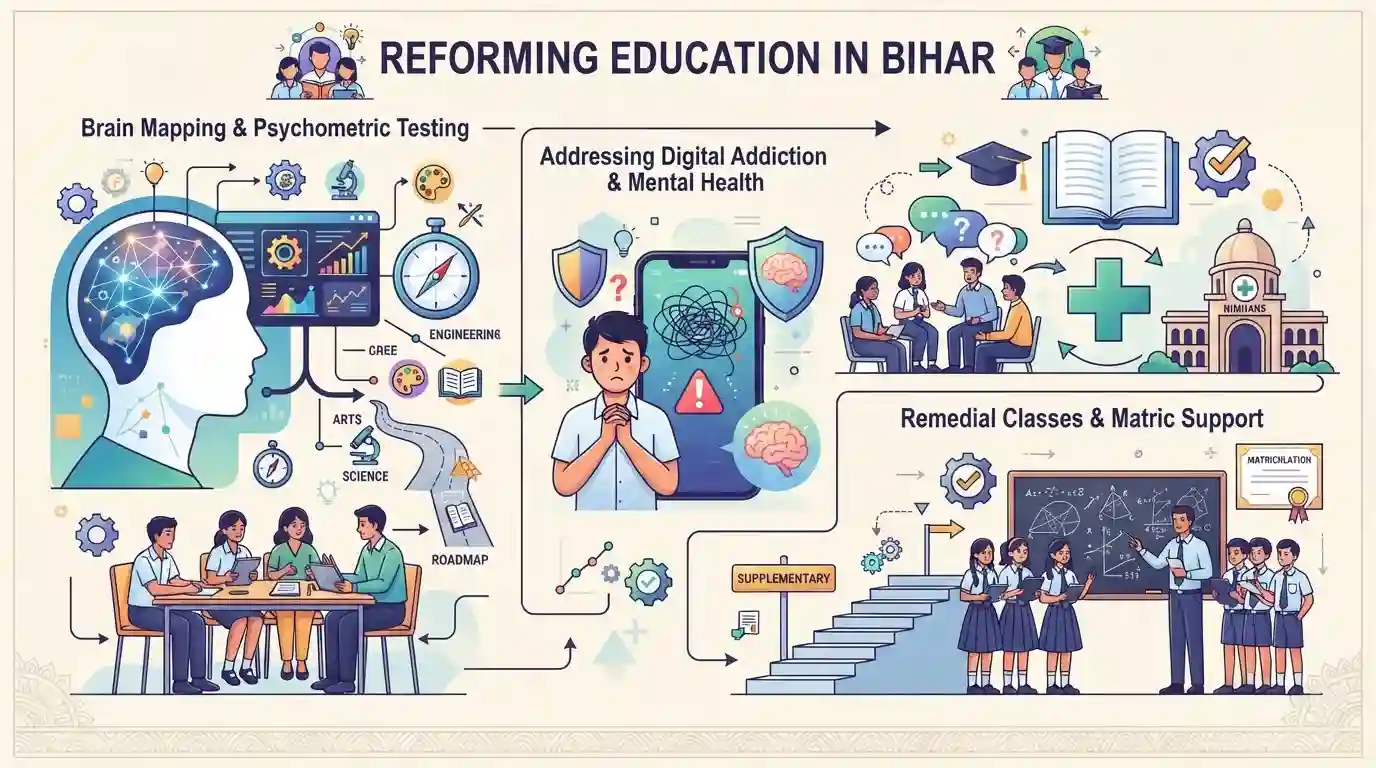
The Bihar government is planning to introduce a first-of-its-kind brain mapping and psychometric testing initiative for government school students to provide scientific career guidance and assist in choosing academic streams based on innate capability. Announced by Education Minister Mithilesh Tiwari, the initiative is part of broader educational reforms that include drafting policies on digital addiction in consultation with NIMHANS and holding special remedial classes for Matric supplementary candidates.
Key Points
- The Bihar government plans to introduce a brain mapping initiative for students in government schools to help them identify their natural interests, intelligence types, and ideal career paths.
- The proposed career guidance framework will integrate brain mapping techniques with psychometric testing, assessing student profiles across multiple intelligence fields using psychological frameworks.
- This initiative aims to provide scientific guidance to students, steering them away from parental and peer pressure, and helping them choose academic streams (Science, Commerce, Arts) aligned with their innate capabilities.
- In addition to brain mapping, the Bihar Education Department is drafting policies to combat digital addiction and regulate screen time for children, collaborating with experts from NIMHANS.
- The department also plans to introduce special coaching classes for students appearing for the Matric (secondary) supplementary examinations.
Important Terms
State Education Department, Bihar

The provincial government authority in Bihar responsible for formulating policies, administering schools, creating academic frameworks, and building infrastructure for primary, secondary, and higher education.
UPSC context
GS Paper II (Social Sector/Education). Tests governance systems, human resource development, and literacy initiatives in Bihar.
National Institute of Mental Health and Neurosciences (NIMHANS)
An autonomous, Bengaluru-based premier medical institution of national importance under the Central Government, specializing in clinical care, academic training, and research in psychiatry and neurosciences.
UPSC context
GS Paper II (Health/Social Sector). Tests central-state institutional coordination, mental health policies, and public welfare.
Brain Mapping
A non-invasive, data-driven technique (using quantitative electroencephalography or QEEG) to measure and analyze electrical activity to map cognitive functions, intelligence types, and emotional regulation.
UPSC context
GS Paper II (Science & Technology). Tests application of neurotechnology in educational reforms and student development.
Psychometric Testing
A standardized, scientifically validated evaluation method used to measure cognitive abilities, intellectual aptitude, personality traits, and natural career interests in individuals.
UPSC context
GS Paper II (Education). Tests knowledge of modernized student counseling frameworks and child-centric pedagogical reforms.
Digital Addiction
The compulsive and excessive engagement with digital devices and screens, leading to physical, psychological, and cognitive impairment in children and adolescents.
UPSC context
GS Paper II (Social Issues/Health). Tests awareness of technological challenges on adolescent health and child welfare policies.
Prelims Trap
BSEB replacing 'Fail' with 'Vocational Pass' (Vyavasayik Uttirn) on Class 10/12 marksheets.
The exact phrase introduced on marksheets is 'Kaushal ke liye patra' (Eligible for Skills), not a direct vocational pass certificate or grade-based euphemism.
Static Concepts Connected
What are the NEP 2020 provisions on student assessment and career pathways?
- Formative Assessment: Advocates shifting from summative exams to regular, formative, competency-based assessments that map cognitive and psychomotor skills.
- Holistic Progress Card: Mandates a 360-degree Holistic Progress Card tracking self, peer, and teacher assessments alongside AI-driven career guidance.
- Vocational Exposure: Aims to integrate vocational education systematically from Class 6 onwards, exposing students to diverse skill-based careers.
What are the primary constitutional provisions governing education in India?
- Article 21A: The 86th Constitutional Amendment Act, 2002 inserted Article 21A, making free and compulsory education for ages 6-14 a Fundamental Right.
- Concurrent List: Education was moved from the State List to the Concurrent List by the 42nd Constitutional Amendment Act, 1976.
- Article 45 (DPSP): Directs the State to endeavor to provide early childhood care and education for all children until they complete six years of age.
Cross-Topic Patterns
Student mental health and Article 21
Connecting academic distress mitigation (removing 'Fail', NIMHANS tie-up) to the wider judicial interpretation of the Right to Life with dignity, expanding the scope of RTE.
AI-driven learning vs. digital addiction
Balancing the rollout of AI learning apps (Vidya Saathi) with NIMHANS-guided screen-time regulations highlights the dual challenge of tech adoption and mental wellness.

State's unique marksheet changes and mental health partnerships with NIMHANS likely to be tested under Bihar social sector reforms.
Linked PYQs · 3
Linked PYQs · 3
- 2025BPSC_PRELIMSGS1
What is the primary objective of Bihar’s Mission Daksh?
- 2024-IBPSC_PRELIMSGS1
In April, 2020 the Bihar Education Department started the following program through DD Bihar
- 2024-IBPSC_PRELIMSGS1
The Ishihara test is related with
