Bihar Unveils Mega Urban Master Plan and Satellite Townships for Patna
Source:indianmasterminds ↗
Why It Matters
Understanding Bihar-specific urban development schemes, regional decentralization through satellite townships, and local smart-city initiatives is highly relevant for both BPSC Prelims and state governance-focused GS papers.
Summary
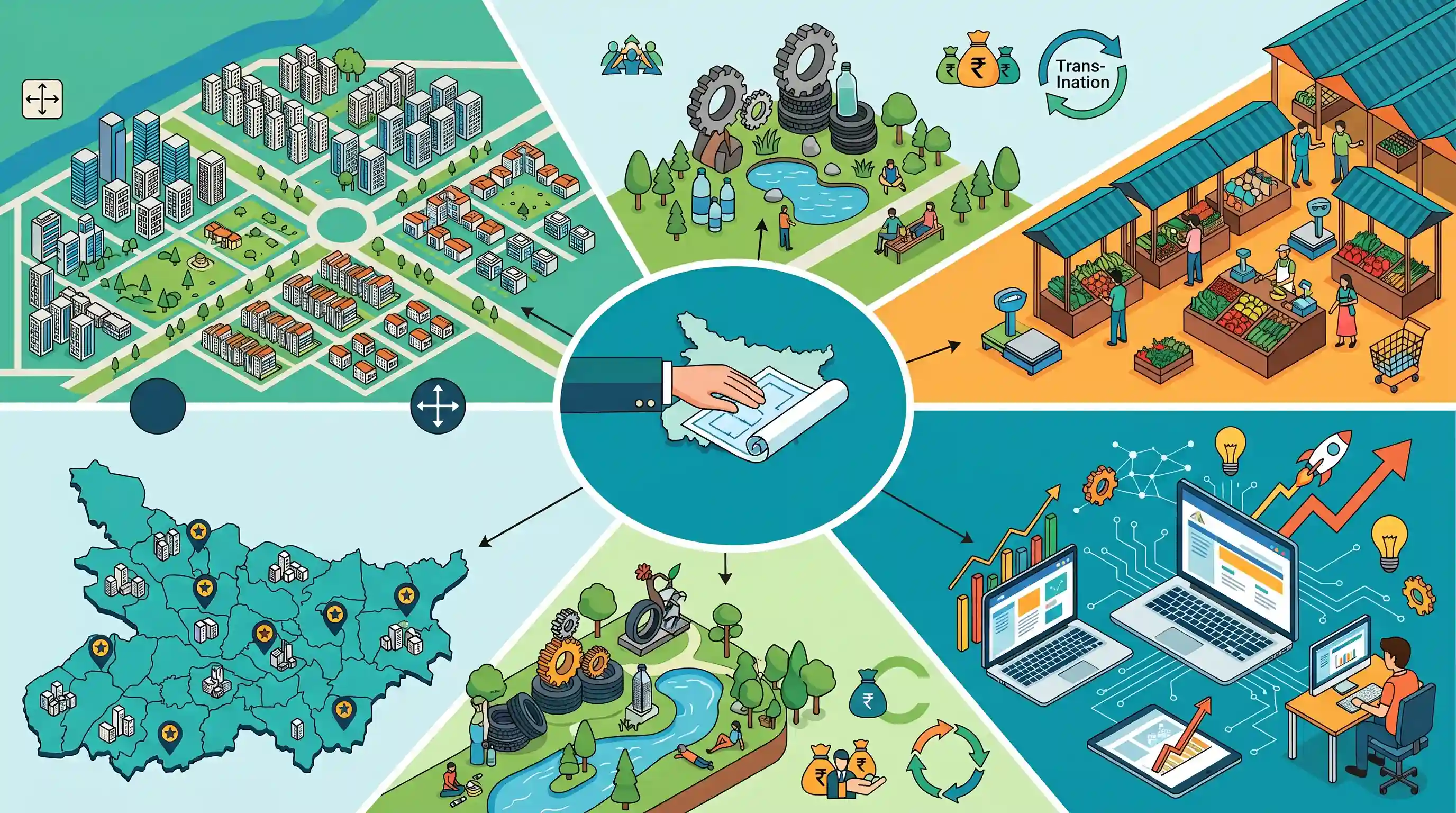
The Bihar state government has unveiled a comprehensive urban transformation plan for its capital, Patna, and other districts. Key initiatives include the massive 66,000-acre 'Pataliputra' satellite township, the establishment of 11 regional satellite townships, the ₹11.44 crore Waste to Wonder themed JP Narayan Park under AMRUT 2.0, the launch of the 'Sabzi Haat' scheme for organized markets, and the creation of the 'Bihar Tech' portal to nurture IT startups and economic growth.
Key Points
- Bihar CM Samrat Chaudhary announced a mega urban development plan integrating historical preservation with modern infrastructure.
- A ₹11.44 crore Waste to Wonder themed 'JP Narayan Park' is launched in Patna under AMRUT 2.0, showcasing the life and ideology of Loknayak Jayaprakash Narayan.
- The mega 'Pataliputra' satellite township is planned to span approximately 66,000 acres in Patna, providing world-class residential, education, healthcare, and commercial infrastructure.
- The government plans to develop 11 satellite townships across Bihar to facilitate balanced and structured urban expansion.
- The 'Sabzi Haat' scheme will be implemented to organize local vegetable markets and mitigate traffic congestion in Patna.
- The 'Bihar Tech' portal will be launched to encourage innovation, streamline startup support, and attract IT sector investments.
Important Terms
AMRUT 2.0

A Centrally Sponsored Scheme launched under the Ministry of Housing and Urban Affairs in 2021 to ensure water security by providing functional tap connections to all urban households and complete sewerage management.
UPSC context
GS Paper II (Schemes) & GS III (Infrastructure). Tests knowledge of urban basic services delivery and sustainable water management.
Pataliputra Satellite Township Project
A massive, planned greenfield satellite township covering around 66,000 to 81,000 acres in the Punpun–Fatuha belt on Patna's outskirts, designed to ease municipal congestion and establish specialized economic zones.
UPSC context
GS Paper I (Urbanization) & GS III (Infrastructure). Tests models of planned urban sprawl mitigation and satellite city development.
BUIDCO (Bihar Urban Infrastructure Development Corporation)
A wholly state-owned enterprise established in 2009 that functions as the apex agency under Bihar's Urban Development Department for planning and executing urban infrastructure projects statewide.
UPSC context
GS Paper II (State Institutions) & GS III (Infrastructure). Tests understanding of institutional mechanisms for state-level urban renewal.
Bihar Tech Portal Initiative
A digital governance platform launched by the Bihar government in June 2026 to streamline startup registration, provide mentorship, share funding resources, and attract industrial investment.
UPSC context
GS Paper III (Economy & Startup Ecosystem). Tests government interventions in digital empowerment and regional entrepreneurship promotion.
Patna Smart City Limited
A Special Purpose Vehicle (SPV) incorporated in 2017 to implement and monitor Patna’s municipal projects under the national Smart Cities Mission, focusing on sustainable local infrastructure.
UPSC context
GS Paper II (Urban Governance) & GS III (Infrastructure). Tests understanding of Special Purpose Vehicles in municipal planning.
Prelims Trap
The Town Planning Scheme (TPS) land-pooling model requires compulsory government acquisition of private land under the LARR Act 2013.
TPS does not use compulsory acquisition; it pools irregular plots, reorganizes them, installs infrastructure, and returns a high percentage of developed land to owners.
Static Concepts Connected
What is the Town Planning Scheme (TPS) land-pooling mechanism?
- Non-Acquisition Model: Avoids compulsory acquisition by allowing landowners to voluntarily pool irregular parcels for collective infrastructure planning.
- Land Return: Returns a high percentage (typically 50-60%) of the developed, higher-value land back to the original owners.
- Self-Financing: Finances public infrastructure by selling a small portion of the pooled land, avoiding state budgetary strain.
What are the core objectives and features of AMRUT 2.0?
- Water Security: Aims to provide 100% tap water coverage to all households in all statutory towns.
- Circular Water Economy: Promotes wastewater recycling, reduction of non-revenue water, and rejuvenation of urban water bodies.
- Green Spaces: Supports carbon sequestration and climate resilience by developing parks, green buffer zones, and open public spaces.
Cross-Topic Patterns
Land Pooling vs LARR Act 2013
Compares cooperative land-pooling models with compulsory central land acquisition, highlighting state-level regulatory innovations to bypass high compensation costs and litigation.
Urbanization Dynamics and Devolution
Connects low state urbanization rates to fiscal devolution, as Central Finance Commissions increasingly link municipal grants to urban reforms and population density.

State land-pooling models (TPS) vs LARR 2013 acquisition laws likely to feature in UPSC as a federal urban governance question.
Linked PYQs · 2
Linked PYQs · 2
- 2022BPSC_PRELIMSGS1
The new ministry proposed in the Bihar Budget for the year 2021-22 focuses on
- 2018BPSC_PRELIMSGS1
In which city of Bihar, Sulabh International. launched cheapest drinking water project 'Sulabh Jal?
