Bihar Gram Panchayat Tax Rules 2026 for Own Source Revenue
Source:outlookindia ↗
Why It Matters
Financial empowerment is a critical component of democratic decentralisation. The ability of Panchayats to generate Own Source Revenue (OSR) is directly linked to the effective functioning of local governance as envisioned under the 73rd Constitutional Amendment Act.
Summary
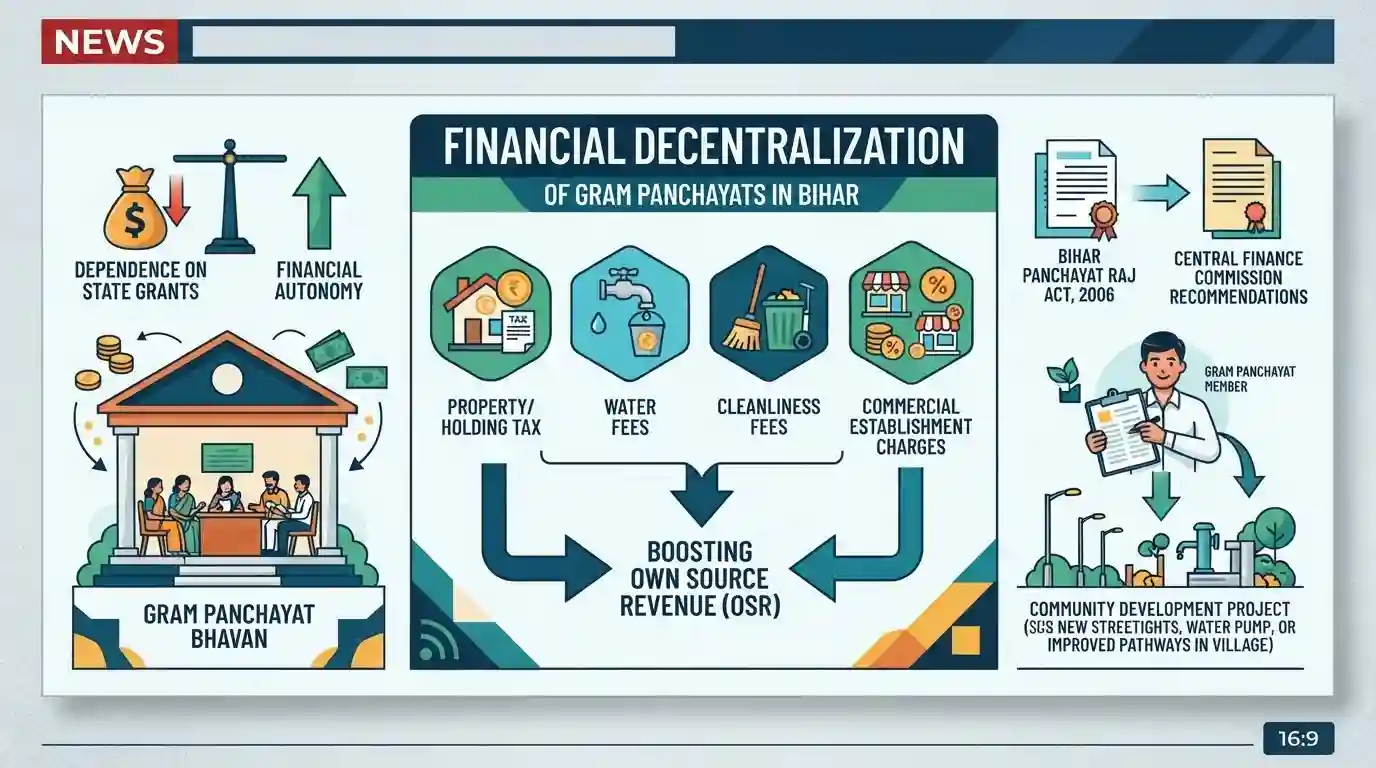
The Bihar government has introduced rules to allow Gram Panchayats to levy local taxes, including property (holding) taxes, water and cleanliness fees, and charges on commercial establishments. This move is aimed at boosting the Own Source Revenue (OSR) of rural local bodies, making them financially self-reliant rather than completely dependent on government grants. The decision fulfills the mandate of the Bihar Panchayat Raj Act, 2006, and aligns with recommendations from the Central Finance Commission.
Key Points
- The Bihar Cabinet has approved the 'Bihar Gram Panchayat Taxes, Rates and Fees Rules, 2026', empowering Gram Panchayats to levy local taxes and fees.
- This rule operationalises Section 27 of the Bihar Panchayat Raj Act, 2006, allowing panchayats to collect 'holding tax', water supply charges, cleanliness fees, and commercial establishment fees.
- The objective is to increase the Own Source Revenue (OSR) of local bodies and reduce their absolute dependence on State and Central Finance Commission grants.
- The Central Finance Commission had been pressing Bihar to strengthen the financial autonomy of its local bodies, a practice already active in states like West Bengal and Karnataka.
Important Terms
Bihar Gram Panchayat Taxes, Rates and Fees Rules, 2026

A 2026 set of rules allowing Bihar's Gram Panchayats to levy local taxes and user charges, moving them towards financial self-reliance.
UPSC context
GS-2 (State Politics/Panchayati Raj). Tests knowledge of sub-state decentralisation and implementation of local tax mechanisms.
Bihar Panchayat Raj Act, 2006
The foundational state-level legislation for rural local bodies in Bihar, which authorized tax collection under Section 27 but lacked operational rules until 2026.
UPSC context
GS-2 (Local Governance). Tests awareness of specific state legislations empowering PRI bodies.
Own Source Revenue (OSR)
Revenue generated internally by local governing bodies through taxes, tolls, and fees, rather than relying on state or central grants.
UPSC context
GS-2 and GS-3 (Local Governance/Economy). Crucial for assessing PRI financial independence and the fiscal federalism framework.
73rd Constitutional Amendment Act
The 1992 constitutional change establishing Panchayati Raj Institutions in India, mandating decentralised governance and empowering states to authorize PRI tax collection.
UPSC context
GS-2 (Indian Polity). The bedrock of India's rural self-governance framework.
Gram Panchayats
The lowest tier of rural self-government in India, responsible for village-level administration, civic services, and, under new rules in Bihar, local tax collection.
UPSC context
GS-2 (Polity). Core PRI bodies; tests understanding of their powers, functions, and financial constraints.
Prelims Trap
Panchayats possess inherent constitutional powers under the 73rd Amendment to independently levy taxes without state legislative authorization.
Article 243H only enables State Legislatures to authorize Panchayats to levy taxes. There is no automatic, inherent taxing power vested directly in PRIs.
Static Concepts Connected
What does Article 243H dictate regarding the taxing powers of Panchayats?
- State legislative authorization: Panchayats cannot levy taxes inherently; the State Legislature must pass specific laws authorizing them to collect taxes, duties, tolls, and fees.
- Assigned taxes: Allows State Legislatures to assign state-collected taxes, duties, and fees directly to local bodies to augment their resources.
- Grants-in-aid: Empowers the state to provide grants-in-aid to Panchayats from the Consolidated Fund of the State.
What is Own Source Revenue (OSR) and why is it critically low for PRIs?
- Definition of OSR: Revenue generated by local bodies through their own tax (property, profession) and non-tax (fees, user charges) collection mechanisms.
- Extreme fiscal dependence: According to RBI data, PRIs raise only about 1.1% of their revenue through OSR, remaining heavily reliant on central and state grants.
- Finance Commission push: Central Finance Commissions increasingly link untied grants to states' willingness to empower PRIs to collect local taxes.
Cross-Topic Patterns
Fiscal federalism and grant conditionalities
Central Finance Commissions increasingly use performance-based grants to compel states to devolve actual taxation powers, reshaping local administrative landscapes.
Inclusion-driven progressive local taxation
Exempting kutcha/PMAY houses while taxing commercial rural entities integrates social justice principles directly into grassroots public finance frameworks.

Article 243H limits and the 1.1% OSR threshold of PRIs are prime targets for a multi-statement Prelims 2026 question on local self-government.
Linked PYQs · 3
Linked PYQs · 3
- 2025BPSC_PRELIMSGS1
Who is empowered to review the financial position of the Panchayats?
- 2024-EBPSC_PRELIMSGS1
Under Article “243J” which of the following can make provisions to the maintenance of accounts by Panchayats?
- 2024-IBPSC_PRELIMSGS1
What is the system of governance in the Panchayat Raj set-up?
