Bihar Sets e-GramSwaraj Deadline for Panchayat Development Plans
Source:indianmasterminds ↗
Why It Matters
Panchayati Raj institutions and their functional effectiveness are foundational topics in the BPSC syllabus (Polity). The integration of e-governance (e-GramSwaraj portal) to map the three-tier development plans highlights Bihar's administrative push towards transparent and decentralized democratic decentralization as envisioned by the 73rd Constitutional Amendment.
Summary
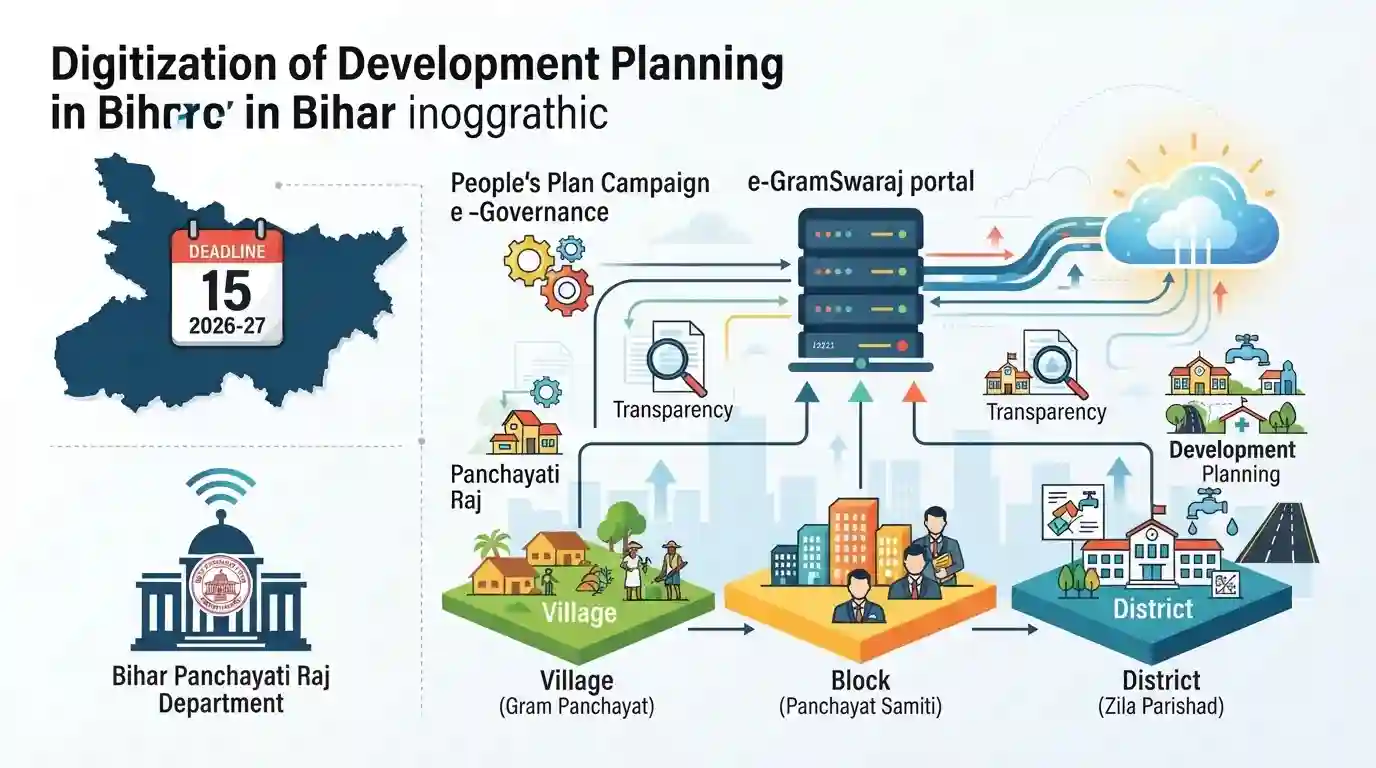
The Bihar Panchayati Raj Department has issued a firm August 15 deadline for uploading the 2026-27 Gram Panchayat Development Plans on the national e-GramSwaraj portal. Initiated under the People's Plan Campaign, this directive targets structured and timely digitalization of development plans across all three tiers of the Panchayati Raj system—Village, Block, and District—to boost efficiency, transparency, and grassroots development planning in Bihar.
Key Points
- The Bihar Panchayati Raj Department has set August 15 as the deadline for uploading the 2026-27 Gram Panchayat Development Plans (GPDP) on the e-GramSwaraj portal.
- The deadline for uploading the Block Panchayat Development Plans (BPDP) is September 15, and for District Panchayat Development Plans (DPDP) is October 15.
- This mandate forms a part of the People's Plan Campaign, accelerating local-level democratic planning in the state.
- Digitalizing the 3-tier panchayat plans ensures enhanced transparency and expedited grassroots development.
Important Terms
e-GramSwaraj

A comprehensive digital platform developed by the Ministry of Panchayati Raj to digitize Gram Panchayat functioning, ensuring transparency in planning, accounting, and tracking of local development work and funds.
UPSC context
GS Paper 2 (e-Governance, Panchayati Raj). Tests knowledge of digital interventions in grassroots governance and accountability mechanisms in PRIs.
People's Plan Campaign
Also known as 'Sabki Yojana Sabka Vikas,' this nationwide campaign by the Ministry of Panchayati Raj drives community participation through Gram Sabhas to prepare inclusive, localized Panchayat Development Plans.
UPSC context
GS Paper 2 (Governance). Crucial for topics on democratic decentralization, citizen participation, and grassroots planning.
Gram Panchayat Development Plan (GPDP)
An annual, participatory action plan mandated by Article 243G of the Constitution, prepared by Gram Sabhas to identify local needs, align resources, and execute projects for economic development and social justice.
UPSC context
GS Paper 2 (Panchayati Raj). Vital for understanding constitutional mandates (Article 243G) for local self-government and decentralized planning.
District Panchayat Development Plan (DPDP)
An integrated plan prepared by the District Panchayat that consolidates grassroots GPDPs and Block-level plans, addressing larger-scale infrastructure and multi-village resource needs across the district.
UPSC context
GS Paper 2 (Panchayati Raj). Highlights the tiered integration of decentralized rural planning and the role of District Planning Committees.
Prelims Trap
District Planning Committees (DPCs) formulate the Gram Panchayat Development Plans (GPDP).
DPCs (Article 243ZD) consolidate plans at the district level. GPDPs are formulated independently by Gram Panchayats in consultation with the Gram Sabha.
Static Concepts Connected
What is the constitutional basis for Panchayat Planning under Article 243G?
- State Discretion: State legislatures have the voluntary power to endow Panchayats with authority for local self-governance.
- Core Mandate: Authorizes Panchayats to prepare and implement plans specifically targeting economic development and social justice.
- 11th Schedule: Encompasses 29 functional subjects, including agriculture, rural housing, and poverty alleviation programs.
How does e-GramSwaraj modernize rural governance?
- Unified Portal: Merges decentralized planning, accounting (PRIASoft), and monitoring into a single, unified digital platform for all three Panchayat tiers.
- PFMS Integration: Integrates with the Public Financial Management System (PFMS) to enable direct, real-time online payments to vendors and beneficiaries.
- Citizen Oversight: Provides public dashboards allowing citizens to track local fund allocations, physical progress of works, and asset creation.
Cross-Topic Patterns
e-GramSwaraj as Rural DPI
Coupling grassroots planning (GPDP) with digital payment gateways (PFMS) creates a robust rural Digital Public Infrastructure, crucial for tracking central finance allocations without leakage.
Decentralization vs Finance Commission Grants
Highlights the ongoing linkage between Finance Commission grants (tied/untied funds) and the functional autonomy of Panchayats in framing bottom-up development plans without state overreach.

Expect a multi-statement Prelims question linking e-GramSwaraj, Article 243G, and PFMS integration for Panchayat fund transparency.
Linked PYQs · 3
Linked PYQs · 3
- 2024-IBPSC_PRELIMSGS1
What is the system of governance in the Panchayat Raj set-up?
- 2023BPSC_PRELIMSGS1
At what level does a Panchayat Samiti operate a Panchayati Raj structure?
- 2025BPSC_PRELIMSGS1
Where was the National Panchayati Raj Day 2025 event organised?
