Opposition raises paper leak issue on opening day of assembly session
Source:The Hindu ↗
Why It Matters
The article covers essential state-level governance issues important for BPSC Prelims, including the presentation of a supplementary budget (Article 205), the devolution of taxation powers to Panchayats (Article 243H), and the procedural dynamics of the State Legislature.
Summary
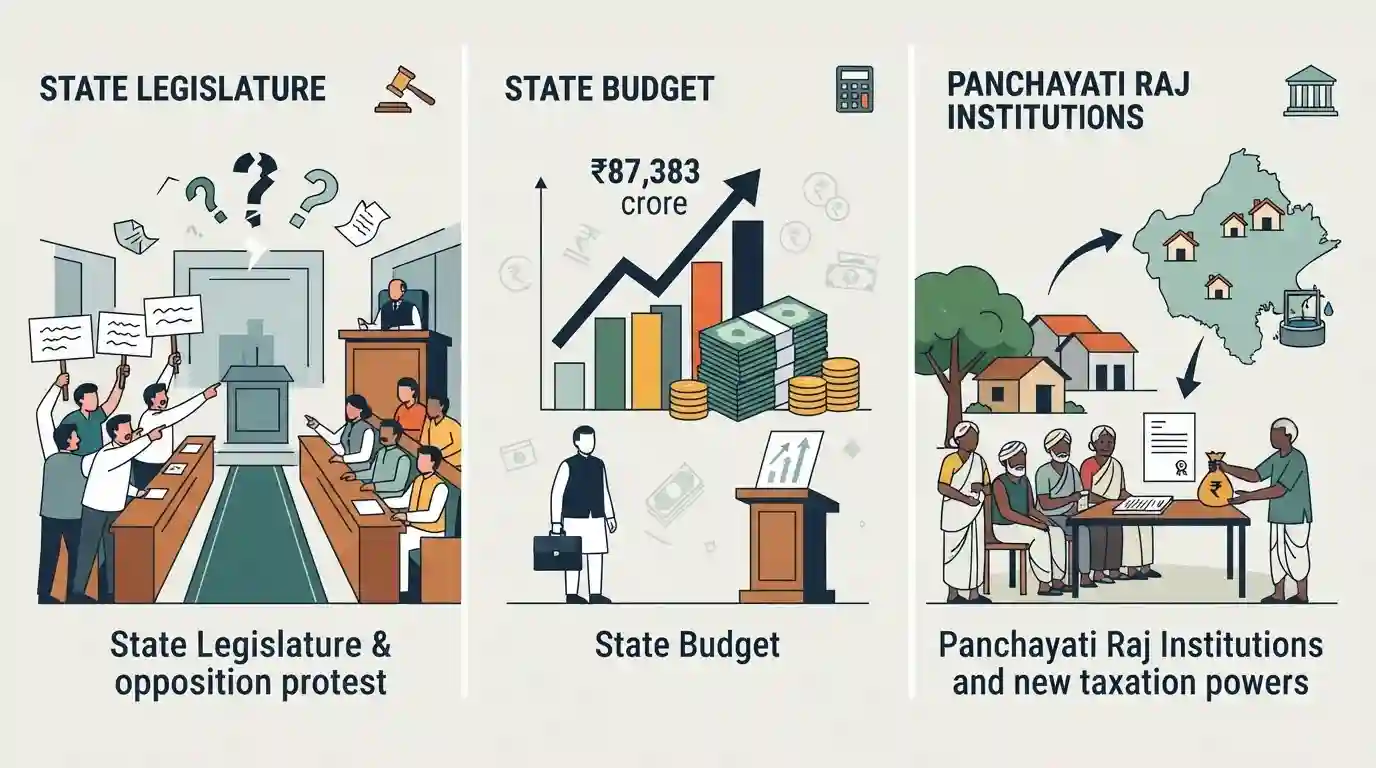
On the opening day of the Bihar Legislature's Monsoon Session, the Opposition protested over recent paper leaks, demanding the Union Education Minister's resignation. Concurrently, the State government presented a supplementary budget of ₹87,383 crore, and the State cabinet authorized Gram Panchayats to levy and collect taxes.
Key Points
- The Bihar Opposition protested in the State Legislature demanding the resignation of Union Education Minister Dharmendra Pradhan over paper leaks, including NEET.
- Deputy Chief Minister and Finance Minister Samrat Choudhary presented the first supplementary Budget of ₹87,383 crore for the 2026-27 financial year on the first day of the Monsoon Session.
- The Bihar cabinet passed a significant resolution authorizing Gram Panchayats to levy and collect taxes, enhancing local self-government financial autonomy.
- Chief Minister Nitish Kumar and Leader of Opposition Tejashwi Yadav were absent from the session due to their focus on the Bankipur Assembly by-election.
Important Terms
National Testing Agency (NTA)

An autonomous testing organization under the Ministry of Education that conducts major higher-education entrance examinations, such as NEET and JEE, across India.
UPSC context
GS Paper 2 (Governance & Education). Important for understanding institutional accountability and the integrity of national examination systems.
Gram Panchayats
The foundational tier of rural local self-government. State governments can empower them to levy holding taxes, profession fees, and user charges to build independent financial resources.
UPSC context
GS Paper 2 (Polity). Relevant for the 73rd Amendment, democratic decentralization, and the fiscal empowerment of local bodies.
Supplementary Budget
Additional funds granted under Article 205 of the Constitution when the authorized annual budget amount is insufficient for a state's current financial year.
UPSC context
GS Paper 2 (Polity) & GS 3 (Economy). Tests constitutional mechanisms for state finances, fiscal management, and legislative control.
State Cabinet
The supreme executive decision-making body of a state government, headed by the Chief Minister, responsible for approving draft legislation, rules, and major administrative policies.
UPSC context
GS Paper 2 (State Executive). Tests understanding of the state-level Council of Ministers and executive decision-making processes.
State Legislature
The state's law-making body that holds the executive accountable. During its constitutionally mandated sessions, it debates public issues, questions policies, and approves state budgets.
UPSC context
GS Paper 2 (Polity). Covers state legislative procedures, constitutional sessions (Article 174), and mechanisms for executive accountability.
Supplementary Budget
Additional funds granted under Article 205 of the Constitution when the authorized annual budget amount is insufficient for a state's current financial year.
UPSC context
GS Paper 2 (Polity) & GS 3 (Economy). Tests constitutional mechanisms for state finances, fiscal management, and legislative control.
Prelims Trap
Gram Panchayats possess an inherent constitutional mandate under Part IX to independently levy and collect local taxes.
Under Article 243H, Panchayats have no inherent taxation powers. They can only levy, collect, and appropriate taxes if expressly authorized by a law passed by the State Legislature.
Static Concepts Connected
How do Gram Panchayats derive their power to levy taxes?
- Article 243H: Empowers the State Legislature to legally authorize Panchayats to levy, collect, and appropriate certain taxes, duties, tolls, and fees.
- State Finance Commission: Under Article 243-I, it recommends the principles governing the distribution, assignment, and appropriation of taxes to Panchayats.
What are the constitutional provisions for Supplementary Budgets?
- Articles 115 & 205: Deal with supplementary, additional, or excess grants for the Union and States respectively, when authorized funds for a service are found insufficient.
- Legislative Approval: Must be passed by the respective legislature before the end of the financial year, following the exact same procedure as the regular budget.
Cross-Topic Patterns
PRI finances & 2nd ARC recommendations
Bihar’s move aligns with long-standing demands to end PRIs' over-reliance on state/central grants by operationalizing their taxation powers, a key theme in governance mains questions.
Exam integrity & New Penal Laws
The ongoing paper leak controversies connect the NTA's structural issues with the newly enacted Public Examinations (Prevention of Unfair Means) Act, 2024, highlighting regulatory deficits in higher education.

Expect a multi-statement MCQ in 2026 linking PRI financial autonomy (Article 243H), State Finance Commission roles, and taxation powers.
Linked PYQs · 5
Linked PYQs · 5
- 2024-EBPSC_PRELIMSGS1
Who presented the Bihar Budget 2024-25 in the State Assembly?
- 2025BPSC_PRELIMSGS1
Which of the following statement/s is/are correct about Bihar’s economic performance in 2023-24?
- 2025BPSC_PRELIMSGS1
Who is empowered to review the financial position of the Panchayats?
- 2024-EBPSC_PRELIMSGS1
Under Article “243J” which of the following can make provisions to the maintenance of accounts by Panchayats?
- 2025BPSC_PRELIMSGS1
What is true about the proceedings of the State Legislature?
