GOBARdhan Scheme: Bihar Land Offer for Compressed Bio Gas Projects
Source:iamrenew ↗
Why It Matters
Highlights a significant policy step by the Bihar government for solid waste management and renewable energy generation (CBG). Remembering the 4 specific cities chosen is crucial for BPSC Prelims, alongside understanding the mechanics of the GOBARdhan scheme.
Summary
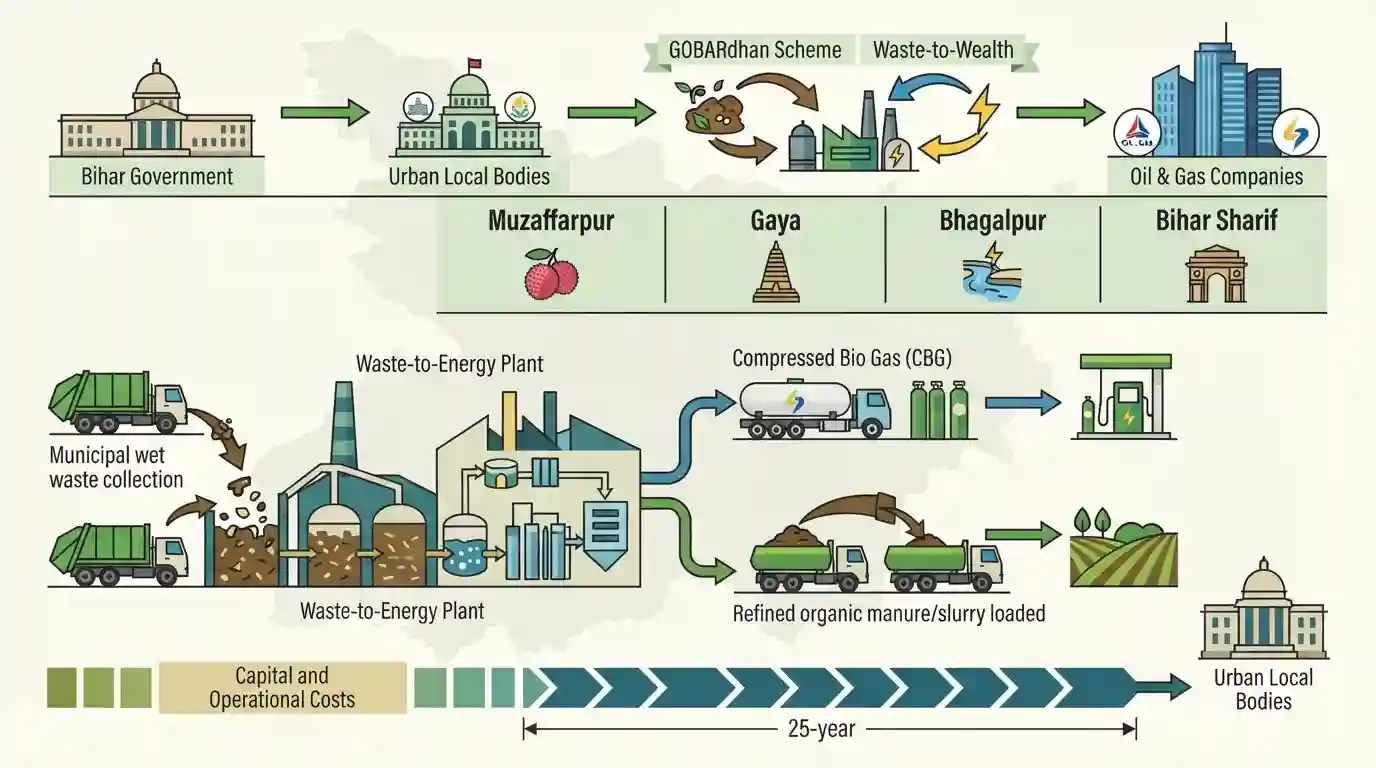
The Bihar government is facilitating the establishment of Compressed Bio Gas (CBG) projects by offering land to oil and gas companies in four major cities: Muzaffarpur, Gaya, Bhagalpur, and Bihar Sharif. Working under the Centre's GOBARdhan scheme and a Waste-to-Wealth framework, the initiative mandates companies to handle capital and operational costs to convert municipal wet waste into CBG. The firms will operate these facilities for 25 years, after which ownership transfers to the respective Urban Local Bodies.
Key Points
- The Bihar government has offered to provide land to oil and gas companies to set up Compressed Bio Gas (CBG) projects in Muzaffarpur, Gaya, Bhagalpur, and Bihar Sharif.
- These CBG plants will be based on processing municipal wet waste, aiming to generate renewable energy from solid waste under a Waste-to-Wealth model.
- Oil and gas companies will bear the capital and operational expenditures (CAPEX and OPEX) and operate the plants for 25 years.
- After 25 years, the ownership of the plants will be transferred to the local Urban Local Bodies (ULBs).
- The initiative is aligned with the Centre's GOBARdhan scheme, which promotes the establishment of CBG plants to manage waste and produce clean energy.
Important Terms
Compressed Bio Gas (CBG)

A renewable green fuel produced through the anaerobic decomposition of organic waste, such as municipal solid waste and agricultural residue, which is then purified and compressed.
UPSC context
Crucial for BPSC GS Paper 2 (Environment and Energy); tests knowledge of renewable energy alternatives and sustainable waste management.
GOBARdhan Scheme
The National Circular Bioenergy Scheme that promotes processing organic waste into clean energy like CBG. It aims to generate wealth from waste while reducing fossil fuel reliance.
UPSC context
Important for BPSC GS Paper 2 (Government Schemes); tests understanding of waste management frameworks and rural development initiatives.
Urban Local Bodies (ULBs)
Local governance institutions responsible for city administration. In Bihar's CBG initiative, ULBs provide land and segregated organic waste, eventually taking full ownership of the plants after 25 years.
UPSC context
Relevant for BPSC GS Paper 2 (Polity); tests the functional domains, responsibilities, and resource mobilization of municipal governments in Bihar.
Waste-to-Wealth Framework
A sustainable policy approach that transforms discarded materials, such as municipal wet waste, into economically valuable resources like renewable energy and organic fertilizers to support a circular economy.
UPSC context
Significant for BPSC GS Paper 2 (Economy & Environment); tests awareness of circular economy principles and sustainable urban infrastructure.
Biofics
A private waste-to-value enterprise operating in India's bioenergy sector. It established one of Bihar's early operational decentralized Compressed Bio Gas (CBG) units with a 6-Tonnes-Per-Day (TPD) capacity.
UPSC context
Useful for BPSC GS Paper 2 (Bihar Economy); provides a specific example of private sector investment in the state's renewable energy landscape.
Prelims Trap
"Bihar Govt shares the capital costs for setting up CBG plants in Patna and other major cities."
The Bihar government provides ONLY the land free of cost. State-owned oil and gas companies cover 100% of the CAPEX and OPEX. Also, Patna is excluded from this phase.
Static Concepts Connected
How does Compressed Biogas (CBG) differ from raw biogas?
- Methane Enrichment: CBG is purified biogas. Impurities like hydrogen sulfide, carbon dioxide, and moisture are removed, resulting in a methane content of over 90%.
- CNG Equivalence: Due to its high methane concentration and compression, CBG shares the same calorific value and automotive properties as commercially available compressed natural gas (CNG).
- Valuable By-products: The anaerobic decomposition process yields high-quality solid and liquid fermented organic manure (FOM) alongside the gas, boosting organic farming efforts.
Which constitutional schedule empowers Urban Local Bodies with waste management?
- 12th Schedule: Introduced by the 74th Constitutional Amendment Act, 1992, the 12th Schedule outlines 18 functional items that fall under the purview of municipalities.
- Sanitation mandate: Entry 6 of the 12th Schedule specifically lists 'Public health, sanitation conservancy and solid waste management' as a core constitutional responsibility of ULBs.
Cross-Topic Patterns
Circular Economy: CBG + Ethanol policies
Bihar's municipal CBG initiative complements its pioneering Ethanol Production Promotion Policy, linking both agricultural and municipal waste management to the state's broader renewable energy and bio-economy goals.
PPP models bridging Municipal Governance gaps
The 25-year concession arrangement highlights a Build-Operate-Transfer (BOT) PPP model. It effectively bypasses the historical lack of capital and technical expertise within Bihar's Urban Local Bodies for complex waste-processing infrastructure.

Expect a multi-statement question testing the specific 4 cities (note: Patna is excluded) and the 100% CAPEX/OPEX model by oil firms.
Linked PYQs · 2
Linked PYQs · 2
- 2022BPSC_PRELIMSGS1
Biodegradable wastes can usually be converted into useful substance with the help of
- 2022BPSC_PRELIMSGS1
Which district of Bihar has mica deposits?
