NITI Aayog Index Ranks Bihar as Emerging Performer in Investments
Source:patnapress ↗
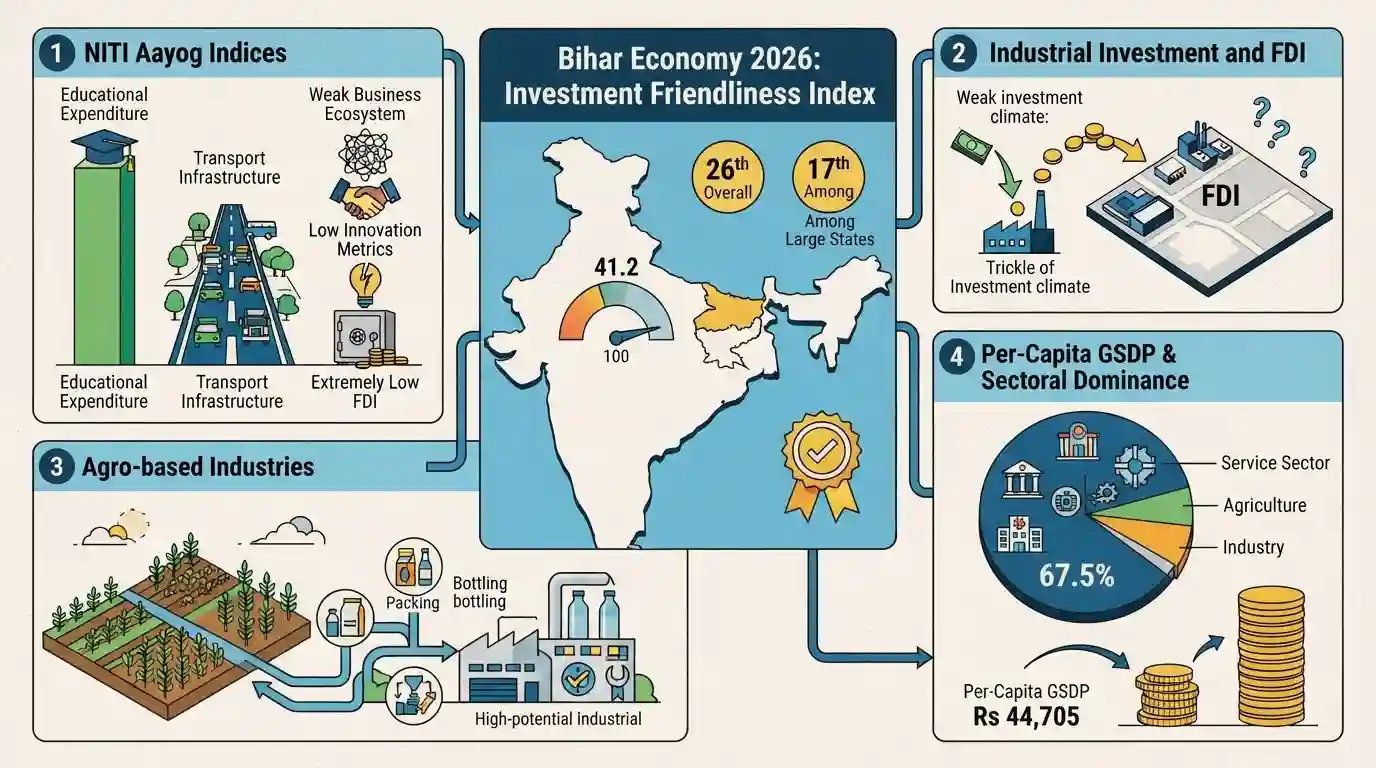
Why It Matters
NITI Aayog indices, state rankings, and sectoral contributions (Services vs. Industry vs. Agriculture) are recurring high-yield areas in BPSC Prelims, assessing the candidate's grasp of Bihar's specific development hurdles and fiscal challenges.
Summary
According to the NITI Aayog's Investment Friendliness Index 2026, Bihar has been designated as an 'Emerging Performer' with a composite score of 41.2 out of 100, ranking 26th overall in India and 17th among large states. While Bihar displays strength in educational expenditure and robust transport infrastructure, it is severely constrained by a weak business ecosystem, extremely low FDI, poor innovation metrics, and a low per-capita GSDP of Rs 44,705. The service sector continues to dominate Bihar's economy at 67.5%, while agro-based food processing remains a high-potential sector for future industrialization.
Key Points
- Bihar achieved a score of 41.2 out of 100 in the NITI Aayog Investment Friendliness Index 2026, placing it in the 'Emerging Performer' category alongside states like Jharkhand, Punjab, and West Bengal.
- The state ranks 26th among all 36 states and Union Territories, and 17th among the large states category in India.
- Bihar's structural strengths include education (with per capita spending 46% higher than the average for large states) and transport infrastructure (robust road/rail connectivity and 23% higher cold storage capacity than the national average).
- Key economic weaknesses include a very low per capita GSDP of Rs 44,705 (72% lower than the average of other large states) and low FDI inflows of just USD 0.16 million during 2023-24.
- The sectoral composition of Bihar's economy shows Services leading at 67.5%, followed by Industry at 22.1% and Agriculture at 10.4%, with food processing highlighted as a principal industry of high potential.
- Financial challenges persist with Bihar's outstanding liabilities being approximately 500 basis points higher than the national average, coupled with low bank credit to industry (6.7% of GSDP).
Important Terms
Investment Friendliness Index 2026

A comprehensive assessment framework by NITI Aayog evaluating how effectively Indian states and Union Territories foster an environment that attracts and sustains domestic and foreign private investments.
UPSC context
GS Paper 3 (Economic Development). Highlights competitive federalism, state-level business reforms, and the investment readiness of different states.
NITI Aayog
India's premier policy think tank responsible for designing strategic, long-term policies and programmes, while fostering cooperative and competitive federalism among states and Union Territories.
UPSC context
GS Paper 2 (Governance). Tests knowledge of non-constitutional bodies, policy formulation, and frameworks driving Centre-State cooperation.
Emerging Performer
A classification within the Investment Friendliness Index for states, like Bihar, showing progress in infrastructure or resources but needing substantial improvements in overall business climate and industrial development.
UPSC context
GS Paper 3 (Indian Economy). Relevant for analyzing regional growth disparities and evaluating states' progress in structural economic reforms.
Per-Capita GSDP
A state's total economic output (Gross State Domestic Product) divided by its population. It measures the average economic production per person and reflects regional living standards.
UPSC context
GS Paper 3 (Economic Growth). Crucial for assessing regional inequalities, state-level economic health, and developmental bottlenecks.
Foreign Direct Investment (FDI)
Capital invested by foreign entities into domestic business interests. It is a critical driver of industrialization, technology transfer, manufacturing capacity expansion, and employment generation.
UPSC context
GS Paper 3 (Investment Models). Important for understanding India's external sector, capital formation, and state-level industrial competitiveness.
Agro-based Food Processing
The industry that transforms raw agricultural materials into consumable products. It holds high potential for agrarian economies by creating rural jobs, reducing post-harvest losses, and boosting incomes.
UPSC context
GS Paper 3 (Food Processing Industries). Tests understanding of supply chain management, rural industrialization, and agricultural value addition.
Prelims Trap
Agriculture contributes the largest share to Bihar's GSDP, reflecting its rural and agrarian population.
Despite its agrarian demographic and rural landscape, Bihar’s economy is overwhelmingly dominated by the tertiary (services) sector (67.5%), not agriculture (10.4%).
Static Concepts Connected
How does NITI Aayog operationalize 'Competitive Federalism' in India?
- Index-based Ranking: Publishing comparative indices (e.g., Innovation, Health, Investment Friendliness) to force states to compete for capital and central incentives.
- Outcome-driven Governance: Shifting the governance focus from mere financial outlays (money spent) to measurable, verifiable development outcomes and structural reforms.
What are the key determinants of Foreign Direct Investment (FDI) inflows into Indian states?
- Business Ecosystem: Robust regulatory frameworks, single-window clearances, and high-quality transport/logistics infrastructure that reduce the cost of doing business.
- Industrial Finance: Availability of deep local banking networks, high industrial credit-to-GSDP ratios, and manageable state fiscal liabilities.
- Human Capital: Presence of a skilled, employable workforce supported by innovation hubs, bridging the gap between basic education and industry needs.
Cross-Topic Patterns
Food Processing & Cold Storage Nexus
Bihar’s high cold storage capacity aligns with the PM KISAN SAMPADA scheme objectives, showing how agrarian states can leverage logistics to transition into agro-processing hubs.
Demographic Dividend vs. Investment Deficit
High state educational expenditure coupled with low industrial credit and FDI illustrates the classic out-migration push-factor: human capital formation without local capital absorption.

Expect a 2026 Prelims multi-statement question testing NITI Aayog's competitive federalism indices against state-level GSDP compositions.
Linked PYQs · 3
Linked PYQs · 3
- 2023BPSC_PRELIMSGS1
In the year 2020, Bihar gained the __ rank out of 36 States in the Ease of Doing Business, awarded by Business Reforms Action Plan (BRAP).
- 2024-IBPSC_PRELIMSGS1
The 60.2 percent share in GSDP of Bihar in 2019 – 20 was of
- 2018BPSC_PRELIMSGS1
Which type of industries has potentials and prospects in Bihar?
