Bihar Higher Education Reforms and New PhD Admission Regulations
Source:patnapress ↗
Why It Matters
This regulatory overhaul represents a major restructuring of higher education in Bihar in alignment with the National Education Policy 2020 and UGC norms. By simplifying pathways for top undergraduate researchers while tightening academic standards—such as plagiarism checks, mandatory publications, and structured workloads—it aims to bolster research output and teaching quality across Bihar's state universities.
Summary
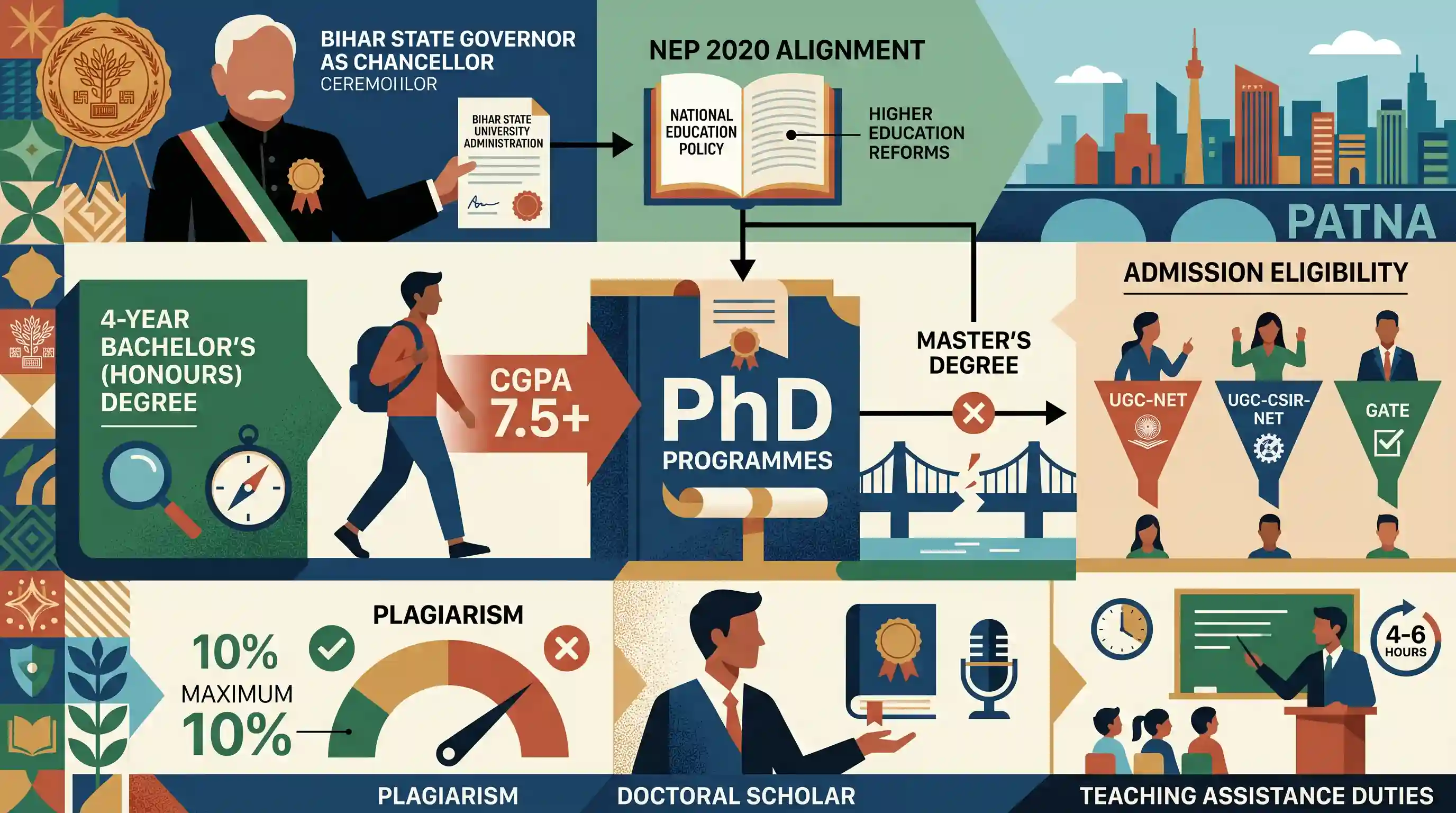
Bihar has notified the 'Bihar State Universities PhD Ordinance and Regulations, 2026', replacing the previous 2017 rules to align state universities with UGC Regulations, 2022. The new regulations allow high-performing students completing a four-year Bachelor's (Honours) degree with research and a CGPA of 7.5 or higher to bypass a Master's degree and seek direct admission into PhD programmes. Admission eligibility is tied to national tests like UGC-NET, UGC-CSIR-NET, or GATE, with stricter standards for plagiarism (maximum 10%), mandatory publication, and structured teaching assistance duties for doctoral scholars.
Key Points
- Bihar replaced its 2017 PhD regulations with the 'Bihar State Universities PhD Ordinance and Regulations, 2026', effective July 4, 2026, aligning with UGC Regulations, 2022.
- Direct PhD Admission: Students completing a four-year Bachelor's (Honours) degree with research can get direct PhD admission without a Master's degree, provided they secure a CGPA of 7.5 or above across 6 semesters.
- For candidates with a standard three-year Bachelor's degree, a two-year Master's degree (or a one-year Master's degree after a standard four-year Bachelor's without research) remains mandatory.
- Admission Eligibility: General category candidates must have at least 55% marks (with standard UGC-defined relaxations for reserved categories), and admission is limited to candidates who qualify in UGC-NET, UGC-CSIR-NET, or GATE.
- Selection Weightage: The selection process allocates 80% weightage to the national qualifying examination score and 20% to the interview.
- Duration & Relaxations: The PhD duration ranges from a minimum of 3 years to a maximum of 6 years. Extensions of up to 2 years are possible under special circumstances, with additional 2-year relaxations for female scholars and candidates with more than 40% disability.
- Mandatory Requirements: Research scholars must teach or assist for 4–6 hours a week, publish at least one research paper, present a paper at an academic conference before thesis submission, and ensure plagiarism does not exceed 10%.
- Supervision and Evaluation: Faculty members with less than 3 years before retirement cannot register new PhD students. Evaluation will be conducted by two external examiners and the supervisor, with online viva-voce permitted and a target completion time of 6 months.
- The ordinance was approved by the Governor of Bihar (who acts as the Chancellor of State Universities) and signed by Additional Chief Secretary Deepak Kumar Singh.
Important Terms
National Education Policy 2020

India's comprehensive academic reform framework targeting early childhood to higher education. It introduces a multidisciplinary focus, flexible entry-exit options, and seeks to transform India into a global knowledge superpower.
UPSC context
GS Paper II (Social Justice/Education). Tests understanding of national education reforms, structural shifts, and higher education integration.
University Grants Commission
A statutory body established in 1956 under the UGC Act, responsible for coordinating, determining, and maintaining standards of higher education and providing funding to recognized universities in India.
UPSC context
GS Paper II (Statutory Bodies/Governance). Evaluates statutory oversight, educational standards, and federal dynamics in central-state academic regulation.
UGC Regulations, 2022
Guidelines governing doctoral degrees in India, establishing standard norms for admission, supervisor eligibility, mandatory coursework, plagiarism limits, and allowing direct PhD entry for high-performing four-year bachelor's graduates.
UPSC context
GS Paper II (Governance/Education). Tests knowledge of regulatory reforms designed to align Indian doctoral research with global quality benchmarks.
Governor as Chancellor of State Universities
A colonial-era convention where the state Governor acts ex-officio as the academic head (Chancellor) of state-run universities, wielding discretionary powers to appoint Vice-Chancellors and approve university statutes.
UPSC context
GS Paper II (Polity/Federalism). Analyzes center-state friction, executive-governor conflicts, and recommendations of commissions like Sarkaria and Punchhi.
UGC-NET
A national-level examination conducted to determine the eligibility of Indian nationals for Assistant Professorship, Junior Research Fellowship (JRF), and admission to PhD programs in Indian universities.
UPSC context
GS Paper II (Social Justice/Education). Tests understanding of standardized testing for academic quality assurance and institutional research standardisation.
Prelims Trap
The Governor, when acting as the ex-officio Chancellor of State Universities, is constitutionally bound by the aid and advice of the Council of Ministers.
The Chancellor role is statutory, not constitutional. Under state university acts, the Governor acts in an independent statutory capacity, free from Article 163's binding aid and advice.
Static Concepts Connected
What is the legal status of the Governor acting as State University Chancellor?
- Statutory Origin: The Chancellor position is created by state legislative acts, not by the Constitution of India.
- Independent Capacity: The Governor is not bound by the aid and advice of the Council of Ministers under Article 163 when acting as Chancellor.
- Judicial Clarification: The Supreme Court has held that Chancellors must exercise their statutory powers independently of executive interference.
Cross-Topic Patterns
Federalism and Higher Education Standards
Under Entry 66 of the Union List, Central bodies like the UGC set standards that override state-level university legislation, illustrating asymmetric federal control in education.
Governor-State Executive Friction
Statutory powers of Governors as Chancellors frequently spark political conflicts over university administration, challenging the constitutional convention of executive-led governance.

The statutory status of the Governor as Chancellor vs. constitutional 'aid and advice' under Article 163 is a prime target for GS-2 Polity.
Linked PYQs · 3
Linked PYQs · 3
- 2023BPSC_PRELIMSGS1
The National Education Policy, 2020 emphasizes the integration of vocational education into mainstream education from which grade onwards?
- 2025BPSC_PRELIMSGS1
What is the primary objective of Bihar’s Mission Daksh?
- 2018BPSC_PRELIMSGS1
The Governor of a State is appointed by
