Bihar Imposes Statewide Monsoon Ban on Sand Mining Operations
Source:patna-press ↗
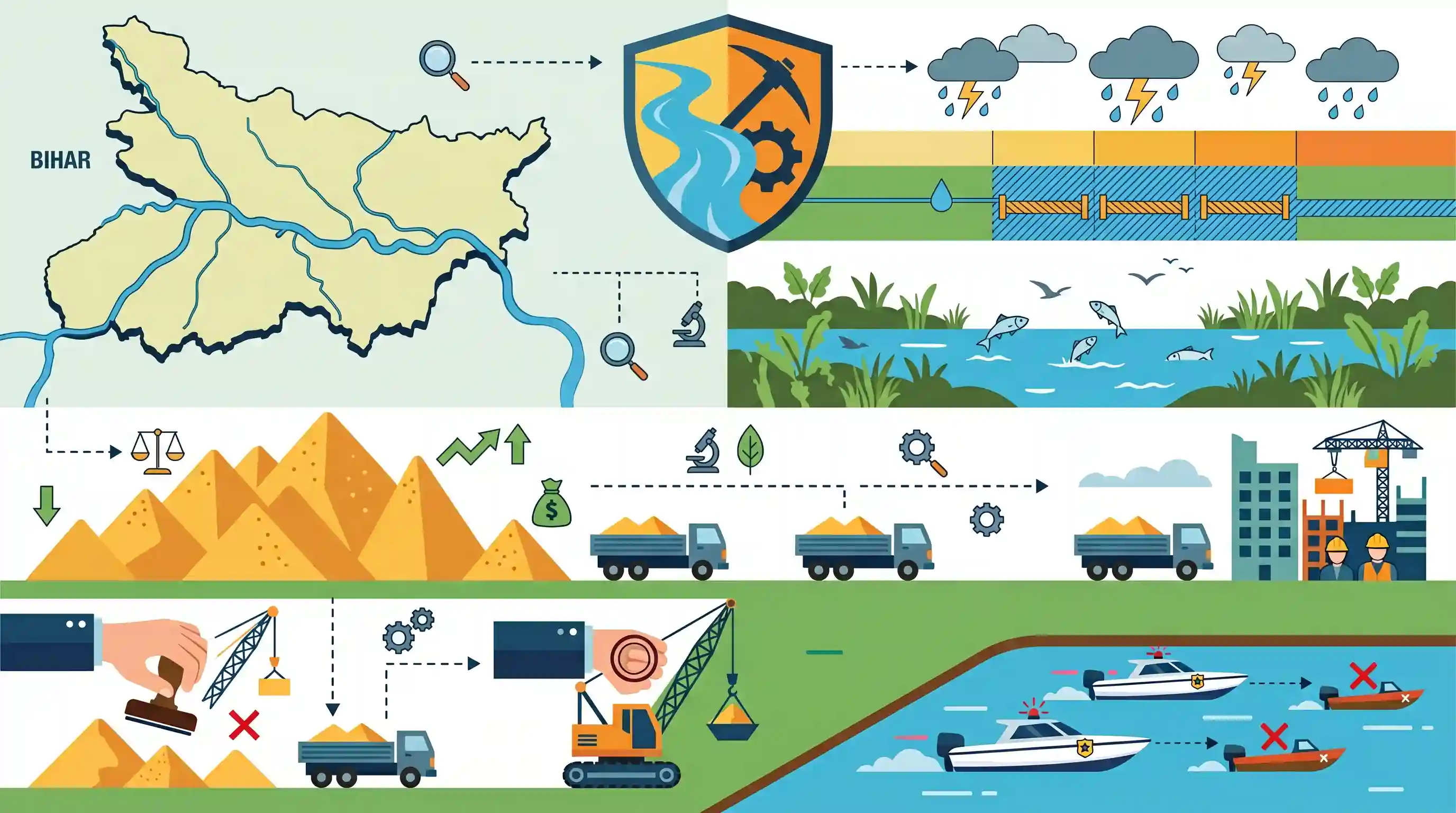
Why It Matters
Sand is classified as a minor mineral, and its regulation falls under state jurisdiction. Annual monsoon bans in Bihar are critical to study because they highlight the conflict between infrastructure development (which relies on sand from major rivers like the Son) and ecological conservation (preventing erosion and riverbed degradation). Understanding the administrative mechanisms (like SEIAA and the Mines and Geology Department) and the economic impacts (buffer stocking) is vital for state services exams.
Summary
The Bihar government has imposed a state-wide four-month ban on sand mining from June 15 to October 15, 2026, to protect river ecosystems during the monsoon. Enforced under SEIAA guidelines, the ban is backed by a buffer stock of 30-35 lakh cubic feet of sand to maintain construction supplies and curb price spikes, alongside intensified patrolling by the Mines and Geology Department to combat illegal mining.
Key Points
- The Bihar government has suspended sand mining operations across all sand ghats in the state for four months, from June 15, 2026, to October 15, 2026.
- This annual ban coincides with the monsoon season, aiming to protect river ecosystems, prevent ecological damage, and reduce safety risks due to rising water levels.
- The restriction is enforced under guidelines issued by the State Environment Impact Assessment Authority (SEIAA).
- To prevent construction disruptions and check artificial scarcity or price spikes, the government has pre-stocked a buffer of 30 to 35 lakh cubic feet of sand across districts.
- The Mines and Geology Department has instructed district administrations to step up surveillance, leading to enforcement actions like the seizure of a sand-transporting tractor in Gaya.
Important Terms
State Environment Impact Assessment Authority

A state-level statutory body constituted by the Central Government under the Environment (Protection) Act, 1986, responsible for evaluating and granting environmental clearances to Category B developmental projects.
UPSC context
GS Paper III (Environment); tests understanding of federal environmental regulatory framework, clearance categories, and statutory bodies.
Environmental Impact Assessment
A systematic process that evaluates the potential environmental, social, and economic consequences of a proposed development project before granting regulatory approval.
UPSC context
GS Paper III (Environment); tests knowledge of policy tools balancing ecological preservation with infrastructure growth under EIA Notifications.
Minor Minerals
Minerals declared by the Central Government under the MMDR Act, 1957, such as sand, gravel, and clay, whose regulatory and leasing powers belong entirely to State Governments.
UPSC context
GS Paper III (Resources & Development); tests federal division of powers in resource governance and MMDR Act provisions.
Sustainable Sand Mining Management Guidelines
Guidelines issued by the MoEFCC to ensure eco-friendly riverbed sand mining through tools like mandatory District Survey Reports to monitor sand replenishment rates.
UPSC context
GS Paper III (Environment & Pollution); tests understanding of policies curbing illegal mining and protecting river hydrology.
Manufactured Sand
An artificial substitute for natural river sand produced by crushing hard granite stones, presenting an ecologically superior alternative for the construction sector.
UPSC context
GS Paper III (Infrastructure & Environment); tests awareness of eco-friendly construction alternatives to reduce ecological footprints.
Prelims Trap
The Central Government frames the rules for preventing illegal mining and regulating transit of minor minerals like sand.
Under Section 23C of the MMDR Act, 1957, State Governments—not the Central Government—possess the exclusive power to frame rules to curb illegal minor mineral mining.
Static Concepts Connected
How are minor minerals regulated under the MMDR Act, 1957?
- State Jurisdiction: State governments possess complete legislative and administrative power to frame rules for regulating minor minerals, including sand.
- Royalty Collection: Unlike major minerals, all royalties and revenues generated from minor minerals flow entirely to the state government treasuries.
- Section 23C: Empowers state governments to make rules for preventing illegal mining, transportation, and storage of minor minerals.
What are the ecological consequences of excessive riverbed sand mining?
- Water Table Depletion: Channel incision and deepening cause the surrounding groundwater table to drop, drying up nearby wells.
- Instream Habitat Loss: Destroys spawning grounds of aquatic species, increases turbidity, and degrades benthic ecosystems essential for food chains.
- Coastal Salinity Intrusion: In estuarine areas, excessive sand removal allows saltwater to push further inland, contaminating fresh groundwater aquifers.
Cross-Topic Patterns
Federalism vs. Environmental Mandates
Examines the tension between sole state legislative authority over minor minerals and centrally-mandated environmental clearances under the EPA, 1986.
Urbanization vs. Riverine Hydrology
Links skyrocketing real estate demand for river sand with irreversible damage to river channels, prompting a policy push toward Manufactured Sand (M-Sand).

Expect a 2026 question combining the federal division of mineral rights (MMDR Act) with the hydrogeological impacts of riverbed sand mining.
Linked PYQs · 3
Linked PYQs · 3
- 2018BPSC_PRELIMSGS1
Which type of industries has potentials and prospects in Bihar?
- 2023BPSC_PRELIMSGS1
Bihar’s geographical structure consists of rock systems. Match the rock systems with their descriptions: a. Dharwar rock system 1. Created by the rapid deposition of alluvium by Himalayan and Peninsular rivers b. Vindhyan rock system 2. Can be found in the West Champaran district c. Quaternary rock system 3. Part of the oldest Archaean rock system d. Tertiary rock system 4. Sandstone, limestone, dolomite, quartzite and shale are the main constituents of this rock system Select the correct answer using the codes given below.
- 2022BPSC_PRELIMSGS1
The confluence of the rivers Son and Ganga is located in which district of Bihar?
