Bihar Urban Transport Modernization and Bus Terminal PPP Model
Source:patna-press ↗
Why It Matters
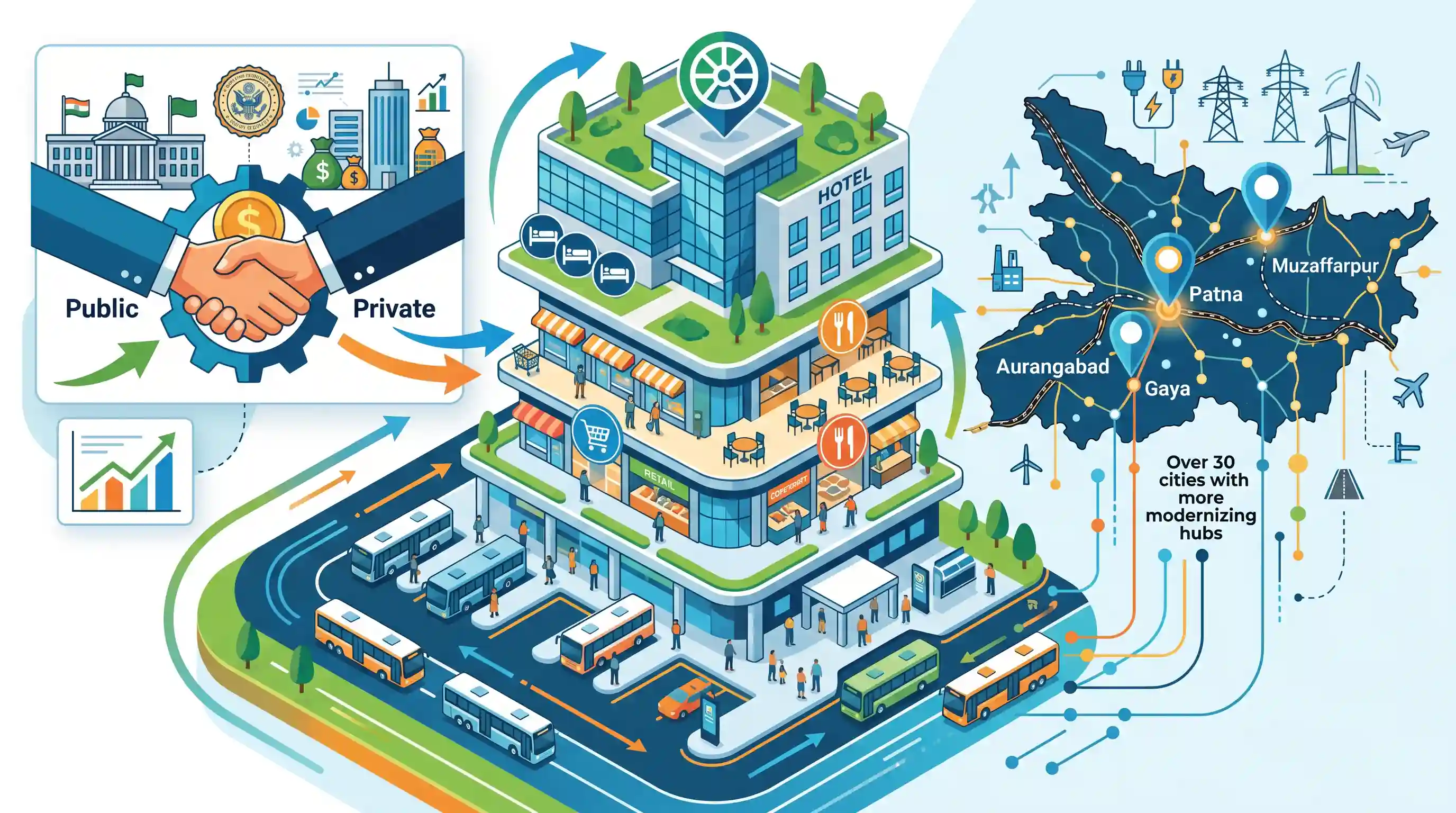
This modernization drive demonstrates Bihar's active transition toward public-private partnerships (PPP) to upgrade transport facilities, boost urban economies, and introduce multi-modal transport concepts that secure recurring commercial revenues.
Summary
The Bihar government, through the Bihar State Road Transport Corporation (BSRTC), is set to develop modern five-storey bus terminals and depots across more than 30 cities under the Public-Private Partnership (PPP) model. These multi-modal hubs will merge public transport services with substantial commercial facilities, such as retail spaces, cafeterias, hotels, and waiting areas, to create financially self-sustaining complexes. Major land allocations have already been mapped out across several districts like Patna, Aurangabad, Gaya, and Muzaffarpur to initiate development under this state-wide infrastructure modernization plan.
Key Points
- The Bihar State Road Transport Corporation (BSRTC) plans to construct modern, five-storey bus depots and terminals across more than 30 cities under the Public-Private Partnership (PPP) model.
- These facilities will function as multi-modal transport hubs, housing both public transport infrastructure and commercial developments to ensure long-term financial sustainability.
- The ground floors of the five-storey structures will be reserved for bus parking, passenger platforms, and maintenance workshops.
- The upper floors will feature BSRTC offices, air-conditioned/non-air-conditioned waiting halls, cafeterias, retail outlets, dormitories, feeding rooms for women, shopping areas, hotels, and entertainment spaces.
- Major land parcels have been earmarked, including around 5 acres in Patna, over 5 acres in Aurangabad and Muzaffarpur, and around 3 to 4.9 acres in Gaya, Jamui, Nawada, Bihar Sharif, Purnia, Tarapur (Munger), and Darbhanga.
- Transport Minister Damodar Rawat emphasized that the initiative aims to build world-class depots at district headquarters, boosting public transport, local employment, and commercial activity.
Important Terms
Public-Private Partnership (PPP) Model

A long-term contract between a government agency and a private company to fund, construct, and operate public infrastructure or services, sharing risks and rewards.
UPSC context
GS Paper 3 (Investment Models/Infrastructure); tests economic viability, financing methods, and private sector integration in national development.
Bihar State Road Transport Corporation (BSRTC)
A state-owned enterprise in Bihar responsible for managing public transit, operating bus fleets, and modernizing transport terminals under state-wide development plans.
UPSC context
GS Paper 2 (State policies/governance) and GS Paper 3 (Infrastructure); tests regional public transport systems and decentralized execution of welfare infrastructure.
Multi-Modal Transport Hub (MMTH)
A single transit facility integrating different transportation modes—like railways, buses, and mass transit—to ensure seamless, efficient passenger transfers and regional connectivity.
UPSC context
GS Paper 3 (Infrastructure/Planning); tests concepts of seamless passenger mobility, integrated urban transit systems, and PM Gati Shakti initiatives.
Urban Infrastructure
The fundamental physical systems—such as transit, sanitation, energy, and water supply—needed to support economic growth, modernization, and basic services in urban settlements.
UPSC context
GS Paper 3 (Infrastructure Development) and GS Paper 1 (Urbanization); tests challenges of rapid urbanization, sustainable development, and central/state missions.
Prelims Trap
Transit-Oriented Development (TOD) models are exclusively confined to rail and metro corridor planning.
TOD is equally applicable to high-capacity road transport networks, bus terminals, and multi-modal hubs to drive commercial cross-subsidization.
Static Concepts Connected
What are the primary Public-Private Partnership (PPP) investment models in Indian infrastructure?
- BOT Model: Private player designs, builds, and operates the asset for a concession period, earning revenue through tolls/fees before transferring ownership to the state.
- EPC Model: Government funds the project completely, paying a private contractor to execute the construction, transferring all operational and market risks back to the state.
- Hybrid Annuity Model: A mix of EPC (40% upfront government funding) and BOT-Annuity (60% paid over time by the government based on performance metrics).
What is Transit-Oriented Development (TOD) and its core objective?
- High-density mixing: Integrates residential, commercial, and public spaces within walking distance of high-capacity transit nodes to optimize land use.
- Commercial cross-subsidization: Generates non-fare revenue through retail leases, hotels, and workspaces to fund and maintain the public transit infrastructure.
- Environmental benefits: Reduces private vehicle dependency and carbon emissions by promoting last-mile walking, cycling, and public transit usage.
Cross-Topic Patterns
TOD + Municipal fiscal health
Using commercial concessions in transit hubs creates sustainable non-tax revenue streams, reducing the fiscal dependence of Urban Local Bodies on state-level grants.
Infrastructure + Counter-magnet urban planning
Developing robust multi-modal transport nodes in Tier-2 and Tier-3 districts serves as a regional development strategy to stem distress migration to primate cities.

Mains 2026 may evaluate how Transit-Oriented Development (TOD) in Tier-2/3 cities can balance municipal finances and stem distress migration.
Linked PYQs · 2
Linked PYQs · 2
- 2016BPSC_PRELIMSGS1
'SUPUR' project in Bihar relates to :
- 2011BPSC_PRELIMSGS1
In Bihar, name the scheme which aims at building up infrastructural facilities of high standard, required for the establishment of 'Export oriented Units':
