Bihar Power Sector Peak Demand and Grid Infrastructure Growth
Source:times-of-india ↗
Why It Matters
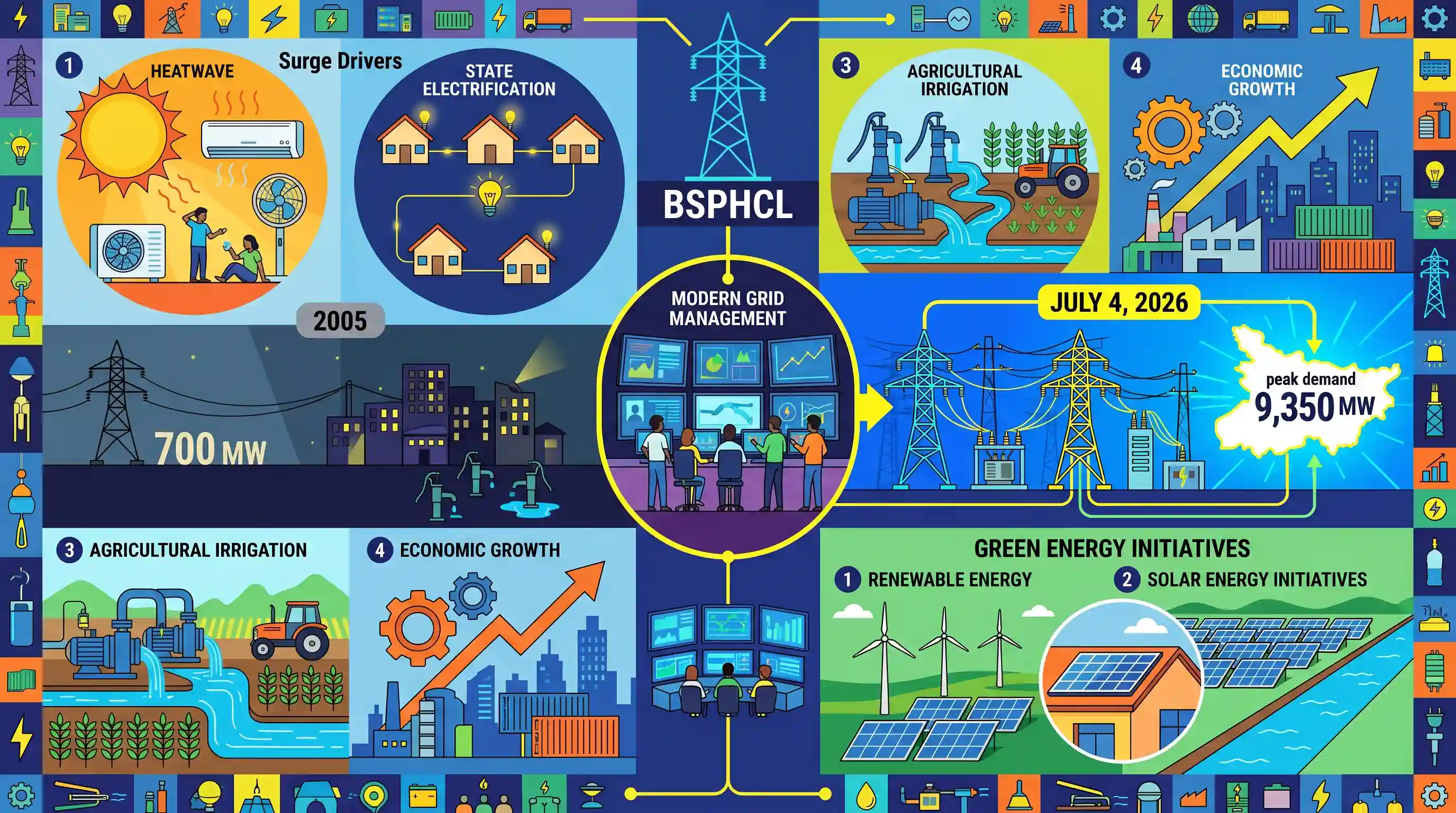
Illustrates Bihar's transition from an energy-deficit state with massive infrastructure constraints to a modernised power grid handling historically high loads, which is a key indicator of state economic development and standard of living.
Summary
On July 4, 2026, Bihar achieved a milestone in its power sector by successfully meeting an all-time high peak electricity demand of 9,350 MW. Managed by the Bihar State Power Holding Company Limited (BSPHCL), the milestone showcases Bihar's massive infrastructural transformation since 2005, when peak demand was just 700 MW. The surge is driven by summer heatwaves, state electrification schemes, expanding agricultural irrigation, and economic growth, complemented by modern grid management and solar energy initiatives.
Key Points
- Bihar recorded an all-time high peak power demand of 9,350 MW at 8:28 PM on Saturday, July 4, 2026, managed seamlessly without grid disruptions.
- The peak demand is driven by an intense summer heatwave (cooling requirements), near-universal household electrification through state welfare schemes, expanding agricultural irrigation, and growing commercial/industrial activity.
- Historically, Bihar's peak electricity demand was merely 700 MW in 2005, which grew to over 2,500 MW in 2016, 8,428 MW in 2025, and finally reached 9,350 MW in 2026.
- The modernised grid employs technology-driven management, real-time monitoring, and strengthened consumer grievance redressal systems.
- Alongside thermal power, Bihar is promoting green energy, with around 20,000 households currently utilizing rooftop solar systems under state subsidy schemes.
Important Terms
Peak Power Demand

The maximum electrical power load required from an electrical grid or utility system during a specific period, reflecting peak consumption levels.
UPSC context
GS Paper III (Infrastructure: Energy); crucial for studying grid stability, demand-supply gaps, and industrial growth.
Bihar State Power Holding Company Limited (BSPHCL)
The state-owned holding enterprise responsible for coordinating generation, transmission, and distribution utilities across Bihar, spearheading the state’s electricity sector reforms.
UPSC context
GS Paper III (State Infrastructure); tests knowledge of power sector restructuring, utility corporatisation, and state governance.
Har Ghar Bijli Nishchay
A landmark state-level electrification scheme under Bihar's "Saat Nishchay" (Seven Resolves) program, providing metered electricity connections to rural and urban households.
UPSC context
GS Paper II (Welfare Schemes); examines state-driven inclusive growth, rural electrification, and socio-economic transformation.
PM Surya Ghar: Muft Bijli Yojana
A central government scheme launched in 2024 providing substantial subsidies for rooftop solar systems, targeting free electricity for one crore Indian households.
UPSC context
GS Paper III (Renewable Energy); key for analyzing India's energy transition, climate commitments, and decentralized power.
Utility-Led Aggregation Model
A solar deployment model where distribution utilities aggregate residential rooftop demand and appoint developers, eliminating upfront installation costs for low-income households.
UPSC context
GS Paper III (Infrastructure & Energy Economics); tests innovative green finance, DISCOM operations, and scalable renewable energy models.
Bihar Renewable Energy Development Agency (BREDA)
The state government’s nodal agency in Bihar responsible for promoting, implementing, and supervising clean energy, energy conservation, and solar power initiatives.
UPSC context
GS Paper III (Environment and Renewable Energy); tests state-level institutional frameworks driving green technology transition.
Prelims Trap
Agricultural consumers represent the largest share of electricity consumption in Bihar's power distribution profile.
Domestic consumers hold the largest share at nearly 48%. While agricultural demand is growing fastest, it remains a smaller fraction (around 15%).
Static Concepts Connected
How is the Indian power sector constitutionally and regulatorily structured?
- Concurrent Subject: Electricity is placed under Entry 38 of the Concurrent List (List III), allowing joint legislative authority to both Central and State governments.
- Dual Regulation: The Central Electricity Regulatory Commission (CERC) operates federally, while State Electricity Regulatory Commissions (SERCs) regulate regional tariffs and distribution.
- Operational Hierarchy: State Load Despatch Centres (SLDCs) manage intra-state dispatch, integrated into a unified National Grid overseen by Grid Controller of India.
What is the 'Duck Curve' in grid management?
- Definition: A graph of net electricity load over a day, showing a steep drop during midday due to solar generation, followed by a sharp evening peak.
- Operational Strain: It requires conventional thermal and hydro generators to ramp up extremely rapidly as solar generation drops off at sunset.
Cross-Topic Patterns
Cooperative federalism in grid balancing
Peak demand surges in agricultural states like Bihar test the interstate transmission system (ISTS) and the Center's allocation of unallocated power pools to states.
The Agri-Water-Energy Nexus
Rapidly increasing agricultural power consumption (from 5.3% to 14.9% in Bihar) reflects groundwater extraction trends, directly linking power subsidies to regional aquifer depletion.

The structural shift in rural peak demand will drive UPSC to test the state-level grid integration of rooftop and floating solar by 2026.
Linked PYQs · 3
Linked PYQs · 3
- 2017BPSC_PRELIMSGS1
The latest annual per capita consumption of electricity in Bihar is
- 2023BPSC_PRELIMSGS1
The first ‘floating solar power plant’ has been built at which place in Bihar?
- 2024-EBPSC_PRELIMSGS1
In which of the following years the Bihar state Hydroelectric power corporation was established?
