Lightning strikes in Bihar kill nine people across three districts
Source:daily-pioneer ↗
Why It Matters
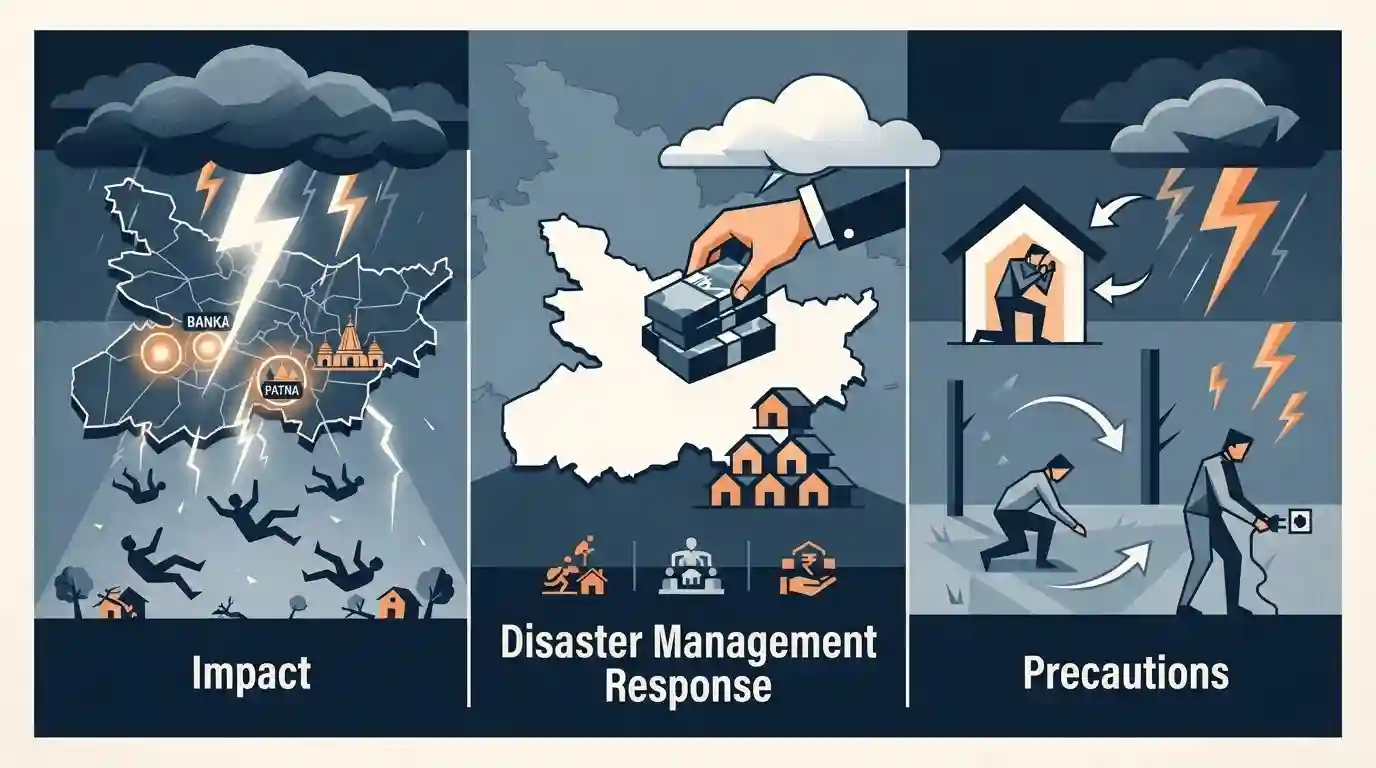
Lightning strikes are a major recurrent natural hazard in Bihar, often causing significant fatalities during the pre-monsoon and monsoon seasons. It highlights the intersection of local climatology and disaster management, underscoring the need for effective early warning systems and state government relief policies.
Summary
Nine people were killed by lightning strikes in three districts of Bihar, including Banka, Lakhisarai, and Patna. The state government announced an ex gratia of Rs 4 lakh for the families of the victims, while authorities urged residents to take precautions during thunderstorms.
Key Points
- Nine people died due to lightning strikes across three districts in Bihar: Banka (5), Lakhisarai (3), and Patna (1).
- The state government announced an ex gratia payment of Rs 4 lakh for the families of each deceased individual.
- Deputy Chief Minister Samrat Choudhary urged the administration to provide proper medical care to the injured and advised citizens to exercise caution during inclement weather.
Important Terms
Ex-gratia relief

A financial relief payment made on humanitarian grounds without establishing legal liability. In disaster management, it is provided to families of victims for immediate support following a calamity like a lightning strike.
UPSC context
GS Paper 3 (Disaster Management). Tests understanding of disaster financing, relief mechanisms, and how the State Disaster Response Fund is utilized.
State Disaster Response Fund (SDRF)
A dedicated fund under the Disaster Management Act, 2005, primarily used by states to provide immediate relief for notified disasters. It is funded jointly by the central and state governments.
UPSC context
GS Paper 3 (Disaster Management). Highly relevant for understanding the center-state financial framework for disaster response and mitigation.
NDMA Guidelines on Lightning
Guidelines created to mitigate lightning casualties, focusing on mapping vulnerable zones, installing early warning systems (like Doppler Radars), deploying structural protection (lightning arresters), and promoting mass awareness.
UPSC context
GS Paper 3 (Disaster Management). Crucial for evaluating policy measures, structural/non-structural mitigation strategies, and the national framework for extreme weather events.
Damini App
A mobile application developed by the Ministry of Earth Sciences that provides location-specific lightning forecasts and alerts, acting as an early warning system for vulnerable populations.
UPSC context
GS Paper 3 (Disaster Management / Science & Tech). Demonstrates the role of technology and early warning systems in disaster risk reduction.
Prelims Trap
"Lightning is formally recognized as a centrally notified national disaster under the Disaster Management Act."
Lightning is not a centrally notified national disaster. States instead use a special provision allocating up to 10% of their SDRF to manage it as a "state-specific" local disaster.
Static Concepts Connected
What meteorological mechanisms generate lightning in thunderstorms?
- Charge separation: Rapid updrafts and downdrafts in towering cumulonimbus clouds cause collisions between ice crystals and water droplets, separating charges.
- Polarization: Lighter, positively charged ice crystals gather at the cloud top, while heavier, negatively charged hail and water pool at the base.
- Electrical discharge: The negatively charged cloud base repels negative charges on the Earth's surface, making the ground positively charged and triggering a massive electrical discharge.
How is the State Disaster Response Fund (SDRF) structured under the DM Act?
- Funding ratio: The Central Government contributes 75% for General Category States and 90% for Special Category States (Northeast and Hill states).
- Local disaster exception: States are permitted to utilize up to 10% of their SDRF allocation to declare and manage localized, state-specific natural disasters not on the central notified list.
Cross-Topic Patterns
Climate Change & Convective Activity
Rising global temperatures increase atmospheric moisture and latent heat, intensifying cumulonimbus cloud formation and causing a measurable surge in lightning strike frequency across Eastern India.
Space Tech & Early Warning Systems
ISRO's INSAT-3D/3DR satellite data integrates with IITM Pune's 'Damini' app, bridging space technology and disaster management to provide localized, GPS-based lightning early warnings.

A 2026 Prelims question will likely test funding nuances between centrally notified disasters and state-specific ones like lightning strikes.
Linked PYQs · 2
Linked PYQs · 2
- 2025BPSC_PRELIMSGS1
Most of the Bihar comes under which of the following climate type?
- 2017BPSC_PRELIMSGS1
According to Koppen's Climatic classification, the climate of North Bihar may be explained as
