Bihar Legislature Monsoon Session Commences with Supplementary Budget
Source:inside-bihar ↗
Why It Matters
Understanding the functional aspects of the State Legislature, including the role of the Question Hour, passage of bills, and financial processes like Supplementary Budgets (Article 205), is critical for BPSC Prelims Polity and Bihar Economy sections.
Summary
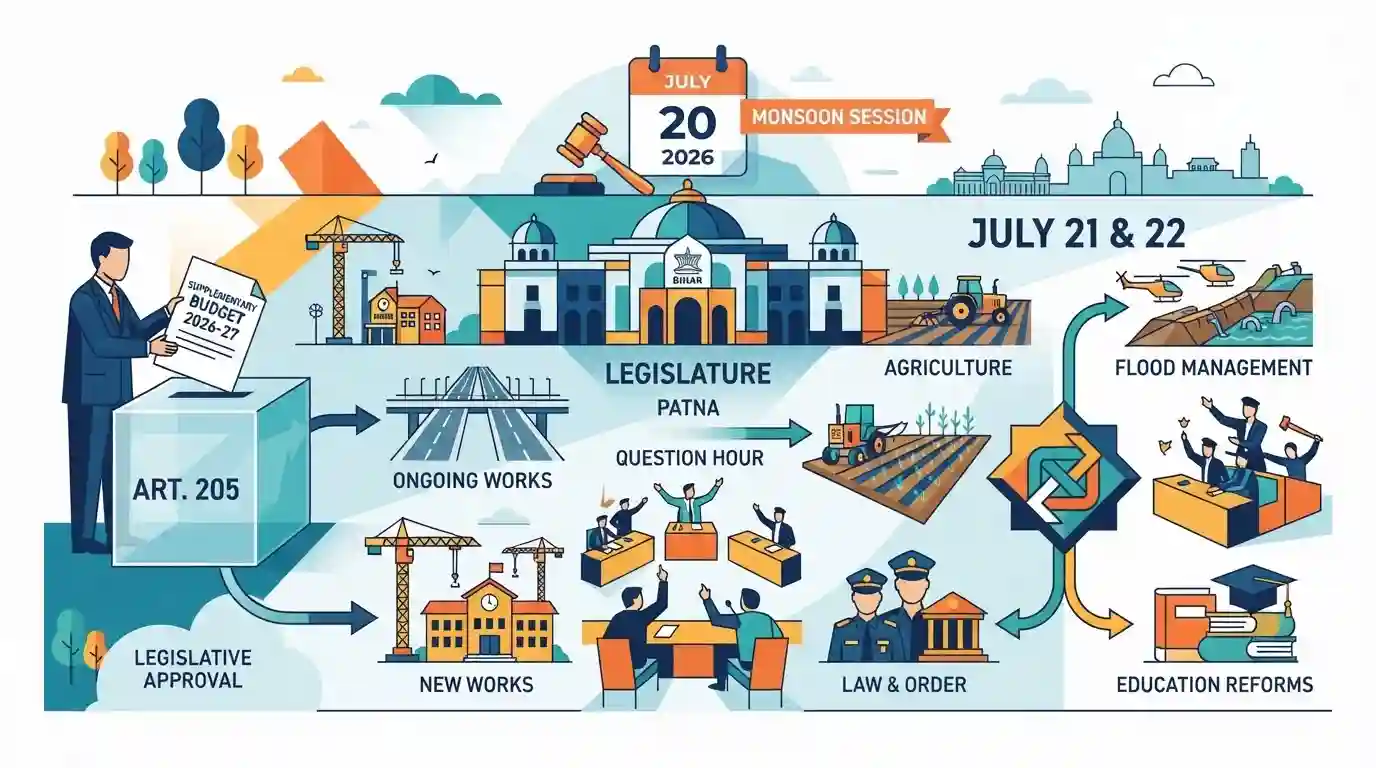
The Monsoon Session of the Bihar Legislature commenced in Patna on July 20, 2026, with the government presenting its first Supplementary Budget for the financial year 2026-27 on the opening day. This financial instrument seeks additional legislative approvals for ongoing and new developmental works. Scheduled for July 21 and 22, the session will address various government bills and witness intense debates on critical issues such as state-wide flood management, agriculture, law and order, and education reforms during the daily Question Hour.
Key Points
- The Monsoon Session of the Bihar State Legislature commenced on July 20, 2026, in Patna.
- On the opening day, the Bihar Government tabled the first Supplementary Budget for the Financial Year 2026-27 to authorize additional spending on ongoing development projects, incomplete schemes, and new welfare initiatives.
- Key legislative businesses, including government bills and amendments, are scheduled to be introduced after the Question Hour on July 21 and 22, 2026.
- The session is expected to feature critical debates on state-specific challenges, including flood management, agricultural conditions under the monsoon, law and order, and education and healthcare reforms.
- The Opposition plans to corner the government on unemployment, teacher recruitment, crime control, and flood relief, while the ruling alliance will highlight achievements in rural development and infrastructure.
Important Terms
Supplementary Budget (Article 205)

Under Article 205, a supplementary budget is presented to the state legislature when authorized funds for a specific service in the current financial year are insufficient, or a need for additional expenditure upon a new service arises.
UPSC context
GS Paper 2 (Polity); tests understanding of constitutional provisions for legislative control over state finances and executive accountability.
State Legislative Assembly
The directly elected lower house of a state legislature. It holds primary lawmaking authority, exclusive power over Money Bills, and controls executive accountability, as the government must maintain the confidence of this house to remain in power.
UPSC context
GS Paper 2 (State Legislature); tests knowledge of state-level legislative powers, bicameralism, and executive-legislature relations.
State Legislative Council (Article 169)
The indirectly elected upper house in a bicameral state legislature. Under Article 169, Parliament may create or abolish it if the Assembly passes a special majority resolution. It acts primarily as an advisory and revising chamber.
UPSC context
GS Paper 2 (Polity); evaluates understanding of Article 169, state bicameralism, and the structural limitations of the upper house.
Question Hour
The first hour of a legislative sitting dedicated to members asking questions (starred, unstarred, or short-notice) to ministers about government activities, thereby ensuring transparency, administrative oversight, and executive accountability.
UPSC context
GS Paper 2 (Parliament/State Legislatures); critical for understanding parliamentary devices, democratic oversight, and daily executive accountability.
Prelims Trap
Supplementary grants are issued exclusively to fund new, unforeseen services not contemplated in the original budget.
This describes an 'Additional Grant'. A 'Supplementary Grant' is specifically utilized when the originally authorized amount for an existing service falls short.
Static Concepts Connected
How do Supplementary, Additional, and Excess grants differ?
- Supplementary Grant: Passed when authorized funds for an existing service are found insufficient for the current financial year.
- Additional Grant: Passed when funds are needed for a new, unforeseen service not originally contemplated in the budget.
- Excess Grant: Passed when spent money exceeds the authorized budget; requires Public Accounts Committee approval before voting.
What geographic factors make North Bihar highly vulnerable to flooding?
- Transboundary Rivers: Rivers like Kosi, Gandak, and Bagmati carry massive, rapid seasonal discharge from the steep slopes of Nepal.
- High Siltation: The sudden transition to flat plains causes these rivers to dump heavy sediment, raising riverbeds above the surrounding land.
- Topographic Depression: The region's flat, saucer-shaped topography and the complex interplay of embankments often lead to severe and prolonged waterlogging.
Cross-Topic Patterns
Hydro-diplomacy with Nepal
Bihar's flood management relies on maintaining cross-border barrages (like Kosi) and real-time data sharing with Nepal, bridging disaster management and international relations.
Fiscal discipline and disaster shocks
Frequent climate disasters force states to rely heavily on supplementary grants to cover immediate relief operations, repeatedly testing the fiscal targets mandated by the FRBM Act.

Expect a prelims question matching grant types (Supplementary, Additional, Excess) with their exact Constitutional definitions.
Linked PYQs · 4
Linked PYQs · 4
- 2025BPSC_PRELIMSGS1
What is true about the proceedings of the State Legislature?
- 2024-EBPSC_PRELIMSGS1
By which time Governor has to return an ordinary bill to the concerned State Legislature for reconsideration?
- 2024-EBPSC_PRELIMSGS1
Who decides the disqualification of members of State Legislative Assembly, for matters other than those in the tenth schedule of the Constitution?
- 2024-EBPSC_PRELIMSGS1
What is the contribution of agriculture in the Gross Domestic Product (GDP) of Bihar?
