Bihar role in national emergency and legislative orientation program
Source:The Hindu ↗
Why It Matters
The article bridges contemporary legislative training in Bihar with pivotal constitutional history (Article 352 National Emergency) and the state's modern socio-political legacy (JP Movement, Karpoori Thakur, Dr. Rajendra Prasad). BPSC frequently tests candidates on Bihar's contribution to national movements, socialist leadership, and Indian polity.
Summary
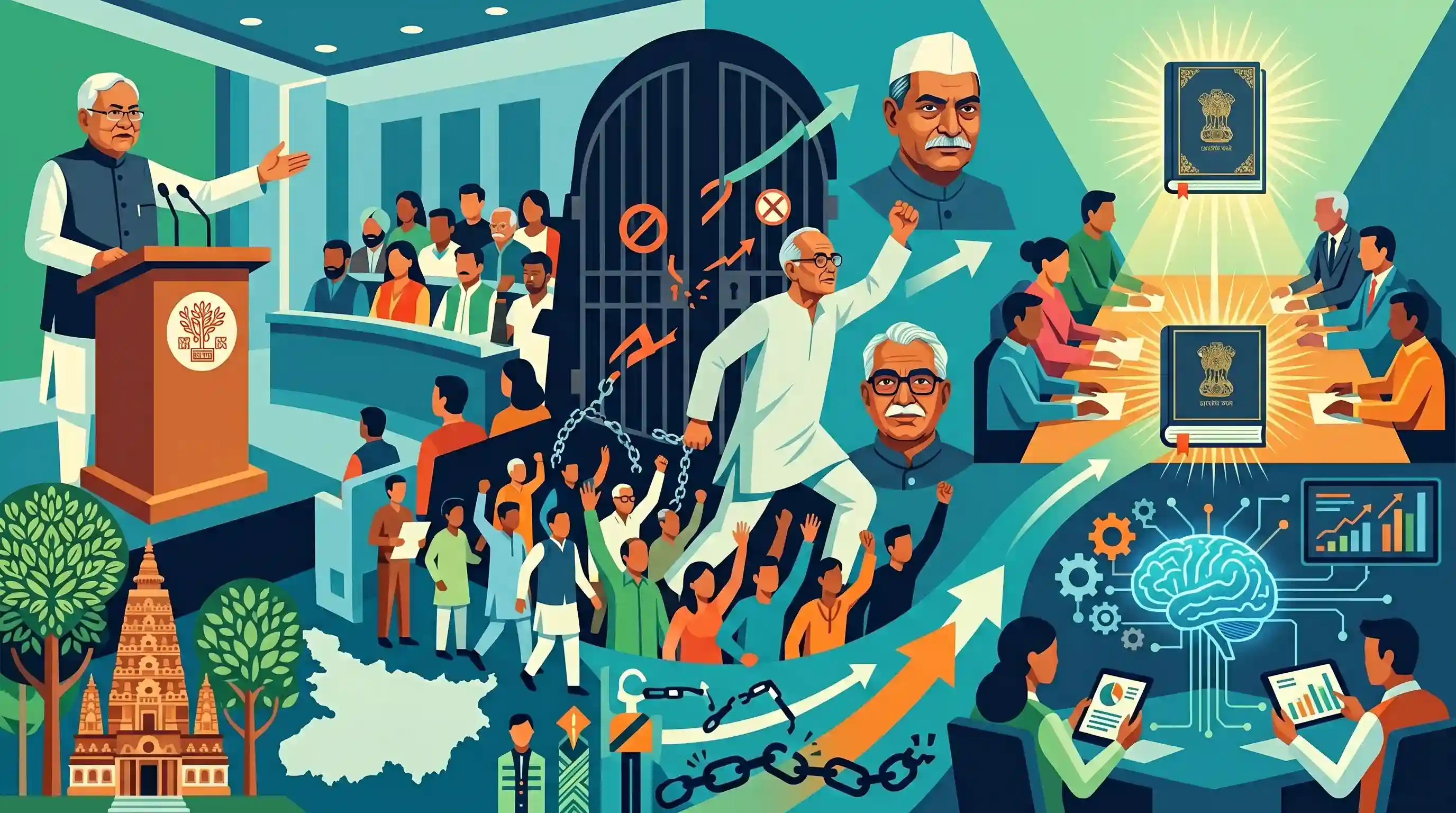
Vice President C.P. Radhakrishnan addressed the inaugural session of a two-day orientation program for Bihar legislators in Gayaji (Gaya). He lauded Bihar's unparalleled contributions to Indian democracy, labeling its opposition to the 1975–1977 National Emergency as a 'second independence movement.' Recalling his participation in the historic Jayaprakash Narayan (JP) Movement, he paid homage to Bihar's stalwarts like Dr. Rajendra Prasad and Karpoori Thakur. He advised MLAs to serve collectively beyond partisan lines, treat the Constitution as their ultimate guide, and integrate modern technologies like AI into legislative proceedings.
Key Points
- Vice President C.P. Radhakrishnan inaugurated a two-day orientation programme for Bihar MLAs in Gayaji (Gaya) district, emphasizing the state's historical and democratic significance.
- He highlighted that Bihar spearheaded the 'second independence movement' during the National Emergency, which was imposed under Article 352 from June 25, 1975, to March 21, 1977.
- The Vice President recalled how his own political journey was deeply shaped by his participation in the Jayaprakash Narayan (JP) Movement during his college days.
- The address paid tribute to iconic figures of Bihar who fought for the impoverished, including Dr. Rajendra Prasad, Jayaprakash Narayan (Lok Nayak), and Karpoori Thakur (Jan Nayak).
- He urged the newly elected legislators to transcend party differences post-elections, use the Constitution as a unified guide, and keep pace with modern digital advancements like Artificial Intelligence (AI) to enhance legislative output.
Important Terms
Article 352 of the Indian Constitution

A constitutional provision empowering the President to declare a National Emergency when India's security is threatened by war, external aggression, or armed rebellion.
UPSC context
GS Paper II (Polity & Constitution); tests national emergency provisions, federal dynamics, and safeguards against executive overreach.
44th Constitutional Amendment Act, 1978
A landmark amendment enacted in 1978 to reverse authoritarian changes of the 1975-77 Emergency, strengthen civil liberties, and make the Right to Property a legal right.
UPSC context
GS Paper II (Polity); tests critical constitutional amendments, emergency safeguards, and civil rights protections.
Bihar Legislative Assembly
The lower house of Bihar’s bicameral state legislature, originally established in 1937 and currently comprising 243 directly elected members.
UPSC context
GS Paper II (State Legislature); tests structure, election dynamics, and historical evolution of state legislative bodies.
Bihar Socialist Party
A political group formed in 1931 by Ganga Sharan Sinha, Phulan Prasad Varma, and JP Narayan to propagate Marxist-Leninist and socialist ideologies.
UPSC context
GS Paper I (Modern History); tests regional national movements, development of left-wing ideologies, and peasant mobilization.
Congress Socialist Party
A left-wing caucus founded within the Indian National Congress in 1934 by Acharya Narendra Deva and JP Narayan to advocate for worker-peasant interests.
UPSC context
GS Paper I (Modern History); tests ideological factions within the national movement and roles of prominent socialist leaders.
Prelims Trap
The Congress Socialist Party (1934) was formally founded in Patna with Jayaprakash Narayan as its President.
Acharya Narendra Dev was the President, whereas JP Narayan was the General Secretary. UPSC often swaps these leadership roles in modern history.
Static Concepts Connected
What were the major changes made to Article 352 (National Emergency) by the 44th Amendment Act?
- Grounds modification: Replaced 'internal disturbance' with 'armed rebellion' to limit executive discretion.
- Written recommendation: Mandated that the President can only act on the written advice of the entire Cabinet.
- Special majority: Altered the parliamentary approval threshold from a simple majority to a strict special majority.
What was the 1978 'Karpoori Thakur Formula' and its significance?
- Layered allocation: Split Bihar's 26% quota among EBCs, backward classes, women, and the poor among upper castes.
- Mandal precursor: Served as a direct structural and political blueprint for the nation-wide Mandal Commission recommendations.
- Economic blending: Pioneered the integration of economic criteria within caste-based affirmative action frameworks.
Cross-Topic Patterns
Socialist origins of Indian affirmative action
Connects 1970s socialist mobilization under Karpoori Thakur to the modern evolution of Article 15 and 16 quota politics and federal power-sharing.
Quit India and Underground Resistance
Links JP Narayan’s 1942 Hazaribagh jailbreak and Azad Dasta movement to GS-1 questions on underground revolutionary networks during the Quit India struggle.

Post-1977 modifications to Article 352 coupled with the 1930s Congress Socialist Party leadership roles remain a highly probable 2026 MCQ zone.
Linked PYQs · 5
Linked PYQs · 5
- 2020BPSC_PRELIMSGS1
Which title was given to Jayaprakash Narayan?
- 2022BPSC_PRELIMSGS1
During Quit India Movement, who among the following escaped from the Hazaribagh Jail?
- 2017BPSC_PRELIMSGS1
Bihar Socialist Party was born in 1934 with its secretary
- 2022BPSC_PRELIMSGS1
Who had formed the Bihar Socialist Party in 1931 AD?
- 2024-IBPSC_PRELIMSGS1
Which Article of the Indian Constitution deals with the proclamation of Emergency?
