Bihar sugarcane nursery scheme and subsidy for farmers
Source:chinimandi ↗
Why It Matters
BPSC Prelims frequently tests state agricultural initiatives, schemes supporting rural entrepreneurs/Self-Help Groups like Jeevika, and key cash crops like sugarcane. This nursery scheme targets high-tech agronomy (Single Bud Plantlets) and major subsidies, which are classic areas of examination interest.
Summary
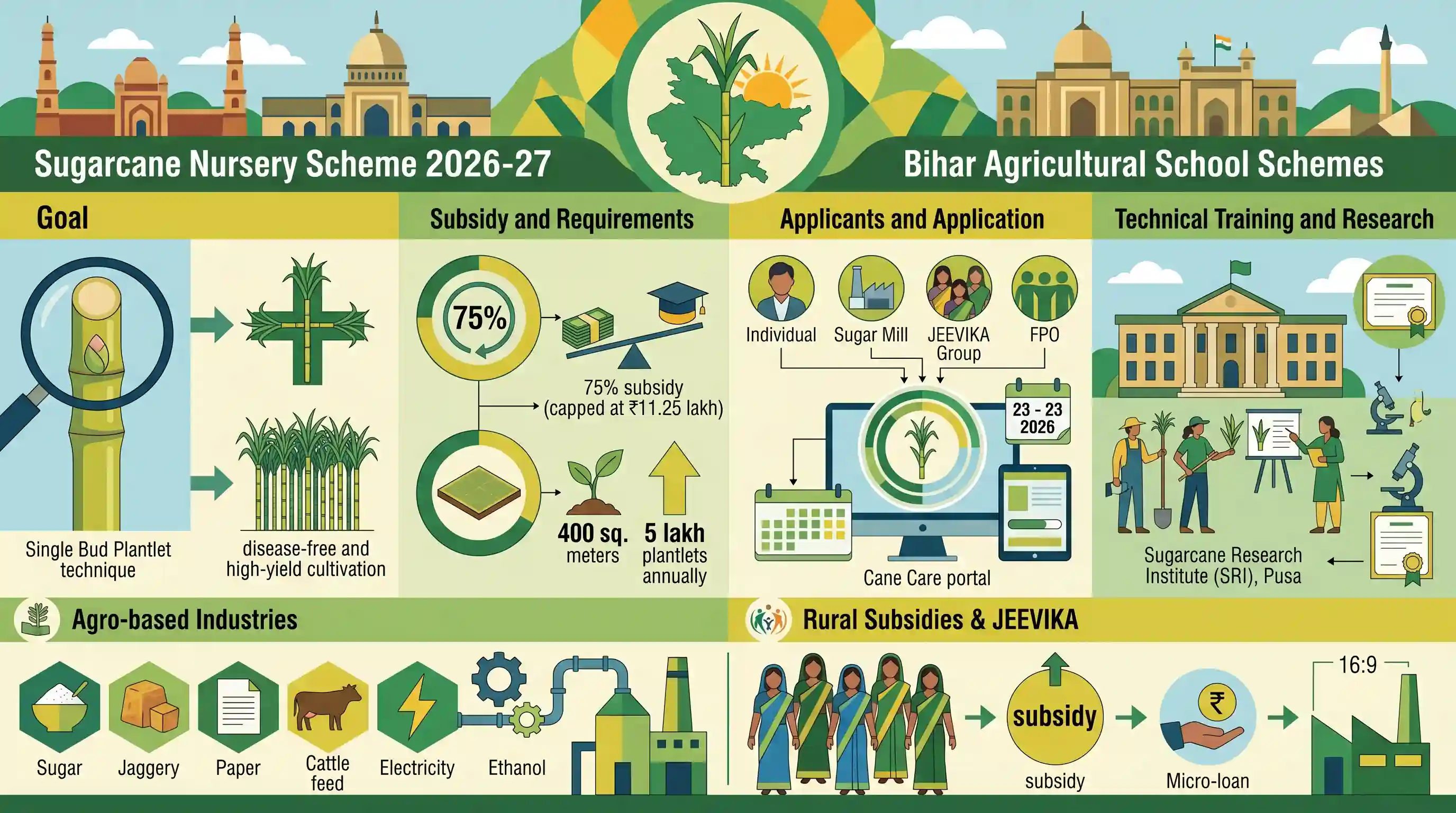
The Sugarcane Industry Department of the Bihar Government has introduced the 'Sugarcane Nursery Scheme 2026-27' to promote disease-free and high-yield sugarcane cultivation using the modern Single Bud Plantlets technique. The scheme provides up to 75% subsidy (capped at ₹11.25 lakh per nursery unit) and is highly accessible as it requires only 400 sq. meters of land to generate 5 lakh plantlets annually. Applications are open to individuals, sugar mills, Jeevika groups, and FPOs on the Cane Care portal from June 23 to July 23, 2026, with technical training anchored at the Sugarcane Research Institute (SRI), Pusa.
Key Points
- Bihar Government's Sugarcane Industry Department launched the 'Sugarcane Nursery Scheme 2026-27' to increase quality planting material.
- The scheme provides up to a 75% subsidy, with a maximum cap of ₹11.25 lakh per unit, distributed in three phases.
- Nurseries will use the modern Single Bud Plantlets technique, allowing high-efficiency production on a small footprint.
- A modern nursery requires only 400 square meters of land and can produce up to 5 lakh single bud plantlets annually.
- Eligible groups include individual landholders, successor farmers, jaggery entrepreneurs, sugar mills, Jeevika groups, SHGs, and FPOs.
- Applications are online via the Cane Care portal from June 23 to July 23, 2026.
- Selected beneficiaries will receive training at the Sugarcane Research Institute (SRI) located in Pusa, Bihar.
Important Terms
Sugarcane Nursery Scheme

A Bihar government initiative (2026–27) providing up to 75% subsidy to set up modern sugarcane nurseries using the Single Bud Plantlets technique to supply high-quality, disease-free seed material.
UPSC context
GS Paper III (Agriculture): Tests state agricultural policies, crop technology adoption, and rural entrepreneurship.
Jeevika
A World Bank-assisted poverty alleviation project in Bihar that empowers rural women by organizing them into Self-Help Groups (SHGs) for financial inclusion and sustainable livelihood development.
UPSC context
GS Paper II & III (Social Justice, Development): Evaluates rural livelihood frameworks and institutional self-help mechanisms.
Farmer Producer Organisations (FPOs)
Collectives of primary producers (farmers, artisans) registered under corporate or cooperative laws, aimed at leveraging economies of scale for better access to inputs, finance, and market bargaining power.
UPSC context
GS Paper III (Agriculture): Essential for addressing land fragmentation and cooperative-led agrarian reforms.
Sugarcane Research Institute (SRI), Pusa
A historical sugarcane research station in Samastipur, Bihar (under RPCAU) specializing in crop breeding, climate-resilient varieties, jaggery research, and technical training for farmers.
UPSC context
GS Paper III (Agriculture): Relevance of agricultural research, technology transfer, and institutional support systems.
Prelims Trap
The Sustainable Sugarcane Initiative (SSI) or nursery-based transplanting completely excludes the application of chemical/inorganic fertilizers.
SSI optimizes input efficiency but does not prohibit chemical fertilizers; it combines organic and inorganic nutrients to maximize yield with lower seed and water inputs.
Static Concepts Connected
What are the core features of the Sustainable Sugarcane Initiative (SSI)?
- Seed saving: Uses single-bud or bud-chip nursery seedlings to reduce seed requirement by 75-80% compared to conventional direct planting.
- Water efficiency: Encourages wide row-spacing and drip irrigation, reducing water consumption by 40-50% while promoting intercropping.
- Nutrient usage: Optimizes resource application by integrating organic manure with chemical fertilizers rather than completely banning inorganic inputs.
What is the historical origin of the IARI (Pusa Institute)?
- Curzon's initiative: Founded in 1905 at Pusa, Bihar, as the Agricultural Research Institute under Lord Curzon's viceroyalty, funded partly by philanthropist Henry Phipps.
- Relocation to Delhi: Following a massive earthquake in Bihar in 1934, the institute was officially relocated to New Delhi in 1936, retaining the historical name 'Pusa'.
Cross-Topic Patterns
Crop-tech + Ground-water conservation
Shifting to single-bud nursery transplanting reduces early-stage field flooding, showing how micro-level state crop schemes align with national groundwater conservation missions.
Institutional history + Modern extension
Connecting British-era research infrastructure (Pusa SRI) to decentralized 21st-century extension models like Jeevika SHGs and FPOs for technology transfer.

Prelims 2026 may link the historical 1905 Pusa agricultural institute with modern Sustainable Sugarcane Initiative (SSI) technology.
Linked PYQs · 3
Linked PYQs · 3
- 2025BPSC_PRELIMSGS1
Which of the following is a Kharif crop?
- 2023BPSC_PRELIMSGS1
Which food industry dominates among the agro-based industries in Bihar?
- 2024-EBPSC_PRELIMSGS1
What is the contribution of agriculture in the Gross Domestic Product (GDP) of Bihar?
