Bihar Launches Khet Bachao Abhiyan to Counter El Nino
Source:uni-india ↗
Why It Matters
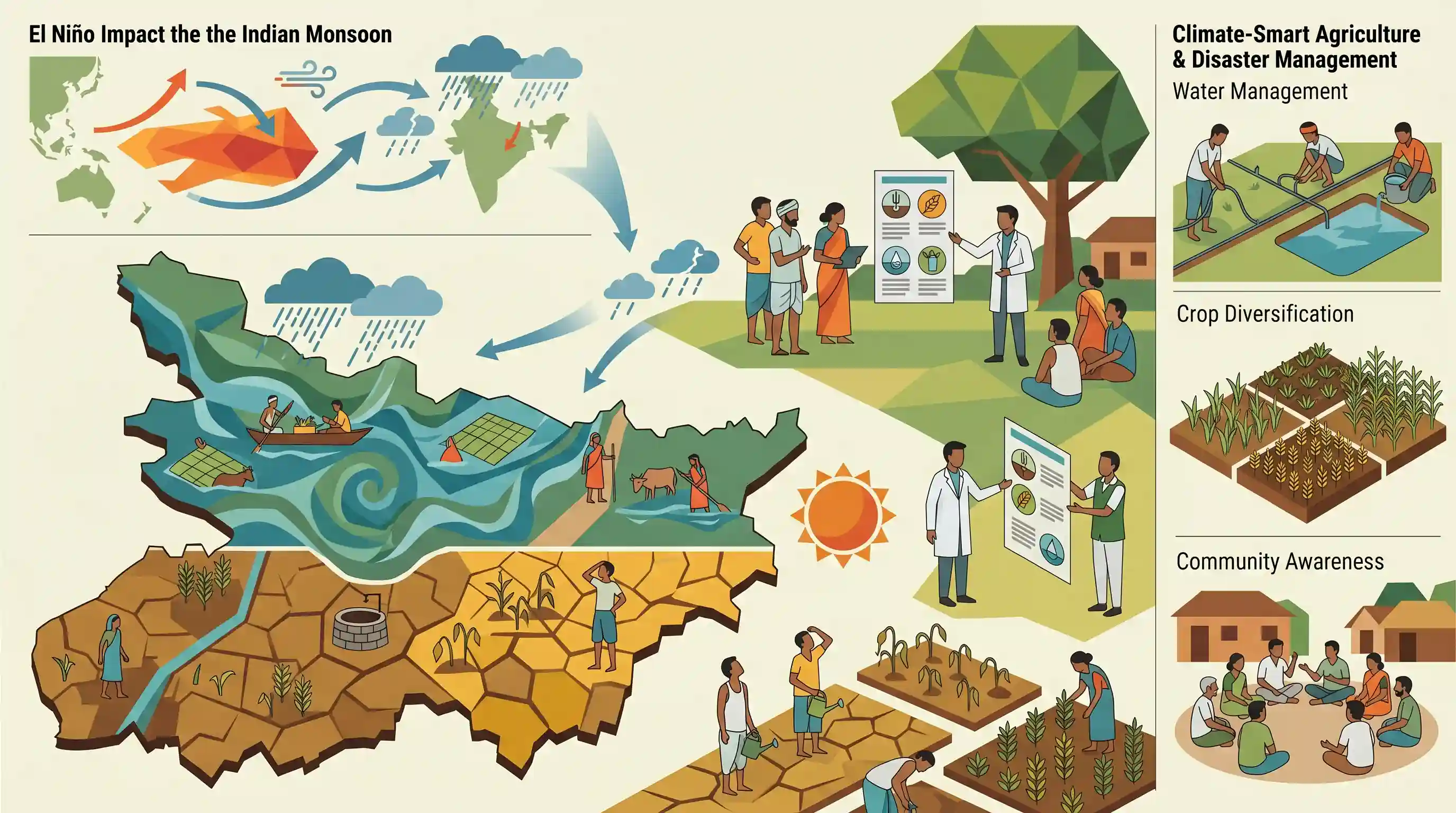
Understanding Bihar's regional climate vulnerability (North Bihar floods vs. South Bihar drought), the high density of smallholder farmers (90%), and active state-level mitigation campaigns like 'Khet Bachao Abhiyan' is crucial for questions on regional geography, state-specific disaster mitigation, and agricultural economics in Bihar PSC exams.
Summary
Bihar Agriculture Minister Vijay Kumar Sinha announced the launch of 'Khet Bachao Abhiyan' (Save the Fields Campaign), a scientific strategy aimed at mitigating the adverse impacts of El Niño. With nearly 90% of Bihar's farmers categorized as small and marginal, the campaign focuses on building rural awareness. The initiative addresses Bihar's stark geographical division where North Bihar experiences regular flooding and South Bihar faces frequent droughts.
Key Points
- The Bihar government has launched the 'Khet Bachao Abhiyan' (Save the Fields Campaign) to spread scientific awareness among farmers to mitigate the potential impact of El Niño on agriculture.
- Bihar's Agriculture Minister, Vijay Kumar Sinha, highlighted that nearly 90% of farmers in Bihar are small and marginal, making them highly vulnerable to climate anomalies.
- The state faces dual geographical challenges: North Bihar is prone to recurring annual floods, while South Bihar frequently suffers from severe drought, requiring targeted mitigation strategies.
- The initiative was reviewed during a high-level video conference convened by the Union Ministry of Agriculture and Farmers' Welfare to coordinate state and central efforts on climate-resilient agriculture.
Important Terms
Khet Bachao Abhiyan

A campaign launched in Bihar to protect soil health, reduce chemical fertilizers, promote natural farming, and implement contingency crop plans to mitigate drought/El Niño risks.
UPSC context
GS Paper III (Agriculture). Tests knowledge of regional climate adaptation strategies, soil conservation, and sustainable farming.
El Niño
A climatic phenomenon involving the warming of equatorial Pacific waters, which typically disrupts the Indian monsoon, leading to deficient rainfall and agricultural drought.
UPSC context
GS Paper I (Climatology) & III (Agriculture). Tests understanding of atmospheric-oceanic phenomena and their impact on monsoon-dependent farming.
Climate-Smart Agriculture
An approach to transforming agricultural systems to sustainably increase productivity, enhance resilience (adaptation) to climate change, and reduce greenhouse gas emissions.
UPSC context
GS Paper III (Environmental & Agri-Technology). Tests understanding of adaptation strategies for sustainable food security.
Small and Marginal Farmers
Cultivators possessing less than two hectares of agricultural land, who represent the vast majority of India’s farming community and face high vulnerability to climate shocks.
UPSC context
GS Paper III (Indian Economy & Agriculture). Tests understanding of demographic vulnerabilities, land fragmentation, and targeted social welfare schemes.
Direct Benefit Transfer (DBT)
A governance reform mechanism that transfers subsidies, disaster relief, and financial incentives directly into beneficiaries' bank accounts, reducing leakages and delays.
UPSC context
GS Paper II & III (Governance & Subsidies). Tests knowledge of technology-driven welfare delivery and leakages mitigation.
Union Ministry of Agriculture and Farmers' Welfare
The central ministry responsible for formulating policies, administering national agricultural schemes, and coordinating central-state initiatives to enhance crop productivity and farmers' income.
UPSC context
GS Paper II (Government Policies). Tests institutional knowledge of federal ministries managing primary sector development.
Prelims Trap
Khet Bachao Abhiyan is a state-specific scheme designed and launched solely by the Government of Bihar for drought relief.
While Bihar integrated it with El Niño drought mitigation, Khet Bachao Abhiyan is actually a national, month-long outreach campaign launched by the Union Ministry of Agriculture and ICAR.
Static Concepts Connected
What is Direct Seeded Rice (DSR) and how does it conserve resources?
- Bypasses transplanting: Seeds are sown directly into the field, completely skipping the labor-intensive nursery raising and manual transplanting stages.
- Water conservation: Saves 15-20% irrigation water by eliminating the pre-sowing continuous flooding (puddling) requirement.
- Methane reduction: Aerobic soil conditions in the early growth stages reduce anaerobic methanogenesis, significantly lowering methane emissions.
How is Bihar classified under India's Agro-Climatic Zones and Köppen's system?
- National Zone: Falls under Zone IV (Middle Gangetic Plains Region) of the Planning Commission's 15 agro-climatic zones of India.
- Köppen Class: Predominantly classified as Cwa (Humid Subtropical Climate with dry, mild winters and hot summers).
- Intra-state divide: Divided into North-West (Zone I), North-East (Zone II), and South Bihar (Zone III) which is highly drought-prone.
Cross-Topic Patterns
Monsoon anomalies + Smallholder vulnerability
Extreme land fragmentation (0.39 ha average in Bihar) limits private capital for deep tube-wells, making smallholders highly dependent on state-led El Niño contingency distributions.
Climate adaptation + Crop diversification
Transitioning from water-guzzling long-duration paddy to short-duration seeds (Turanta, Prabhat) and millets represents a critical shift toward climate-resilient cropping patterns.

Direct Seeded Rice mechanics, Köppen's Cwa classification, and the vulnerability of <1 ha farms will likely merge into a 2026 question.
Linked PYQs · 3
Linked PYQs · 3
- 2025BPSC_PRELIMSGS1
Most of the Bihar comes under which of the following climate type?
- 2024-EBPSC_PRELIMSGS1
What is the contribution of agriculture in the Gross Domestic Product (GDP) of Bihar?
- 2022BPSC_PRELIMSGS1
Which agroclimatic region of Bihar has the highest number of districts?
