Bihar Launches Drive to Revive Cooperative Sugar Mills
Source:chinimandi ↗
Why It Matters
BPSC frequently asks detailed, state-specific questions regarding agro-based industries, cooperative initiatives, and geographic distributions of cash crops like sugarcane. The specific membership criteria (land size, age, family limit) and location details of these historic mills in Mithilanchal are highly relevant for state services exams.
Summary
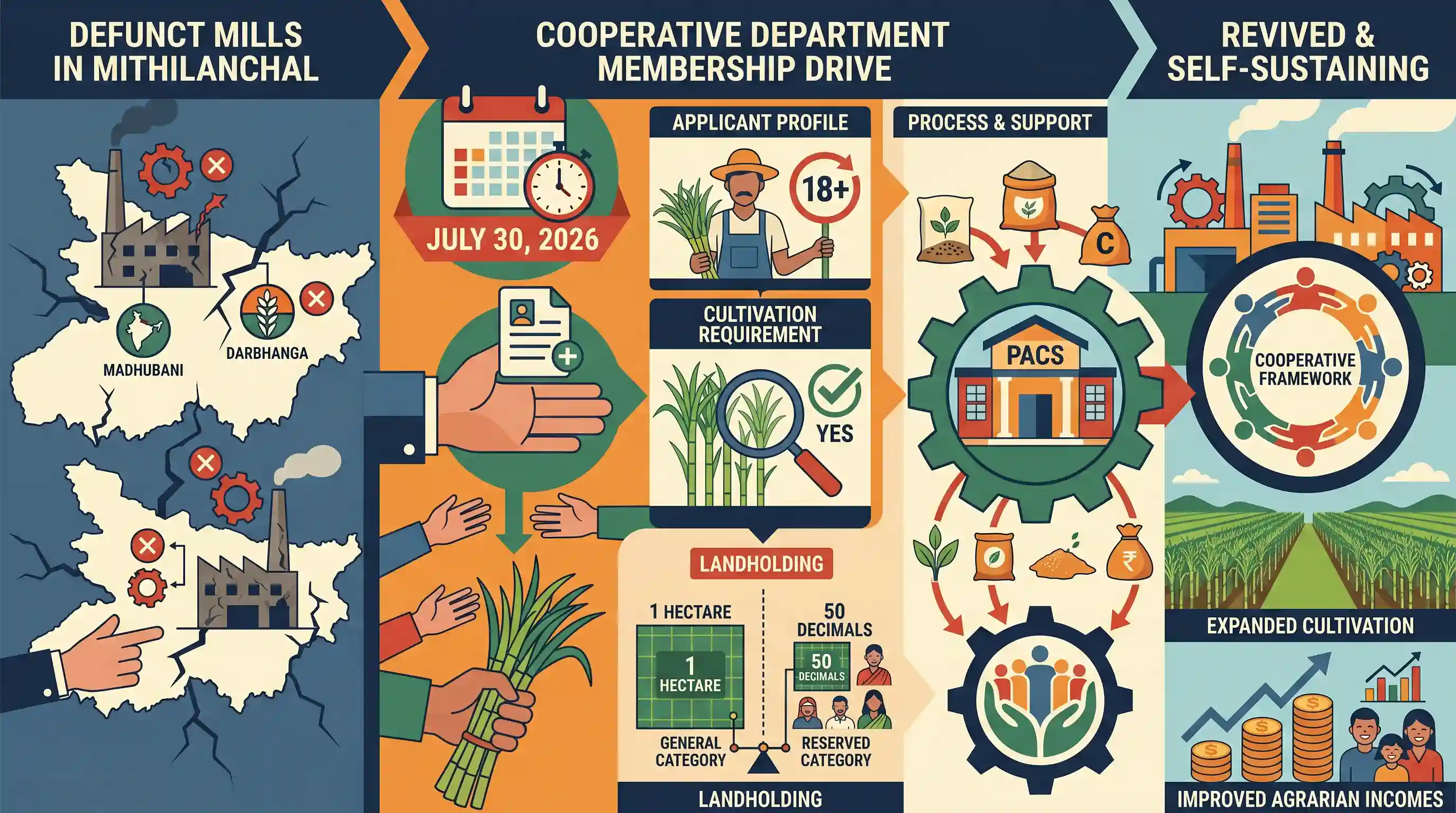
The Bihar government's Cooperative Department has initiated a membership drive until July 30, 2026, to revive the defunct Sakri (Madhubani) and Raiyam (Darbhanga) cooperative sugar mills in the Mithilanchal region. Eligible farmers (minimum age 18) must cultivate sugarcane, with general category members owning at least 1 hectare and reserved category members owning at least 50 decimals of land. The drive aims to foster a self-sustaining cooperative framework, expand sugarcane cultivation, and improve agrarian incomes via PACS support.
Key Points
- The Bihar government has launched a membership drive to revive the long-defunct Sakri sugar mill in Madhubani and Raiyam sugar mill in Darbhanga under a cooperative model.
- The membership drive is open to sugarcane farmers in the command areas of these proposed cooperative mills until July 30, 2026.
- Eligibility criteria for membership: Applicants must be at least 18 years old, reside in the command area, and commit to cultivating sugarcane over the next two crushing seasons.
- Landholding requirement: General category farmers must own a minimum of 1 hectare (approximately 2.5 acres) of land, while reserved category farmers must own at least 50 decimals of agricultural land.
- Only one member per family is allowed to join, and applications can be processed online or offline via Primary Agricultural Credit Societies (PACS) and block-level committees.
- The initiative aims to create a farmer database, boost sugarcane production, distribute high-quality seeds/fertilizers, and generate employment in the Mithilanchal region.
Important Terms
Primary Agricultural Credit Society (PACS)

Grassroots-level cooperative credit institutions in India that provide short-term and medium-term agricultural loans, input distribution, and marketing facilities directly to rural farmers at the village level.
UPSC context
GS Paper III: Agricultural credit, financial inclusion, and cooperative institutions. Tests understanding of rural banking structures.
National Federation of Cooperative Sugar Factories (NFCSF)
The apex national-level body established in 1960 to represent, advocate for, and provide techno-commercial and advisory services to cooperative sugar mills across India, registered under the Multi-State Cooperative Societies Act.
UPSC context
GS Paper III: Agro-based industries, cooperative sector, and agricultural marketing. Tests knowledge of institutional bodies in India.
Saat Nischay-3
The third phase (2025–2030) of Bihar's flagship Seven Resolves development framework, focusing on double employment, income, industrial growth (including sugar mill revival), agricultural progress, healthcare, and education.
UPSC context
GS Paper II: Governance, state-led welfare delivery, and sub-national development planning. Tests policy frameworks.
Cooperative Sugar Mills
Sugar-processing factories owned, financed, and operated democratically by local sugarcane-cultivating farmers themselves, which help ensure fair pricing and share profits from bioenergy and sugar production.
UPSC context
GS Paper III: Land reforms, cooperatives, and food processing industries. Tests cooperative models in Indian agriculture.
Bihar Cooperative Department
The state government department in Bihar responsible for registering, regulating, and empowering cooperative societies, PACS, and implementing state-driven cooperative industrial revivals like sugar mills.
UPSC context
GS Paper II & III: State governance, cooperative institutions, and agricultural development. Tests decentralized planning.
Prelims Trap
The Fair and Remunerative Price (FRP) of sugarcane is determined and announced directly by individual state governments like Bihar.
The Central Government's Cabinet Committee on Economic Affairs (CCEA) determines the FRP, while state governments can only declare a State Advised Price (SAP).
Static Concepts Connected
What constitutional status and rights do cooperative societies hold in India?
- Fundamental Right: The 97th Constitutional Amendment Act, 2011, made the right to form cooperative societies a fundamental right under Article 19(1)(c).
- DPSP Directive: Article 43B was added to the DPSPs, directing the State to promote voluntary formation, autonomous functioning, democratic control, and professional management of cooperatives.
- Part IXB insertion: Introduced Part IXB to the Constitution, containing provisions for the incorporation, terms of members, and audit of cooperative societies.
How is sugarcane priced and what are its ideal growth conditions in India?
- Agro-climatic profile: Requires hot and humid climate, 21°C–27°C temperature, and 75–100 cm rainfall; grown in both tropical (South) and sub-tropical (North) regions.
- Dual-pricing model: Center determines Fair and Remunerative Price (FRP) under Sugarcane (Control) Order 1966, while states can mandate a higher State Advised Price (SAP).
Cross-Topic Patterns
Sugar industry shift: North versus South
Bihar's declining sugar share highlights the geographic shift of Indian sugar mills to the South, driven by peninsular tropical climates yielding higher sucrose and longer crushing seasons.
PACS and rural credit formalization
Utilizing PACS for sugar mill membership drives aligns local cooperative revivals with national efforts to diversify primary societies into multi-purpose economic hubs.

A 2026 question may combine the geographical shift of India's sugar industry with the federal division of powers over cooperative societies.
Linked PYQs · 1
Linked PYQs · 1
- 2023BPSC_PRELIMSGS1
Which food industry dominates among the agro-based industries in Bihar?
