Bihar Mines Department to Recruit Khanan Sipahi to Stop Illegal Mining
Source:indian-masterminds ↗
Why It Matters
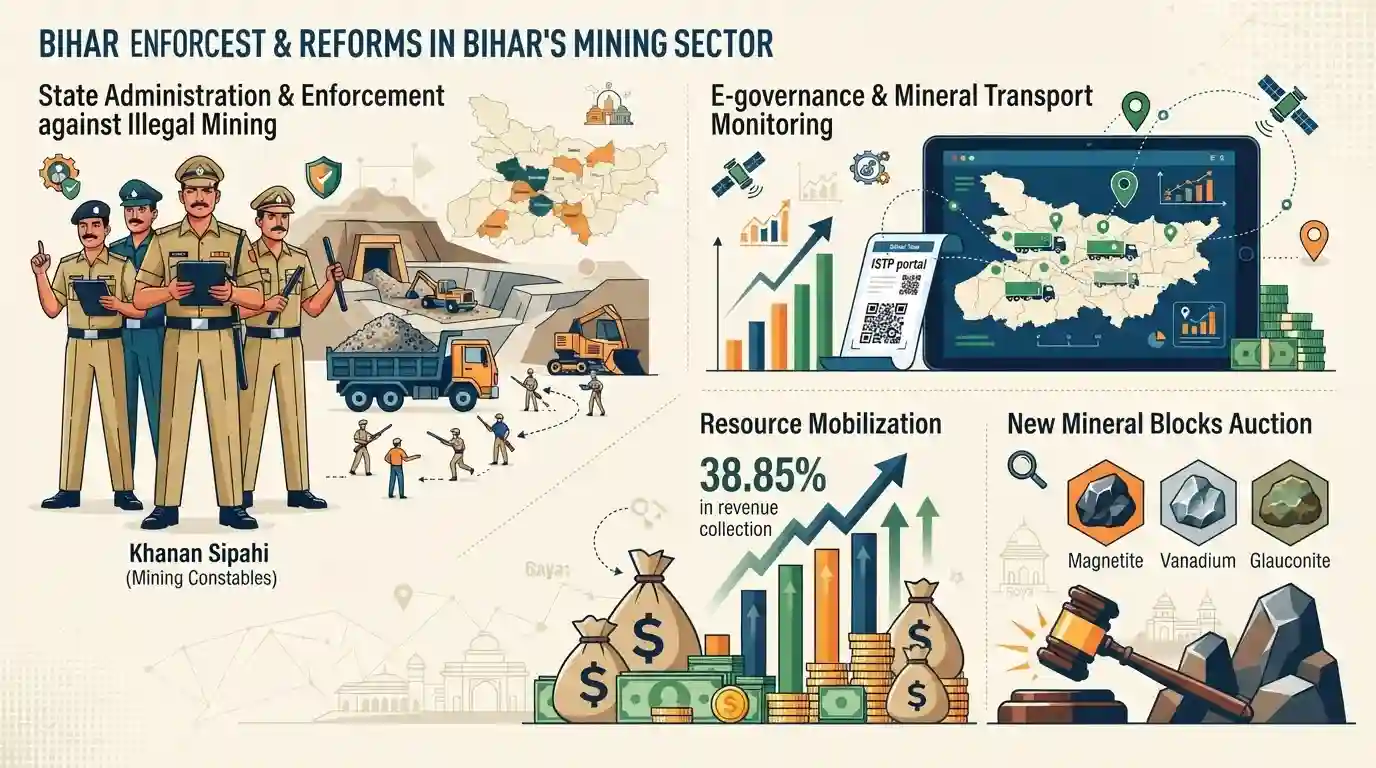
Highlights administrative reforms in Bihar (like dedicated mining constabularies and ISTP portal) to curb illegal resource extraction, while mapping the geological distribution of key minerals (magnetite, vanadium, glauconite, stone) vital for BPSC geography and economy sections.
Summary
The Bihar government has announced the recruitment of 1,000 'Khanan Sipahi' (Mining Constables) to bolster enforcement against illegal mining and reduce reliance on local police. Along with creating this specialized force, the state’s Mines and Geology Department is implementing digital reforms like the Inter-State Transit Pass (ISTP) portal for GPS monitoring of mineral transport. These measures correspond with a 38.85% jump in revenue collection and plans to auction new mineral blocks (magnetite, vanadium, glauconite) in districts like Gaya and Rohtas.
Key Points
- The Bihar government is recruiting a 1,000-strong dedicated force called 'Khanan Sipahi' (Mining Constables) to independently crack down on illegal mining without relying on local police.
- The state's Mines and Geology Department reported a 38.85% increase in revenue in the first four months of FY 2026-27, with a full-year target set at ₹5,000 crore.
- The Inter-State Transit Pass (ISTP) system was launched on June 10 to monitor mineral-laden vehicles, mandate GPS tracking, and check illegal mineral transport from neighboring states.
- New stone mining leases are being issued across Nawada, Aurangabad, Gaya, Sheikhpura, and Banka, alongside the auction of magnetite, vanadium, and glauconite blocks in Gaya and Rohtas.
- District Survey Reports (DSRs) are being formulated by district administrations to ensure scientific silt management and auctioning of silt extraction.
Important Terms
Khanan Sipahi (Mining Constables)

A dedicated enforcement force of mining constables recruited by the Bihar government to independently conduct raids against the illegal mining, storage, and transportation of minerals.
UPSC context
GS Paper 2 (State Administration) & GS Paper 3. Illustrates specialized capacity building for environmental protection and natural resource governance.
Inter-State Transit Pass (ISTP) Portal
An e-governance platform implemented by Bihar for issuing digital transit passes and tracking mineral transport vehicles via GPS, aimed at curbing illegal mining and boosting revenue.
UPSC context
GS Paper 2 (E-governance) & GS Paper 3 (Economy). Highlights technology's role in plugging revenue leakages and ensuring resource monitoring.
Magnetite, Vanadium, and Glauconite
Key critical and strategic mineral resources identified for auction in the Gaya and Rohtas districts of Bihar, expected to attract private investment and expand industrial revenue.
UPSC context
GS Paper 1 (Distribution of Key Natural Resources) & GS Paper 3 (Investment Models). Important for mapping state-wise mineral wealth.
Mines and Geology Department
The state authority responsible for mineral resource management, granting mining leases, auctioning blocks, and enforcing laws against illegal mining across Bihar.
UPSC context
GS Paper 2 (State Governance). Pertinent for understanding the institutional mechanisms governing natural resource mobilization and environmental compliance.
Prelims Trap
"The Central Government has exclusive rule-making power to regulate, auction, and curb illegal mining of minor minerals like sand and silt."
Under Section 15 of the MMDR Act, State Governments are empowered to frame rules for minor minerals, grant leases, and prevent illegal mining.
Static Concepts Connected
How does the MMDR Act distribute regulatory powers for minerals?
- Minor Minerals: State Governments have the power to frame rules, grant leases, and curb illegal mining for minor minerals (e.g., sand, silt, building stones).
- Major Minerals: The Central Government frames the regulatory rules for major minerals, though States conduct the auctions and collect the royalties based on Central guidelines.
What are the strategic applications of Vanadium and Glauconite?
- Vanadium: Crucial for high-strength steel alloys, aerospace components, and Vanadium Redox Flow Batteries (VRFB) for large-scale grid energy storage.
- Glauconite: A green, iron-potassium silicate mineral used as an indigenous source of potash for slow-release agricultural fertilizers, replacing imports.
Cross-Topic Patterns
Sand Mining + Environmental Guidelines
District Survey Reports (DSR) are mandated by MoEFCC's Sustainable Sand Mining Guidelines (2016) to assess river ecology and replenishment rates before auctioning silt or sand.
Critical Minerals + Import Substitution
Bihar’s auction of Glauconite blocks directly supports India's agricultural supply chain by developing indigenous potash sources, reducing vulnerability to global fertilizer supply shocks.

Prelims 2026 may feature a matching pair question on newly mapped state mineral reserves (Glauconite, Vanadium) and their applications.
Linked PYQs · 2
Linked PYQs · 2
- 2023BPSC_PRELIMSGS1
With reference to the mineral production in Bihar, consider the following statements: 1. Rohtas has the highest deposit of pyrites. 2. Limestone is found in Kaimur (Bhabhua), Munger (Monghyr) and Rohtas districts. 3. Gold deposits are found in Jamui district. Which of the statements given above is/are correct?
- 2022BPSC_PRELIMSGS1
Which district of Bihar has mica deposits?
