Bihar and Jharkhand Sign Historic MoU to Resolve Sone Water Dispute
Source:The Hindu ↗
Why It Matters
This resolution of the decades-long inter-state water dispute between Bihar and Jharkhand paves the way for vital irrigation and river-linking projects (like Sone-Falgu Link) in drought-prone South Bihar, which is highly relevant for both geographic and administrative dynamics tested in BPSC.
Summary
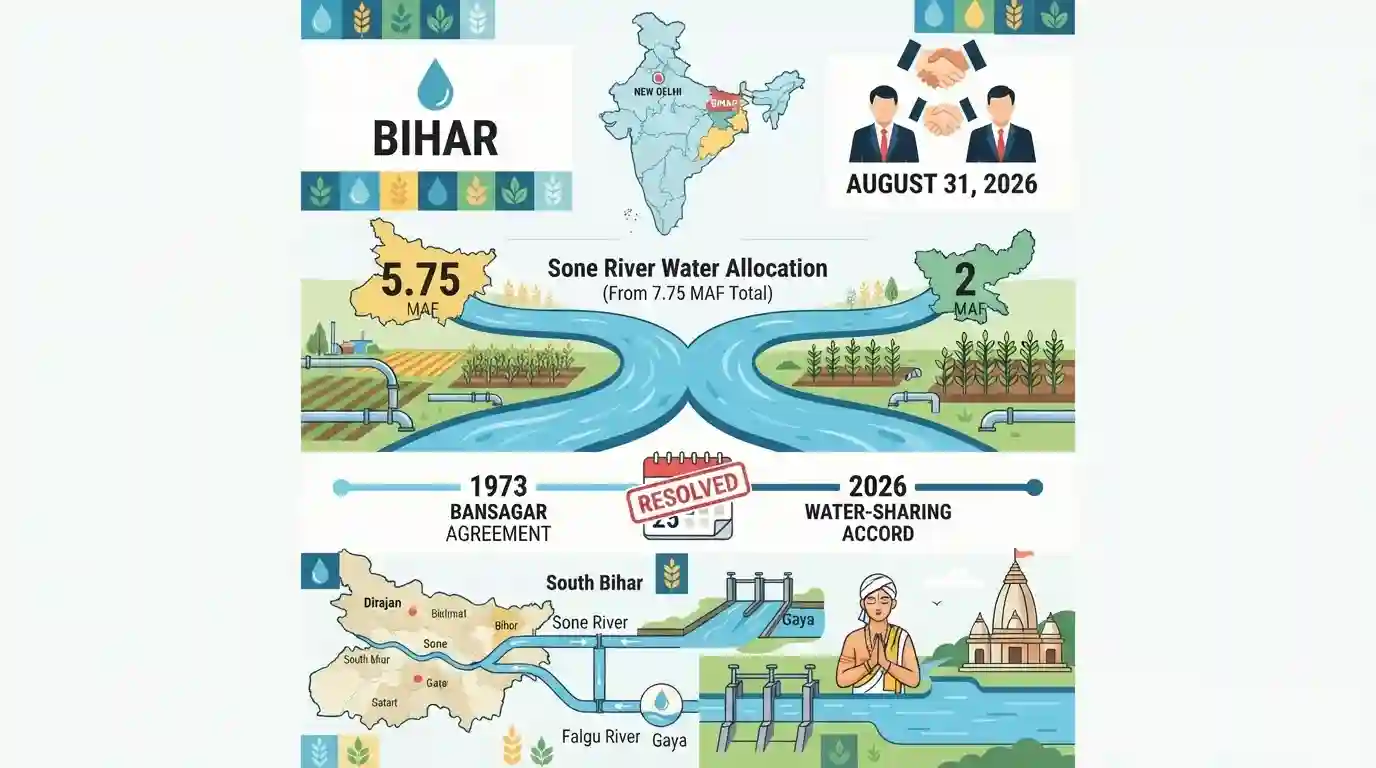
On August 31, 2026, Bihar and Jharkhand signed a landmark water-sharing agreement in New Delhi, resolving a 25-year-old dispute over the Sone River. Bihar has been allocated 5.75 million acre-feet (MAF) and Jharkhand has been allocated 2 MAF out of the 7.75 MAF allocated to undivided Bihar under the 1973 Bansagar Agreement. This agreement will enhance water security across several districts in South Bihar and Jharkhand and expedite key infrastructure initiatives like the Sone-Falgu River Link Project to support water availability for pilgrims in Gaya.
Key Points
- Bihar and Jharkhand signed a historic Memorandum of Understanding (MoU) on August 31, 2026, in New Delhi, permanently resolving a 25-year-old Sone river water dispute.
- Under the new agreement, Bihar is allocated 5.75 million acre-feet (MAF) and Jharkhand is allocated 2 MAF of water, dividing the 7.75 MAF originally allocated to undivided Bihar.
- The 1973 Bansagar Agreement originally distributed the Sone's total 14.25 MAF water among Madhya Pradesh (5.25 MAF), Uttar Pradesh (1.25 MAF), and undivided Bihar (7.75 MAF).
- The resolution will supply drinking, irrigation, and industrial water to eight South Bihar districts (Bhojpur, Buxar, Rohtas, Kaimur, Aurangabad, Arwal, Gaya, Patna) and Jharkhand districts like Palamu and Garhwa.
- The pact enables the proposed Sone-Falgu River Link Project, which aims to supply Sone river water to the sacred Falgu river in Gaya-ji, facilitating 'Tarpan' and 'Pind-daan' rituals during the annual Pitru Paksha fair.
- Geographical Significance: Sone river originates at Amarkantak (Maikal Range) and joins Ganga near Maner (Patna); Falgu river is formed by the confluence of Mohana and Lilajan (Niranjana) rivers near Bodh Gaya.
Important Terms
Sone River Water Sharing MoU (2026)

A bilateral agreement signed on August 31, 2026, resolving a 25-year water dispute. It distributes undivided Bihar's 7.75 MAF Sone River allocation, giving Bihar 5.75 MAF and Jharkhand 2 MAF.
UPSC context
GS Paper II (Polity/Geography); tests knowledge of cooperative federalism, interstate disputes, and water resource management.
1973 Bansagar Agreement
A tripartite agreement between Madhya Pradesh, Uttar Pradesh, and undivided Bihar that divided 14.25 MAF of Sone River water, allocating 7.75 MAF to undivided Bihar.
UPSC context
GS Paper II (Geography of India & Bihar); tests historical river accords and basin water allocations.
Sone-Falgu River Link Project
An intra-state river interlinking project in Bihar to divert Sone river water to the Falgu river using pipelines and canals, ensuring year-round water in drought-prone Gaya.
UPSC context
GS Paper II (Geography of Bihar); tests Bihar-specific river-linking projects and drought mitigation plans.
Indrapuri Reservoir Project
A proposed reservoir on the Sone River between Bihar and Jharkhand, previously stalled by water disputes, designed to stabilize irrigation through the extensive Sone canal system.
UPSC context
GS Paper II (Bihar Geography/Economy); tests infrastructure projects and irrigation canal stability in south Bihar.
Ministry of Jal Shakti
The Union government ministry formed in 2019 to integrate water resource management, resolve interstate river disputes, and oversee national river conservation and drinking water schemes.
UPSC context
GS Paper II (Indian Polity & Governance); tests institutional frameworks for federal water dispute resolutions.
Prelims Trap
The 1973 Bansagar Agreement was originally signed by four states: Madhya Pradesh, Uttar Pradesh, Bihar, and Jharkhand.
Jharkhand did not exist in 1973; the tripartite pact was signed by MP, UP, and undivided Bihar. Jharkhand's share was carved out only in 2026.
Static Concepts Connected
What are the key geographical features and tributaries of the Sone River?
- Origin and Course: Originates at Amarkantak (MP), flows through MP, UP, Jharkhand, and merges with the Ganga near Maner in Patna district.
- Major Tributaries: Key tributaries include the Rihand, North Koel, Gopad, Kanhar, and Johilla rivers.
- Historical Irrigation: Sone Canal System, built in 1874, is one of the oldest and largest canal systems in Bihar.
What is the origin and hydrological nature of the Falgu River?
- Confluence Origin: Formed near Bodh Gaya by the confluence of Mohana and Lilajan (Niranjana) rivers.
- Hydrological Nature: An ephemeral, seasonal river with a dry sandy bed, though water flows just beneath the surface.
- Cultural Rituals: Flows past sacred Gaya-ji, serving as the site for 'Pind-daan' and 'Tarpan' rituals during Pitru Paksha.
Cross-Topic Patterns
River Interlinking + Cultural Tourism
The Sone-Falgu link shows how engineering solutions address seasonal water scarcity in rain-fed rivers, directly securing religious tourism and local livelihood in Gaya-ji.
Water Federalism + Article 262
Resolving a 25-year dispute via center-mediated MoU showcases cooperative federalism, contrasting with prolonged tribunals typical under the Inter-State River Water Disputes Act.

Sone physical geography (origin, confluence) and the 2026 sharing formula (5.75 MAF to Bihar) likely to feature in a multi-statement Q.
Linked PYQs · 3
Linked PYQs · 3
- 2024-IBPSC_PRELIMSGS1
Amarkantak source place of Son river is situated at
- 2022BPSC_PRELIMSGS1
The confluence of the rivers Son and Ganga is located in which district of Bihar?
- 2023BPSC_PRELIMSGS1
Phalgu, a sacred river flowing in Bihar, is formed by the confluence of which of the following rivers?
