Bihar IT Industry Meet 2026 Highlights GCC Policy and Tech Investments
Source:indianmasterminds ↗
Why It Matters
Reflects Bihar's strategic shift to develop its service and tertiary sectors by establishing IT and tech hubs. It provides direct examples for GS Mains answers regarding industrialization, employment generation, and e-governance in Bihar, and forms fact-based current affairs questions for Prelims.
Summary
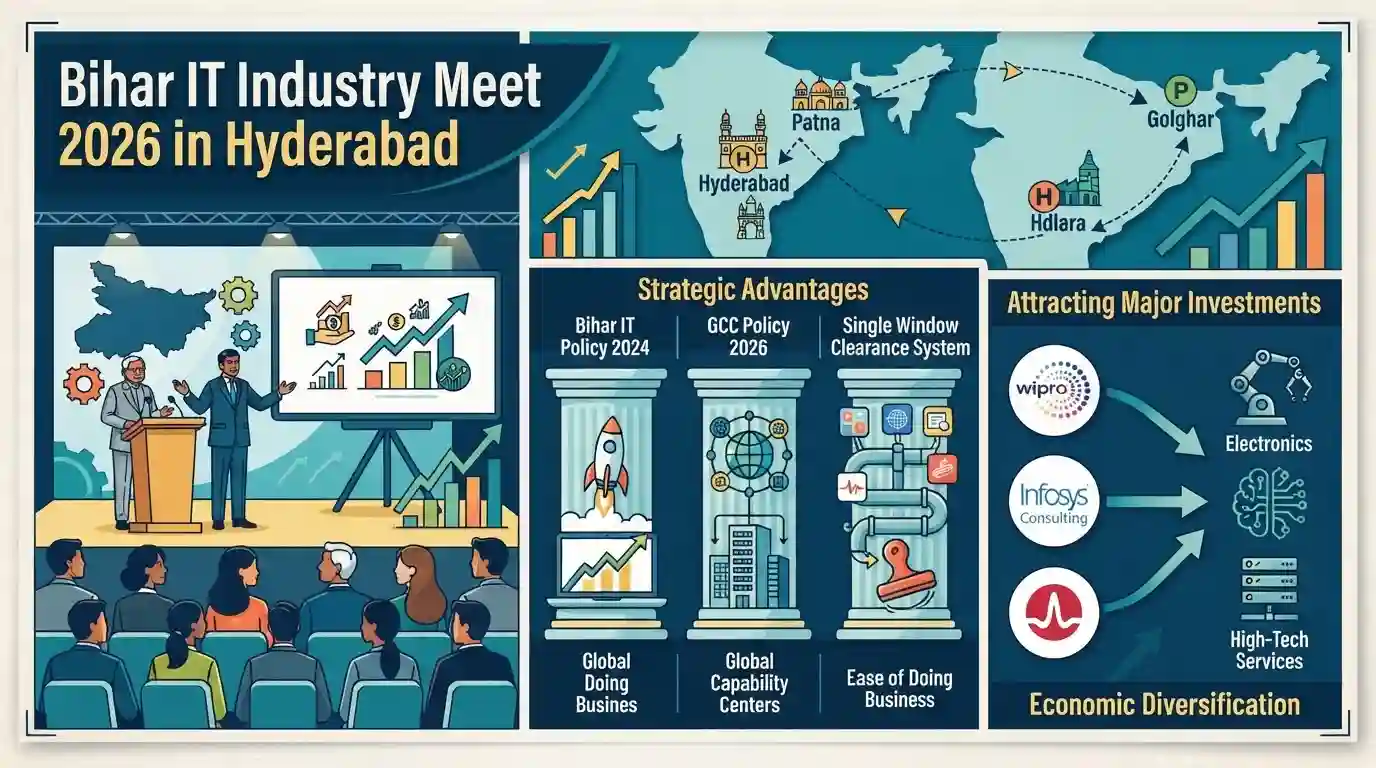
The Bihar government successfully hosted the 'Bihar IT Industry Meet 2026' in Hyderabad to showcase its potential as a prime destination for IT and Global Capability Centre (GCC) investments. Spearheaded by State IT Minister Nitish Mishra and IT Secretary Abhay Kumar Singh, the event highlighted the state's strategic advantages, including the Bihar IT Policy 2024, the GCC Policy 2026, and a robust Single Window Clearance System. The initiative attracted significant interest from major tech and consulting firms like Wipro, Infosys Consulting, and Broadcom, marking a significant step in diversifying Bihar's economy towards high-tech services, AI, and electronics.
Key Points
- The Bihar government organized the 'Bihar IT Industry Meet 2026' in Hyderabad to attract tech investments.
- The state showcased its proactive investment policies, notably the Bihar IT Policy 2024 and the Bihar Global Capability Centre (GCC) Policy 2026.
- Targeted investment sectors include IT, ITES, Artificial Intelligence (AI), Data Centres, Electronics, DeepTech, and Digital services.
- The event saw participation from top global tech firms, signaling Bihar's emerging status as a tech hub and its focus on improving the ease of doing business.
Important Terms
Bihar IT Policy 2024

A state framework to develop IT, ITeS, and ESDM sectors by offering 30% capital subsidies, interest subventions, and employment incentives, aiming to reverse brain drain and create localized tech ecosystems.
UPSC context
GS Paper 2 & 3. Tests knowledge of state-level industrial policies and their role in promoting regional economic growth and employment.
Bihar Global Capability Centre (GCC) Policy 2026
A strategic policy offering financial incentives, infrastructure support, and salary reimbursements to attract multinational firms to establish their offshore tech, AI, and R&D hubs in Bihar.
UPSC context
GS Paper 3 (IT Sector). Demonstrates India's evolving tech landscape and the decentralization of digital growth to Tier-2 eastern cities.
Single Window Clearance System
An ICT-enabled integrated platform mandated by the Bihar Industrial Investment Promotion Act, 2016. It ensures time-bound, multi-departmental approvals for investors within 30-45 days, effectively eliminating bureaucratic bottlenecks.
UPSC context
GS Paper 2 & 3. Tests understanding of e-governance reforms, transparency, and measures boosting the "Ease of Doing Business" for regional development.
Prelims Trap
Global Capability Centres (GCCs) are defined as third-party, multi-client outsourcing agencies that handle standard back-office tasks.
GCCs are fully-owned, captive centers of a single multinational company executing high-value strategic work, not third-party multi-client outsourcing agencies.
Static Concepts Connected
What are Global Capability Centres (GCCs) and how do they differ from BPOs?
- Ownership structure: GCCs are captive, 100% owned subsidiaries of a parent multinational corporation, unlike third-party BPO service providers.
- Value chain: GCCs focus on high-end strategic tasks like product engineering and AI, rather than basic back-office transactional operations.
How do state-level fiscal incentives address regional economic disparity?
- Investment diversion: Financial incentives like capital subsidies and EPF/ESI exemptions reduce entry barriers for companies in non-traditional industrial regions.
- Structural transition: They encourage agrarian or mineral-dependent states to transition directly to knowledge-based services, accelerating job creation.
Cross-Topic Patterns
GCCs and regional urban decentralization
The geographical spread of GCCs to Tier-2/3 states helps ease infrastructure pressure on Tier-1 tech hubs like Bengaluru and Hyderabad while building regional technical ecosystems.
Competitive federalism in industrial policy
States independently drafting targeted policies like the GCC Policy 2026 showcases how competitive federalism drives customized ease-of-doing-business reforms to attract private capital.

The structural evolution of GCCs from back-offices to R&D hubs and states' competitive policies to attract them will be a key GS-3 Mains theme.
Linked PYQs · 3
Linked PYQs · 3
- 2022BPSC_PRELIMSGS1
The 'Digital India Award, 2020' was given to the Bihar Government for
- 2024-EBPSC_PRELIMSGS1
Which sector received the highest allocation in the Bihar Budget 2024-25?
- 2022BPSC_PRELIMSGS1
The new ministry proposed in the Bihar Budget for the year 2021-22 focuses on
