Bihar IAS Reshuffle Impacts Key Departments and District Governance
Source:indianmasterminds ↗
Why It Matters
Understanding the framework of state-level bureaucratic transfers and the roles of key departments helps contextualize state administration, executive functions, and the practical aspects of governance under the Indian constitutional setup.
Summary
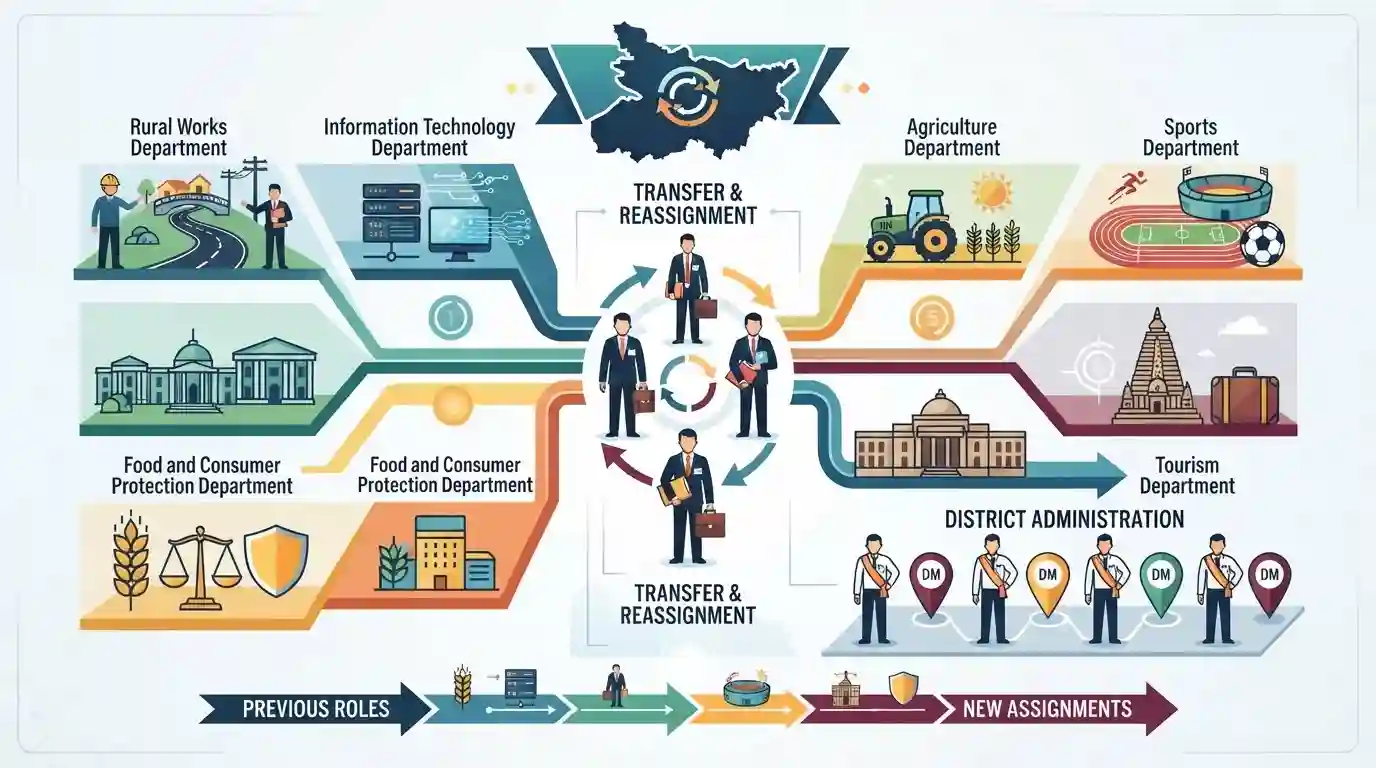
The Bihar government executed a significant administrative reshuffle, transferring and reassigning several senior IAS officers and District Magistrates. Key appointments include Abhay Kumar Singh to the Rural Works Department and Divesh Sehra to the Information Technology Department. The changes spanned various critical sectors such as Agriculture, Sports, Tourism, and Food and Consumer Protection, alongside the repositioning of DMs in multiple districts to streamline state governance and district administration.
Key Points
- The Bihar government carried out a major administrative reshuffle involving several senior IAS officers and District Magistrates (DMs).
- Abhay Kumar Singh was appointed Secretary of the Rural Works Department and Chairman of Bihar Rajya Pul Nirman Nigam.
- Divesh Sehra took over as Secretary of the Department of Information Technology with additional charge of Bihar State Tourism Development Corporation.
- Several other departments including Food and Consumer Protection, Agriculture, Sports, and Education witnessed key secretarial changes.
- Administrative heads of districts like Darbhanga, Saran, Rohtas, Bhagalpur, and Muzaffarpur were also transferred to optimize district administration.
Important Terms
Bihar State Tourism Development Corporation

A wholly-owned government company established in 1980 to develop and promote Bihar's tourism infrastructure, manage hospitality assets, and diversify tourism beyond religious circuits.
UPSC context
Relevant to GS Paper 3 (Economic Development). Tests knowledge of state PSUs' role in regional economic growth and employment generation.
Bihar Rajya Pul Nirman Nigam
A state-owned enterprise formed in 1975 to construct and maintain bridges and roads in Bihar. It is recognized for its successful financial turnaround and infrastructure expansion.
UPSC context
Important for GS Papers 2 and 3. Illustrates PSU reform, governance efficiency, and state-led infrastructure development.
Food and Consumer Protection Department
The state department managing one of India's largest Public Distribution Systems, ensuring food security, overseeing procurement at Minimum Support Prices, and digitizing essential supply chains.
UPSC context
Crucial for GS Papers 2 and 3. Tests understanding of food security, targeted PDS, and e-governance in welfare delivery.
Rural Works Department
A state government department dedicated to building and maintaining rural road infrastructure, primarily implementing the Pradhan Mantri Gram Sadak Yojana (PMGSY) and state-specific connectivity schemes.
UPSC context
Aligns with GS Paper 3 (Infrastructure and Rural Development). Evaluates the impact of rural connectivity on socio-economic development.
Department of Information Technology
The state department responsible for advancing e-governance, digital infrastructure, and IT investments, ensuring technological integration across administrative functions for better public service delivery.
UPSC context
Relates to GS Paper 2 (e-Governance) and GS Paper 3 (Technology). Tests digital transformation initiatives in state public administration.
State Administration
The sub-national executive framework managed by elected officials and civil servants. It implements public policy, manages district governance, and coordinates departmental functions.
UPSC context
Relevant to GS Paper 2 (Polity and Governance). Tests concepts of executive power, bureaucratic reshuffles, and the civil services' role.
Prelims Trap
The Civil Services Board (CSB) has the final binding authority to veto transfer orders of IAS officers.
The CSB acts as an advisory/recommendatory body. The ultimate decision-making power rests with the political executive, though deviations must be formally recorded.
Static Concepts Connected
What is the mandate and composition of the Civil Services Board (CSB) in states?
- Origin: Mandated by the Supreme Court in the landmark T.S.R. Subramanian v. Union of India (2013) ruling to reduce political interference.
- Composition: Headed by the state's Chief Secretary, with other senior bureaucrats serving as members.
- Key Function: Recommends transfers, postings, and minimum tenures for civil servants to the political executive.
What is the 'split system' in Indian administration?
- Definition: Refers to the strict separation between policy formulation (Secretariat) and policy execution (Directorates/Field agencies).
- Purpose: Ensures that policy-making is insulated from daily routine implementation, promoting division of labor and specialized focus.
Cross-Topic Patterns
Tenure security vs executive flexibility
Frequent administrative transfers challenge GS-2 themes of civil service neutrality, policy continuity, and the implementation of Second ARC recommendations on civil service reforms.
Digitizing treasury and financial management
Platforms like Bihar's CFMS represent GS-3 e-governance shifts, optimizing public spending and reducing rent-seeking behavior in state-level infrastructure projects.

Mains 2026 may evaluate the efficacy of state Civil Services Boards in ensuring tenure security vs political-executive friction.
Linked PYQs · 2
Linked PYQs · 2
- 2022BPSC_PRELIMSGS1
The 'split system' in the Indian administration relates to
- 2020BPSC_PRELIMSGS1
Bihar Government has introduced the Comprehensive Financial Management System (CFMS) on 1st April, 2019. This system
