Bihar Childhood Cancer Network Expands Across 38 Districts
Source:punjab-kesari ↗
Why It Matters
The development represents a significant step in regional public health infrastructure, specifically for non-communicable diseases (NCDs) like cancer among vulnerable populations (children). It holds immense relevance for BPSC Prelims state-specific current affairs and aligns with global WHO targets for health outcomes by 2030.
Summary
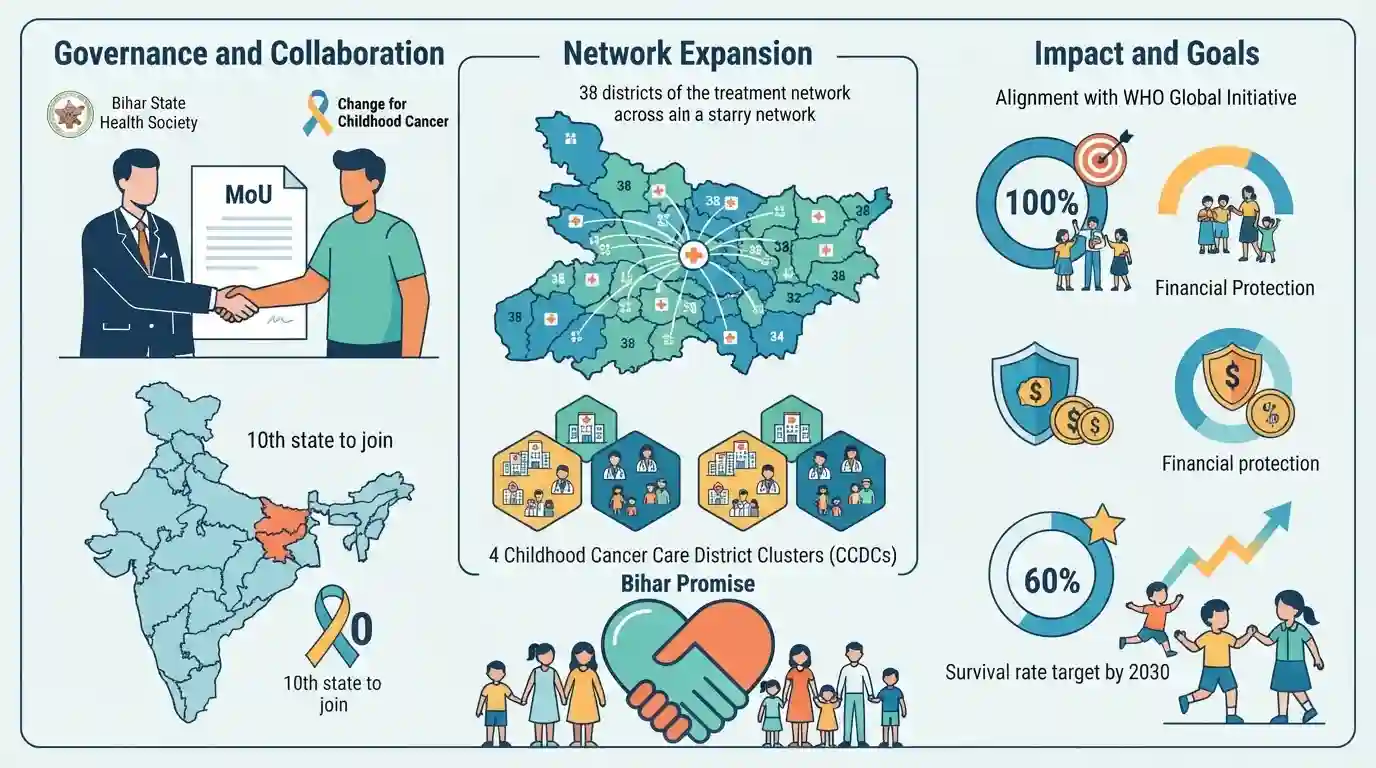
The Bihar government's State Health Society has signed a Memorandum of Understanding (MoU) with the 'Change for Childhood Cancer' initiative (Cankids) to expand and strengthen the childhood cancer treatment network across all 38 districts of the state. With this, Bihar becomes the 10th Indian state to establish an integrated pathway for detecting and treating childhood cancer. The collaboration aligns with the WHO Global Initiative for Childhood Cancer, targeting 100% access to care, complete financial protection, and a 60% survival rate by 2030. The initiative includes the operationalization of four Childhood Cancer Care District Clusters (CCDCs) and the affirmation of 'The Bihar Promise'.
Key Points
- The State Health Society, Bihar signed an MoU with Cankids to expand the childhood cancer treatment network across the state.
- Bihar becomes the 10th state in India to implement an integrated pathway for detecting and treating childhood cancer.
- The initiative covers Bihar's four Childhood Cancer Care District Clusters (CCDCs) and all 38 districts.
- The state aims to achieve 100% access to care, 100% financial protection, and a 60% survival rate by 2030, aligning with the WHO Global Initiative for Childhood Cancer.
- 'The Bihar Promise' was affirmed during the event held at Mahavir Cancer Sansthan in Patna.
Important Terms
WHO Global Initiative for Childhood Cancer

A 2018 global effort aiming to achieve at least a 60% survival rate for children with cancer by 2030, while minimizing suffering and promoting universal health coverage and financial protection.
UPSC context
GS Paper 2 (International Health Initiatives). Tests knowledge of WHO targets and strategies for tackling non-communicable diseases in children.
The Bihar Promise
A collective pledge by Bihar's government, medical experts, and civil society to build a coordinated system ensuring no child with cancer remains unfound, untreated, or financially unprotected in the state.
UPSC context
GS Paper 2 (Governance & Social Justice) and BPSC. Highlights multi-stakeholder commitments for equitable pediatric healthcare delivery.
Childhood Cancer Care District Clusters (CCDCs)
Decentralized healthcare hubs established to streamline the detection, referral, and shared treatment of childhood cancers. Bihar is operationalizing four such clusters to improve specialized local accessibility across its districts.
UPSC context
GS Paper 2 (Health Infrastructure). Tests understanding of decentralized, cluster-based healthcare models for specialized medical treatments.
Change for Childhood Cancer (Cankids)
A civil society initiative and expert network partnering with Indian state governments to establish integrated pathways for diagnosing, treating, and providing shared pediatric oncology care.
UPSC context
GS Paper 2 (Role of NGOs in Health). Important for analyzing civil society-government partnerships for specialized public health interventions.
State Health Society, Bihar
A state nodal agency responsible for implementing health missions. It recently signed an MoU to integrate and expand childhood cancer care networks across all 38 districts of Bihar.
UPSC context
GS Paper 2 (State Health Policies). Useful for state-specific administrative initiatives and BPSC examinations.
Prelims Trap
The WHO Global Initiative for Childhood Cancer targets a 100% survival rate globally by 2030.
The 100% target applies only to access and financial protection. The actual survival rate target is 60% by 2030, a classic numerical swap often used in UPSC statements.
Static Concepts Connected
What is India's national framework for Non-Communicable Diseases (NCDs)?
- Constitutional Mandate: Public health and sanitation fall under the State List (Entry 6), empowering individual states to execute specialized healthcare MoUs and district-level medical interventions.
- NP-NCD Framework: The National Programme for Prevention and Control of NCDs (NP-NCD) operates to establish district-level NCD clinics for cancer screening, early diagnosis, and management.
What are the basic cellular mechanisms underlying cancer biology?
- Oncogenes: Mutated forms of normal genes (proto-oncogenes) that drive uncontrolled cellular division and growth, acting like a permanently stuck accelerator in a cell's life cycle.
- Tumor Suppressor Genes: Normal genes that slow down cell division, repair DNA mistakes, or induce apoptosis (programmed cell death). Their inactivation allows tumors to grow unchecked.
Cross-Topic Patterns
NGOs in GS2 Health Governance
MoUs with specialized CSOs like Cankids reflect a shift from purely state-run healthcare to collaborative governance, filling resource and expertise gaps in specialized care like pediatric oncology.
WHO Targets & SDG 3.4 Linkages
The WHO's 60% survival target for childhood cancer directly feeds into Sustainable Development Goal 3.4, which aims to reduce premature mortality from non-communicable diseases by a third by 2030.

Expect Prelims statements mixing WHO's 60% survival target for childhood cancer with India's National NCD program mechanisms in 2026.
Linked PYQs · 2
Linked PYQs · 2
- 2023BPSC_PRELIMSGS1
Bihar Government has planned to make Bihar State ‘pollution-free’ by reducing carbon emissions by which year?
- 2015BPSC_PRELIMSGS1
Oncogenes are associated with:
