Har Ghar Tiranga Campaign in Bihar to Leverage Grassroots Networks
Source:patna-press ↗
Why It Matters
The involvement of grassroots organizations like Jeevika and PACS in state-level administrative campaigns showcases decentralized governance in Bihar. This is highly relevant for BPSC Prelims as questions frequently target rural development initiatives like JEEVIKA and foundational history facts regarding national symbols.
Summary
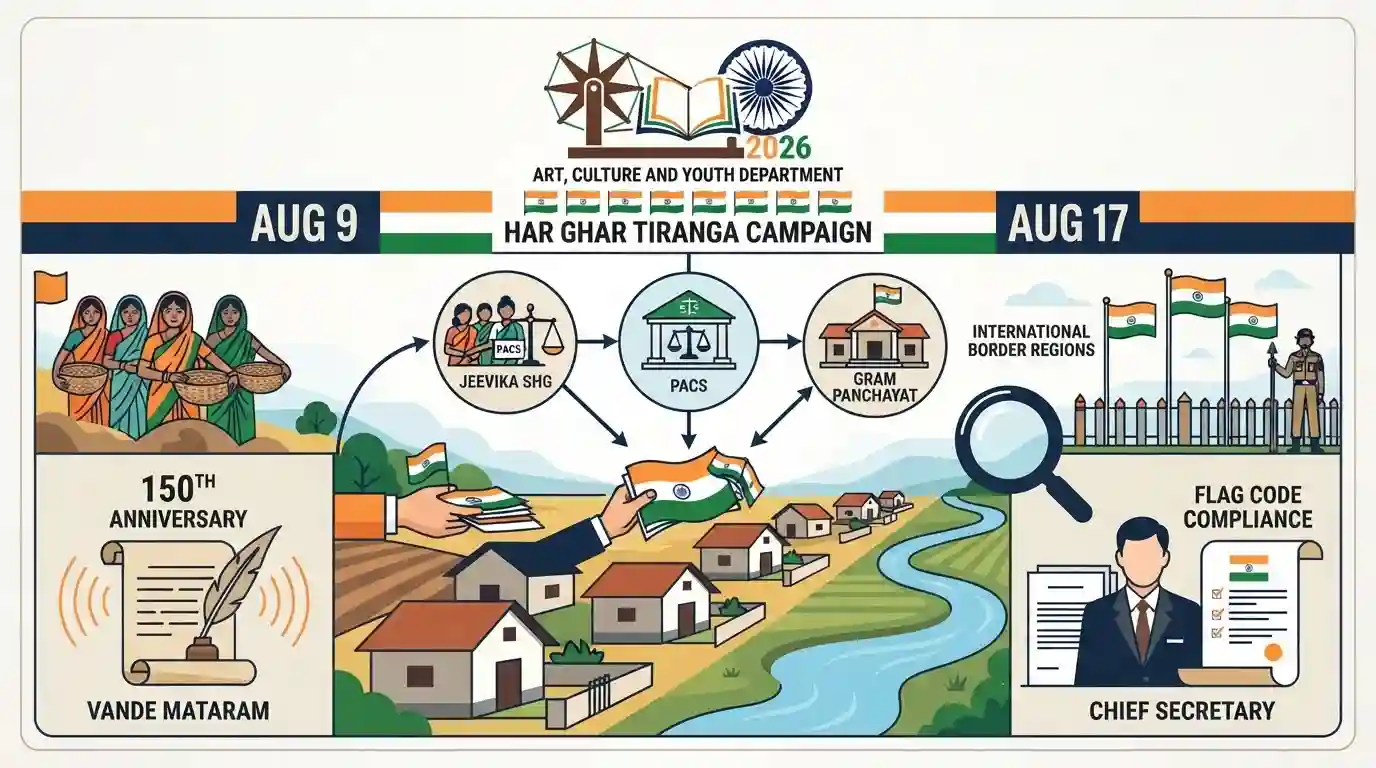
The Bihar Government has announced the 'Har Ghar Tiranga' campaign from August 9 to 17, 2026, spearheaded by the Art, Culture and Youth Department. Celebrating the 150th anniversary of 'Vande Mataram', the initiative will see the distribution of over 21 lakh national flags utilizing grassroots networks like Jeevika SHGs, PACS, and Gram Panchayats, with specific attention on international border regions. Strict compliance with the Flag Code of India has been emphasized by Chief Secretary Pratyaya Amrit.
Key Points
- The Bihar Government will launch a statewide 'Har Ghar Tiranga' campaign from August 9 to 17, 2026.
- The initiative aims to commemorate the 150th year of the national song 'Vande Mataram' and ensure adherence to the Flag Code of India.
- Over 21 lakh national flags will be distributed across the state through local bodies like Gram Panchayats, Jeevika SHGs, and PACS.
- Special focus will be given to households located in international border areas to foster national pride.
Important Terms
Har Ghar Tiranga campaign

A nationwide initiative launched by the Government of India under Azadi Ka Amrit Mahotsav to encourage citizens to hoist the national flag at their homes, fostering patriotism and personal connection to the Tricolour.
UPSC context
GS Paper II: Governance & Schemes. Tests understanding of state-sponsored public awareness programs and civic-led national integration.
Flag Code of India
A comprehensive set of laws, practices, and conventions implemented in 2002 that regulates the display, hoisting, and respectful treatment of the Indian National Flag by private and public entities.
UPSC context
GS Paper II: Polity & Constitution. Tests knowledge of fundamental duties, statutory restrictions, and rules governing national symbols.
Vande Mataram
India's National Song, composed in Sanskritized Bengali by Bankim Chandra Chatterjee in 1875. Published in his 1882 novel Anandamath, it served as a historic rallying cry during India's freedom struggle.
UPSC context
GS Paper I: Modern Indian History. Tests familiarity with key literary figures, patriotic symbols, and the nationalist freedom struggle.
Jeevika Self-Help Groups (SHGs)
Women-led local collectives formed under the Bihar Rural Livelihoods Project (JEEViKA). Supported by the World Bank, they drive socio-economic empowerment, financial inclusion, and poverty alleviation in rural Bihar.
UPSC context
GS Paper II/III: Governance & Economy. Tests understanding of SHG frameworks, rural livelihood schemes, and gender-focused developmental initiatives.
Primary Agricultural Credit Societies (PACS)
Village-level cooperative institutions providing short- and medium-term agricultural credit to rural farmers. They act as the foundational tier of India's short-term cooperative credit structure.
UPSC context
GS Paper III: Economy & Agriculture. Tests conceptual understanding of institutional rural credit, cooperatives, and grassroots financial inclusion.
Gram Panchayats
The basic, village-level executive units of local self-government in India. They were institutionalized as the lowest tier of the Panchayati Raj system under the 73rd Constitutional Amendment Act.
UPSC context
GS Paper II: Polity & Governance. Tests knowledge of democratic decentralization, rural governance, and Panchayati Raj Institutions.
Prelims Trap
"Vande Mataram was originally composed entirely in the Bengali language by Bankim Chandra Chattopadhyay."
It was actually written in a highly Sanskritized verse mixed with Bengali. Aspirants often mistake it for pure Bengali given the author's background.
Static Concepts Connected
What are the key recent amendments to the Flag Code of India (2002)?
- Material allowed: Machine-made and polyester flags are now permitted. Previously, only hand-spun and hand-woven khadi bunting (cotton, silk, or wool) was allowed.
- Timing of hoisting: Members of the public can now hoist the National Flag day and night in the open or at their houses. Earlier, it was restricted to sunrise to sunset.
What is the historical context of 'Vande Mataram' in the freedom struggle?
- Novel origin: The poem was incorporated into Bankim Chandra Chattopadhyay's 1882 Bengali novel Anandamath, which was set against the backdrop of the Sannyasi Rebellion.
- Political debut: It was sung for the first time in a political context by Rabindranath Tagore at the 1896 session of the Indian National Congress.
- Official adoption: The Constituent Assembly adopted it as the National Song on January 24, 1950, granting it equal status with the National Anthem, Jana Gana Mana.
Cross-Topic Patterns
SHGs beyond microfinance
Utilizing Jeevika SHGs for flag distribution highlights the governance trend of using women's collectives for state schemes, transitioning them from credit-groups to last-mile socio-political service providers.
Literary works and peasant uprisings
The 150th anniversary of Vande Mataram directly connects to Anandamath and the Sannyasi Rebellion. UPSC frequently pairs nationalist literary sources with the specific uprisings or socio-political events they depict.

With Vande Mataram's 150th year, expect a Prelims pair-matching question linking nationalist literature to its specific historical context.
Linked PYQs · 3
Linked PYQs · 3
- 2024-EBPSC_PRELIMSGS1
Indian National Flag was adopted by the Constituent Assembly on which date?
- 2016BPSC_PRELIMSGS1
'JEEVIKA' is an initiative of Bihar Govt for:
- 2020BPSC_PRELIMSGS1
Bihar Government launched a new scheme 'Satat Jivikoparjan Yojana' in August 2018. The objective of this scheme is
