Bihar Greenfield Satellite Townships Development via Land Pooling
Source:indianmasterminds ↗
Why It Matters
The adoption of a Land Pooling Policy for building greenfield cities marks a pivotal shift in Bihar's urban planning framework. It addresses the challenges of rapid urbanization and land acquisition, making it a critical topic for state governance and economic development in BPSC.
Summary
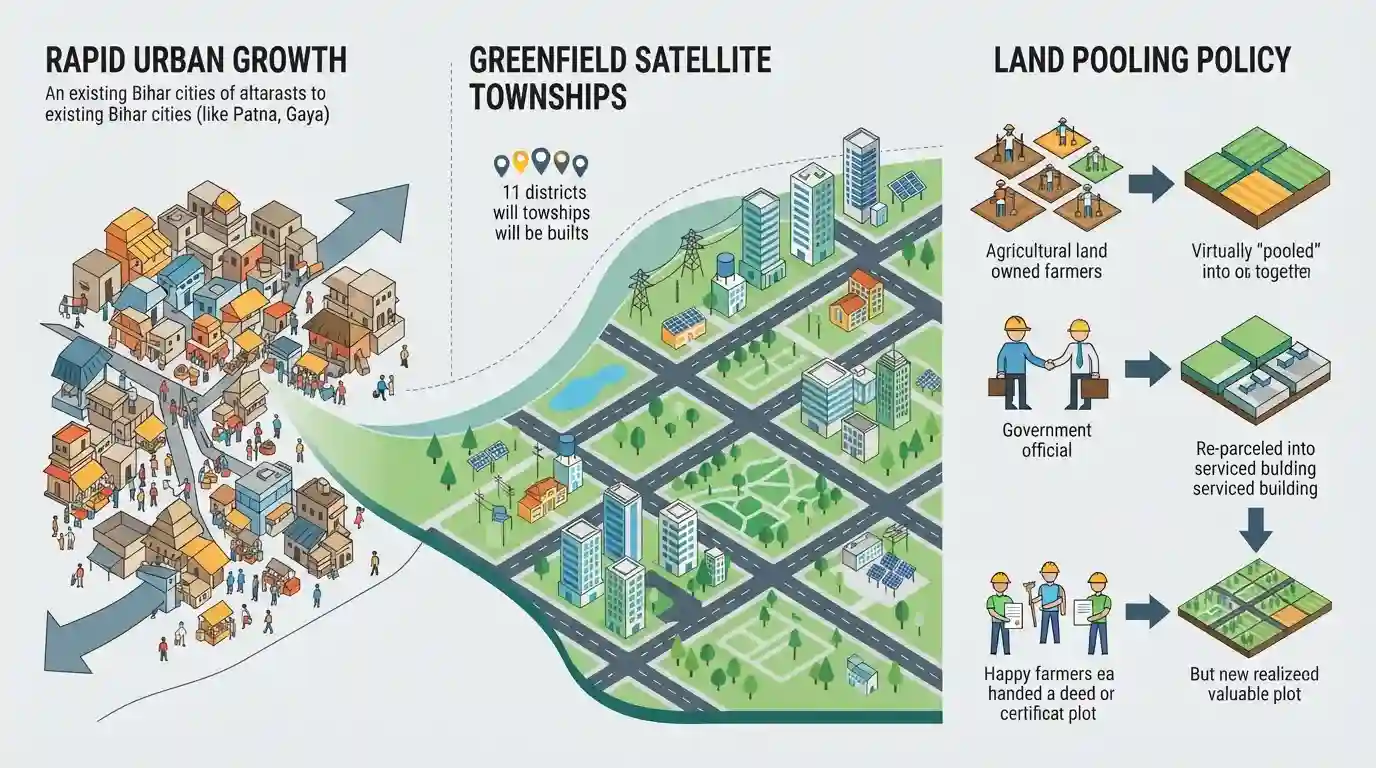
Bihar's Urban Development and Housing Department is set to build greenfield satellite townships in 11 districts, including Patna and Gaya, to manage rapid urban growth. Utilizing a Land Pooling Policy, the government aims to acquire land voluntarily by offering landowners developed plots in return. This strategy bypasses the financial burdens of traditional land acquisition while creating modern, planned urban centers.
Key Points
- Bihar plans to develop greenfield satellite townships across 11 districts to alleviate population pressure on existing major cities.
- The Urban Development and Housing Department (UDHD) is spearheading the initiative.
- The project utilizes a novel 'Land Pooling Policy' where landowners voluntarily surrender land and, in return, receive a share of the fully developed plots, eliminating the need for traditional, costly land acquisition.
- These modern townships will feature well-planned residential, commercial, and green spaces, along with robust infrastructure like roads, drainage, and utilities.
- This move responds to Bihar's accelerating urbanization, which rose from 11.3% in 2011 to 15.3% recently.
Important Terms
Land Pooling Policy

A voluntary land assembly model where owners surrender property for planned urban development and receive 55% back as developed plots, avoiding compulsory acquisition and making farmers stakeholders.
UPSC context
Crucial for BPSC Mains GS-II (Economy & Geography), addressing Bihar's modernization, infrastructure development, and dispute-free land reforms.
Urban Development and Housing Department (UDHD)
The nodal Bihar government agency responsible for urban planning, civic infrastructure, and implementing massive modernization projects like the new greenfield satellite townships and HUDCO funding partnerships.
UPSC context
Important for Prelims and Mains GS-II as the primary policy implementer driving Bihar's contemporary urbanization and housing strategy.
Greenfield Satellite Townships
Completely new, scientifically planned urban settlements built on undeveloped land near major cities to decongest existing urban spaces, backed by a ₹1 lakh crore HUDCO financing agreement.
UPSC context
Tests knowledge of Bihar's core urbanization initiatives and economic geography in BPSC Mains GS-II.
Town Planning Scheme (TPS)
A statutory mechanism under the Bihar Urban Planning and Development Act, 2012, designed to transform irregular, undeveloped land into structured urban layouts without compulsory acquisition.
UPSC context
Relevant for BPSC GS-II (Polity and Governance) emphasizing legal frameworks for systematic state development and smart urbanization.
Bihar Raiyati Bhumi Kray Niti, 2026
A state policy authorizing direct, negotiated land purchases at market rates and offering Transfer of Development Rights (TDR) for landowners opting out of the pooling model.
UPSC context
Vital for BPSC Mains GS-II (Economy/Land Reforms) as it complements land pooling to expedite massive infrastructure projects.
Prelims Trap
The government acquires land for satellite townships by paying market-rate cash compensation to owners under the Land Pooling Policy.
Under the Land Pooling Policy, participation is voluntary and owners are compensated with 55% of the developed land, not cash.
Static Concepts Connected
What are the key urbanization trends in Bihar?
- Current Rate: Urbanization has increased from 11.3% (2011 Census) to 15.3% according to recent Bihar Economic Survey estimates.
- Major Driver: The recent surge is largely driven by the state government's reclassification and upgrading of rural local bodies into new Nagar Panchayats and Parishads.
- Regional Disparity: Urbanization is heavily skewed; Patna is the most urbanized district (>40%), while districts like Samastipur and Banka remain overwhelmingly rural.
How does Land Pooling differ from traditional Land Acquisition?
- Consent Mechanism: Land pooling relies on the voluntary surrender of land by owners, whereas traditional acquisition uses the state's eminent domain for forced takeover.
- Compensation Type: Pooling returns a portion (55% in Bihar's case) of the fully developed land back to the owner, unlike traditional acquisition which pays cash.
- Financial Burden: Pooling bypasses the massive upfront capital required by the state to purchase land, making large-scale greenfield infrastructure projects financially viable.
Cross-Topic Patterns
Land Pooling + EWS Housing
The 45% state-retained land is partially earmarked for Economically Weaker Section (EWS) housing, directly integrating Bihar's new urban planning strategy with the affordable housing targets of PMAY-Urban.
Smart Cities + Greenfield Expansion
While Patna, Muzaffarpur, and Bhagalpur focus on brownfield retrofitting under the Smart Cities Mission, these satellite townships represent a strategic shift towards greenfield expansion to proactively manage urban sprawl.

Expect a multi-statement BPSC question pairing Bihar's 15.3% urbanization stat with the 55:45 land return ratio of the new pooling policy.
Linked PYQs · 1
Linked PYQs · 1
- 2023BPSC_PRELIMSGS1
The urbanization of the State has increased very rapidly in the last ten years. According to the 2011 Census, the level of urbanization in Bihar was just __ percent, which has increased to __ percent at present.
