Kundan Kumar Appointed Patna DM in Bihar IAS Reshuffle
Source:legend-officers ↗
Why It Matters
Understanding bureaucratic postings and key personnel in Bihar's administration (such as the District Magistrate of the state capital, Patna) is crucial for state-level general knowledge (GK) and current affairs questions in the BPSC Prelims.
Summary
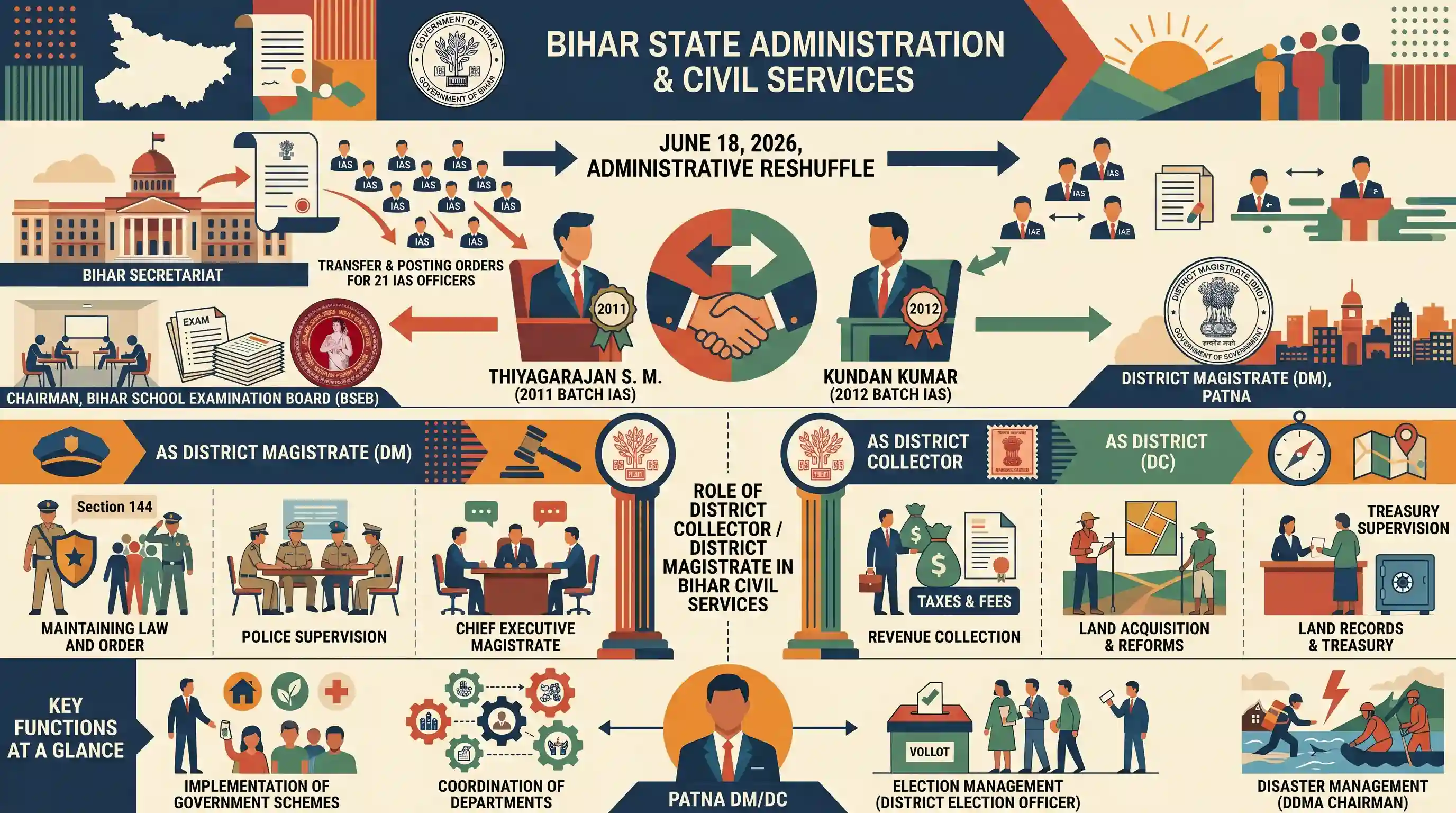
The Bihar government issued transfer and posting orders for 21 IAS officers on June 18, 2026. As part of this significant administrative reshuffle, Kundan Kumar has been appointed as the new District Magistrate (DM) of Patna, succeeding Thiyagarajan S. M.
Key Points
- On June 18, 2026, the Bihar government ordered the transfer and posting of 21 IAS officers across the state.
- Kundan Kumar was appointed as the new District Magistrate (DM) of Patna.
- Kundan Kumar replaces Thiyagarajan S. M. as the DM of Patna.
- The administrative reshuffle aims to optimize state bureaucracy and local administration across Bihar's districts.
Important Terms
District Magistrate

An Indian Administrative Service (IAS) officer serving as the senior-most executive magistrate in a district, primarily responsible for maintaining law, order, and supervising general administration.
UPSC context
GS Paper II (Polity and Governance); tests understanding of district-level administrative machinery and executive powers.
Indian Administrative Service
The premier civil service of India, part of the All India Services, whose officers handle administrative, policy-making, and implementation tasks across state and union levels.
UPSC context
GS Paper II (Polity and Governance); tests knowledge of civil services, administrative structures, and Article 312.
All India Services
Civil services common to both the Union and State governments, established under Article 312 of the Indian Constitution, comprising the IAS, IPS, and IFS.
UPSC context
GS Paper II (Polity and Federalism); tests understanding of center-state administrative relations and constitutional framework.
General Administration Department
A key state government department, typically under the Chief Minister, responsible for administrative policies, postings, transfers, and service rules of state-cadre civil servants.
UPSC context
GS Paper II (State Governance); tests the mechanism of state executive functioning, administrative coordination, and bureaucratic oversight.
Civil Services Board
A state-level advisory body chaired by the Chief Secretary that recommends postings and transfers of civil servants to ensure stability of tenure.
UPSC context
GS Paper II (Administrative Reforms); tests understanding of bureaucratic insulation and judicial directives on civil services.
State Secretariat
The apex administrative organ at the state level, composed of departments that assist the political executive in policy formulation and legislative tasks.
UPSC context
GS Paper II (State Executive); tests understanding of state-level administrative hierarchy and division of work.
Prelims Trap
The Civil Services Board (CSB) has the final binding authority to reject arbitrary transfer orders issued by a State Cabinet.
The CSB's recommendations are purely advisory. The ultimate decision-making authority for postings and transfers remains with the political executive (State Government).
Static Concepts Connected
What is the mandate of the Civil Services Board (CSB)?
- Origin and Composition: Established under Supreme Court's T.S.R. Subramanian (2013) mandate, it is headed by the State's Chief Secretary to oversee administrative postings.
- Key Objective: Aims to shield bureaucracy from political interference by recommending minimum fixed tenures (typically two years) for officers.
- Advisory Nature: Its recommendations are not legally binding; the political executive can override them but must record written reasons.
How is dual control exercised over All India Services?
- Immediate Control: Vested in State Governments, which manage daily administration, postings, transfers, and can issue temporary suspension orders.
- Ultimate Authority: Rests exclusively with the Union Government (President/DoPT) for major disciplinary actions like dismissal or compulsory retirement.
- Constitutional Basis: Governed by Article 312, creating a unique federal link where officers serve both levels of government.
Cross-Topic Patterns
Administrative Stability vs. Local Governance
Frequent district-level transfers disrupt the continuity of developmental schemes and undermine the capacity of local self-government institutions to implement long-term planning.
Federalism and Bureaucratic Dual Control
The dual administrative command of the IAS bridges the Centre-State divide but frequently creates federal friction during conflicts over officer deputations and disciplinary actions.

Mains 2026 may evaluate the efficacy of Civil Services Boards post-T.S.R. Subramanian in curbing arbitrary political transfers of IAS officers.
Linked PYQs · 2
Linked PYQs · 2
- 2023BPSC_PRELIMSGS1
Who among the following was the first Governor of Bihar?
- 2024-EBPSC_PRELIMSGS1
Manvi Madhu Kashyap recently became Bihar’s first transgender
