Mega Industrial Parks and Land Bank Development in Bihar
Source:newsarenaindia ↗
Why It Matters
Industrial growth, infrastructure development (like mega food parks and textile centres), and Ease of Doing Business rankings in Bihar are high-frequency topics in the BPSC Prelims and Mains examinations. Understanding land bank creations and core priority sectors (such as MSMEs and agro-industries) is critical for state-specific economic analysis.
Summary
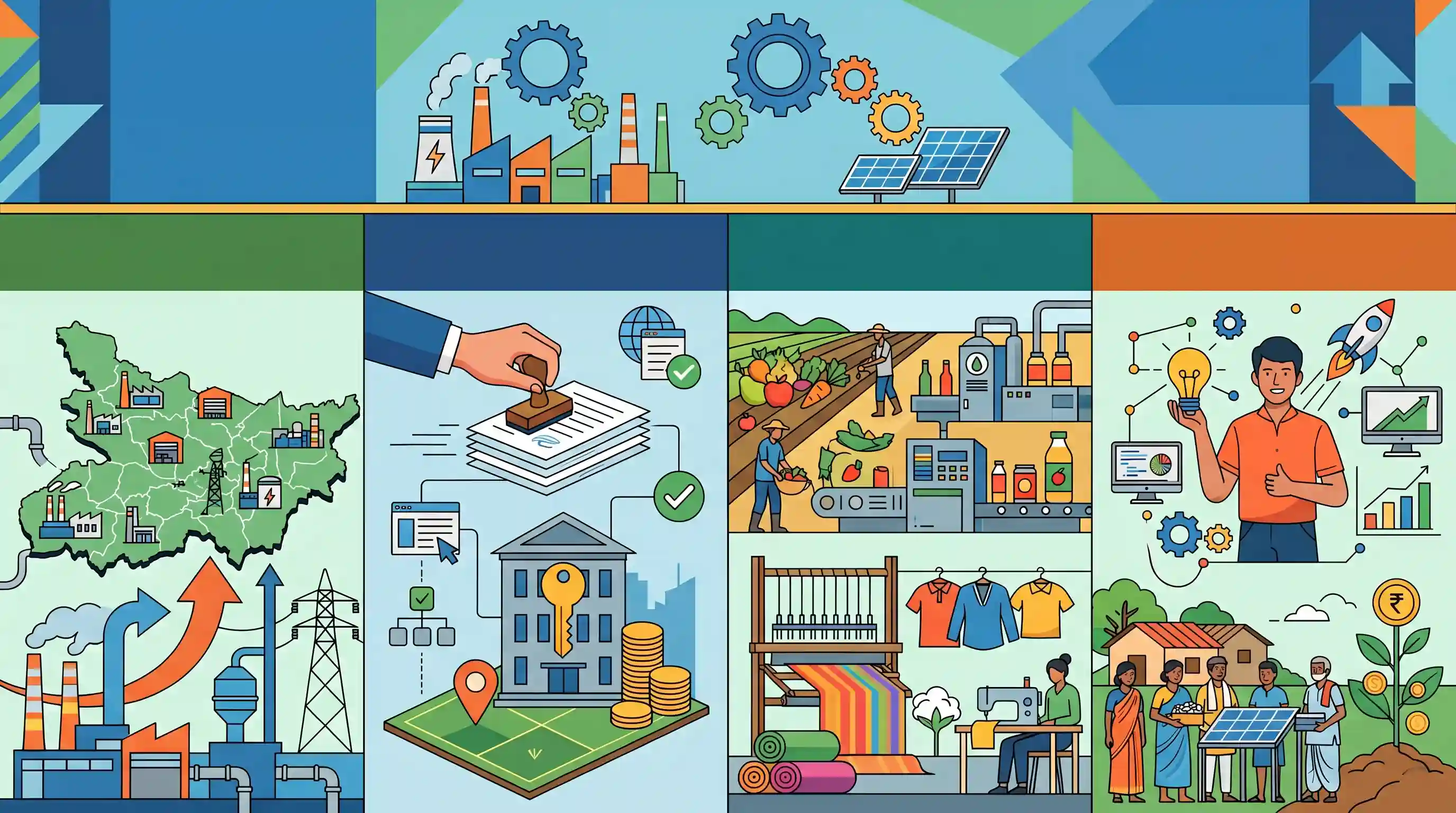
The Bihar government has announced a comprehensive plan to set up 11 mega industrial parks and food parks across all 38 districts of the state, backed by a proposed 50,000-acre land bank. The initiative aims to accelerate industrial progress, simplify clearance procedures to improve Bihar's Ease of Doing Business rankings, and foster growth in key sectors like food processing, textiles, pharmaceuticals, and MSMEs. Measures will also be taken to bolster rural entrepreneurship and the state's startup ecosystem.
Key Points
- The Bihar government has decided to establish 11 mega industrial parks and food parks across all 38 districts to accelerate state-wide industrialisation and generate jobs.
- A massive 50,000-acre land bank will be created to ensure smooth and swift land acquisition/allocation for upcoming industrial projects.
- Special focus has been laid on simplifying industrial approvals to improve Bihar's national ranking in the Ease of Doing Business.
- High-potential sectors identified for growth include food processing, textiles, pharmaceuticals, and micro, small, and medium enterprises (MSMEs).
- The state plan includes setting up a dedicated textile industrial centre and strengthening Bihar's startup ecosystem to support young entrepreneurs and rural self-employment.
- The directives were issued during a high-level review meeting of the Industries Department attended by Samrat Choudhary, Industries Minister Shreyasi Singh, and Chief Secretary Pratyaya Amrit.
Important Terms
Business Reforms Action Plan (BRAP)

An annual framework launched in 2015 by the DPIIT to assess and rank Indian states on implementing business-friendly regulatory reforms, enhancing the Ease of Doing Business (EoDB).
UPSC context
GS Paper 3 (Indian Economy); tests knowledge of federal competitive reforms, ease of doing business, and state-level policy implementations.
Bihar Industrial Area Development Authority (BIADA)
A statutory body established in 1974 under the BIADA Act to acquire land, develop infrastructure, and systematically allot plots to industries to promote balanced industrialization in Bihar.
UPSC context
GS Paper 3 (Infrastructure and Industrial Growth); crucial for understanding land acquisition and state-level industrial-executive bodies.
Bihar Industrial Investment Promotion Policy
A flagship policy framework launched to attract large-scale private investment, build infrastructure, and generate jobs by offering robust fiscal incentives and subsidies to diverse industries.
UPSC context
GS Paper 3 (Government Policies); evaluates regional industrial policy designs, investment promotion strategies, and job creation models.
Bihar Startup Policy
A state government scheme revised in 2022 to stimulate local entrepreneurship and MSME growth by providing interest-free seed loans, coworking spaces, and incubation support, prioritizing underrepresented groups.
UPSC context
GS Paper 3 (Employment and Growth); covers state entrepreneurship ecosystems, inclusive startup ecosystems, and financial support frameworks.
Prelims Trap
The YUVA initiative in Bihar is a state-level extension of the Union Ministry of Education's scheme for young authors.
While the central YUVA scheme focuses on mentoring young writers, Bihar's YUVA is a startup policy acronym providing seed loans and regulatory easing.
Static Concepts Connected
What is the Business Reforms Action Plan (BRAP)?
- Implementing Agency: Released by the Department for Promotion of Industry and Internal Trade (DPIIT), Ministry of Commerce and Industry.
- Categorization Model: States are grouped into qualitative categories (e.g., Top Achievers, Emerging Ecosystems) instead of absolute ranks to foster cooperative federalism.
- Reform Parameters: Evaluates states on regulatory areas like single-window clearances, labor laws, land administration, and environment approvals.
What is the structural model of Mega Food Parks?
- Hub-and-Spoke Design: Employs a hub-and-spoke architecture comprising Central Processing Centres supported by Primary Processing Centres and farm-level Collection Centres.
- Core Objectives: Aims to arrest post-harvest losses of perishables, ensure value addition, and establish direct market linkages for smallholder farmers.
Cross-Topic Patterns
Land banks and Article 300A
State-led pooling of land bypasses acquisition hurdles but must balance industrialization with constitutional property rights and fair compensation under Article 300A.
Agri-processing vs labor migration
Decentralized agro-processing and textile clusters in high-outmigration states act as economic shock absorbers, reducing distress seasonal migration to western and southern manufacturing hubs.

State land bank models and DPIIT's BRAP categorizations are highly likely to be tested under Ease of Doing Business in 2026.
Linked PYQs · 3
Linked PYQs · 3
- 2025BPSC_PRELIMSGS1
Which of the following is NOT one of the components under the YUVA framework of the Bihar Startup Policy 2022?
- 2023BPSC_PRELIMSGS1
Which food industry dominates among the agro-based industries in Bihar?
- 2023BPSC_PRELIMSGS1
In the year 2020, Bihar gained the __ rank out of 36 States in the Ease of Doing Business, awarded by Business Reforms Action Plan (BRAP).
