Bihar Expert Committee on Examination Leaks and Technology Integration
Source:indiatoday ↗
Why It Matters
Frequent examination paper leaks and recruitment delays seriously undermine the integrity of public administration and demoralize youth. This policy initiative by Bihar serves as an important case study for administrative reforms, the role of expert committees in governance, and the integration of e-governance and AI to ensure transparent public service recruitment.
Summary
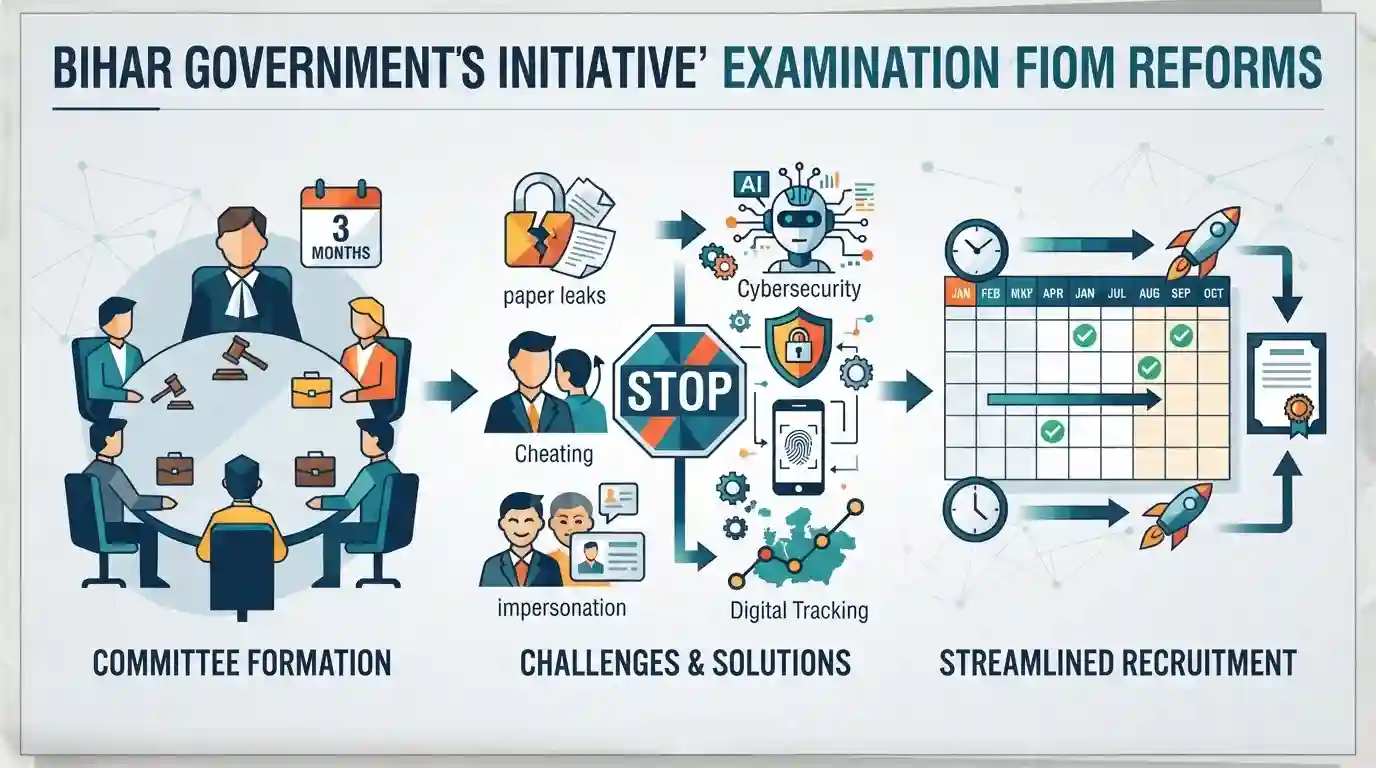
In a significant move to ensure fair and transparent recruitment processes, the Bihar government has set up a five-member expert committee to recommend sweeping examination reforms. Headed by a retired or serving higher judiciary judge, the committee aims to tackle recurring issues such as question paper leaks, cheating, and impersonation across state boards, universities, and recruitment commissions. The panel has three months to formulate its report, which will focus heavily on leveraging technology like Artificial Intelligence, cybersecurity, multi-factor authentication, and end-to-end digital tracking. Additionally, it will work on developing a state-level exam calendar to streamline the recruitment cycle and eliminate delays.
Key Points
- The Bihar government has approved the formation of a five-member expert committee to recommend comprehensive examination reforms.
- The committee will be chaired by a serving or retired High Court judge, or a retired Supreme Court judge.
- It is mandated to submit its recommendations within three months to prevent paper leaks, cheating, impersonation, and result manipulation.
- The reforms will emphasize the deployment of advanced technologies, including Artificial Intelligence (AI), multi-factor biometrics, end-to-end digital tracking, and cybersecurity measures.
- The committee will also propose a centralized, state-level examination calendar to avoid delays and scheduling conflicts across various recruitment agencies.
Important Terms
Bihar Public Service Commission (BPSC)

A state-level recruitment agency that conducts competitive exams for administrative and group posts in Bihar, including the Bihar Civil Services and teaching positions.
UPSC context
Critical for State Administration and Public Service Commissions topics. The primary body managing state recruitment and affected by examination reforms.
Bihar Staff Selection Commission (BSSC)
A state body responsible for recruiting candidates into Group C category roles, such as LDC, Typist, and Forest Guard, in various Bihar government departments.
UPSC context
Relevant to State Administration. Another major exam-conducting body targeted by the government's sweeping examination reforms.
Bihar Police Subordinate Services Commission (BPSSC)
A recruitment body established by the Bihar government to select candidates for Group C subordinate staff jobs, primarily in the Bihar Police, Forest, and Excise departments.
UPSC context
Important for State Administration and Recruitment Commissions topics. Its examinations are under review by the newly formed reform committee.
Prelims Trap
The exam reform committee is headed by the Chief Secretary or BPSC Chairman.
The committee must be chaired by a serving/retired High Court judge or retired Supreme Court judge, ensuring judicial independence over bureaucratic control.
Static Concepts Connected
What constitutional provisions ensure the independence of State Public Service Commissions (SPSCs)?
- Appointment and Removal: Members are appointed by the Governor, but they can only be removed by the President of India under specific Constitutional grounds.
- Service Conditions: Conditions of service are determined by the Governor but cannot be altered to the member's disadvantage after appointment.
- Financial Independence: The expenses of the SPSC, including salaries and pensions, are charged on the Consolidated Fund of the State.
What is the Public Examinations (Prevention of Unfair Means) Act, 2024?
- Central Legislation: A recent Union law targeting organized syndicates, institutions, and individuals involved in paper leaks and examination malpractices.
- Punitive Measures: Prescribes strict imprisonment of up to 10 years and heavy fines up to Rs 1 crore for organized examination crimes.
- Tech Integration: Mandates a high-level national technical committee to formulate strict standards for computerized examination security and digital tracking.
Cross-Topic Patterns
Alignment with Central Anti-Cheating laws
This state-level executive action mirrors the Union government's Public Examinations (Prevention of Unfair Means) Act, 2024, highlighting a nationwide governance priority to secure recruitment processes.
AI and E-Governance in Bihar
The push for AI, biometrics, and digital tracking in exams reflects Bihar's broader e-governance strategy, previously seen in digitized Public Distribution Systems (PDS) and Direct Benefit Transfers (DBT).

Direct factual questions on the exam reform committee's chair (judicial vs administrative) or its 3-month deadline are highly likely.
Linked PYQs · 3
Linked PYQs · 3
- 2022BPSC_PRELIMSGS1
The 'Digital India Award, 2020' was given to the Bihar Government for
- 2018BPSC_PRELIMSGS1
The Chairman of the State Public Service Commission is appointed by
- 2015BPSC_PRELIMSGS1
Justice J. S. Verma Committee's Report, 2013 deals with:
