Bihar Considers New University Act for Higher Education
Source:timesofindia ↗
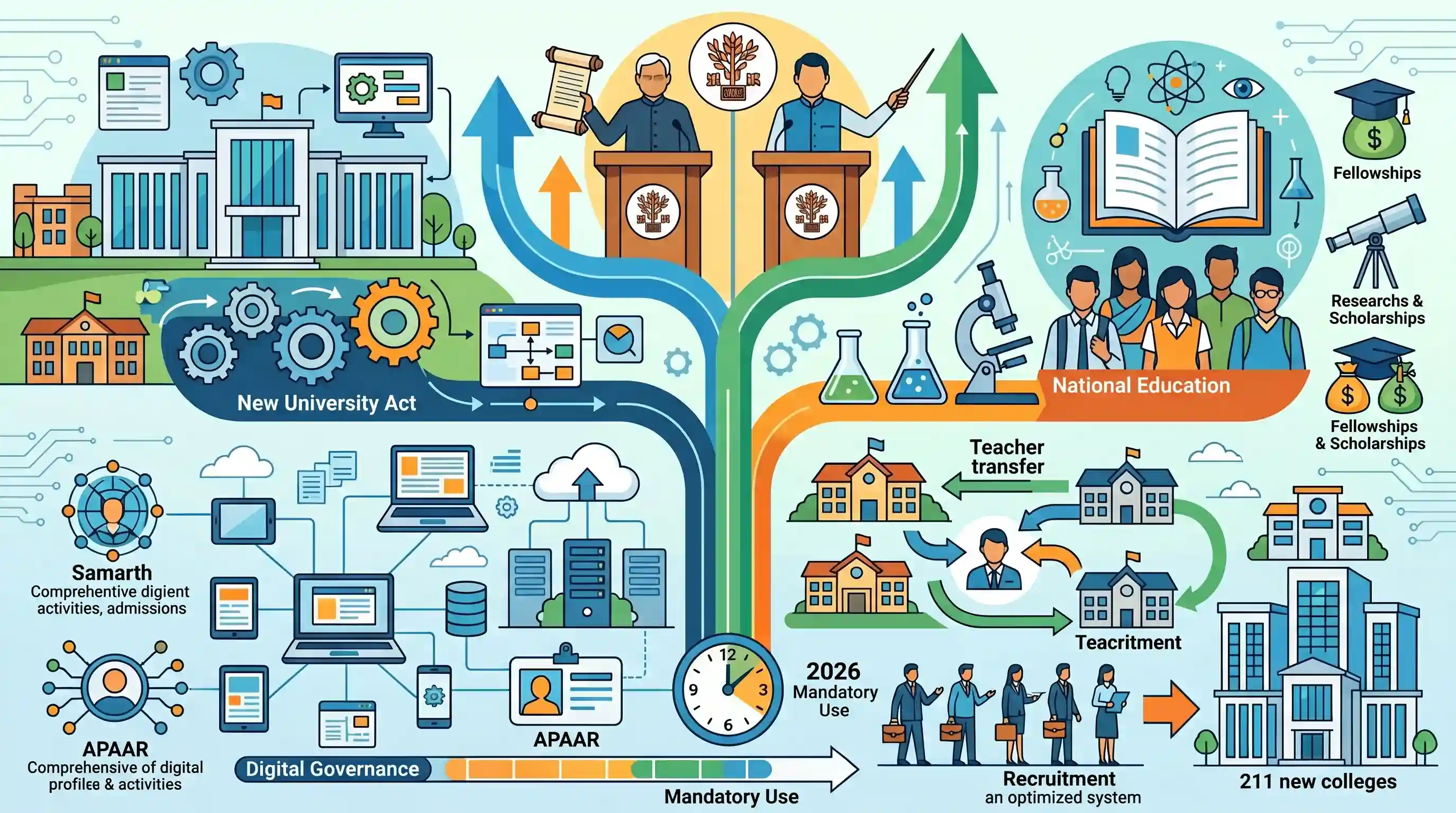
Why It Matters
The proposed reforms indicate a major policy shift toward standardized, transparent, and technology-driven governance in Bihar's higher education system, aligning it with national frameworks like NEP 2020 and addressing systemic issues of delays, administrative stagnation, and lack of research infrastructure in state universities.
Summary
The Bihar government is planning major reforms in its higher education sector, including the drafting of a 'New University Act' to modernize university administration. Under Governor-cum-Chancellor Syed Ata Hasnain and Chief Minister Samrat Choudhary, a series of academic, structural, and digital governance initiatives have been designed. These include new research fellowships and scholarships, the implementation of the National Education Policy (NEP) 2020, and the mandatory use of the Samarth and APAAR digital platforms by the end of 2026. Academic and administrative processes, such as teacher transfers and the recruitment of contractual assistant professors in 211 new degree colleges, will be streamlined and centralized.
Key Points
- The Bihar government is considering a comprehensive 'New University Act' to overhaul state universities after reviewing laws across 15 states.
- Several new academic schemes will be launched, including the Chancellor's Postdoctoral Fellowship, the Chief Minister's Research Grant Scheme, and the Chief Minister's Research Scholarship Scheme.
- Full implementation of the 'Samarth' digital platform across all 26 operational modules is scheduled to be completed by December 31, 2026.
- Adoptions of national digital tools such as APAAR (One Nation One Student ID), INFLIBNET, and the National Academic Depository (NAD) are being monitored to streamline administration.
- Syllabi for 43 postgraduate subjects aligned with the National Education Policy (NEP) 2020 will be finalised.
- Routine transfers and promotions of teachers and staff in state universities will be restricted to the month of June each year to maintain academic stability.
- A centralised recruitment process will be established for contractual Assistant Professors across 211 newly established government degree colleges.
- Teacher training centres operating under the Madan Mohan Malaviya Teacher Training Scheme at Patna University and Muzaffarpur University are set to be strengthened.
Important Terms
APAAR (One Nation One Student ID)

A unique 12-digit digital identification number (Automated Permanent Academic Account Registry) introduced by the Ministry of Education for Indian students to track and store their academic credits, records, and achievements digitally.
UPSC context
GS Paper II (Governance/Education). Tests understanding of digital reforms in human resource development and academic credit tracking.
Samarth digital platform
A comprehensive e-governance suite developed by the Ministry of Education to automate and streamline admissions, exams, finance, and human resource management across state and central universities in India.
UPSC context
GS Paper II (e-Governance/Education). Tests knowledge of administrative transparency, digital public infrastructure, and university reforms.
National Education Policy (NEP) 2020
A comprehensive framework launched to reform India’s education system from school to higher education, promoting multidisciplinary study, flexible academic pathways, research-led learning, and digital integration.
UPSC context
GS Paper II (Education Policy). Tests concepts of structural educational restructuring, standard alignment, and human resource development.
Madan Mohan Malaviya Teacher Training Scheme
A central sector scheme (also known as Malaviya Mission) of the Ministry of Education designed to provide continuous professional development, capacity building, and pedagogical training for higher education faculty.
UPSC context
GS Paper II (Issues relating to Education). Tests knowledge of faculty capacity building, teaching standards, and institutional excellence.
New University Act (Bihar)
A proposed state-level legislative reform in Bihar to modernize and standardize the regulatory, academic, and administrative framework of state universities by adopting best governance practices from 15 other states.
UPSC context
GS Paper II (State Governance/Education). Tests understanding of federal-state legislative reforms and institutional structural modernization in education.
Chief Minister's Research Grant Scheme (Bihar)
A state-funded initiative in Bihar designed to boost the academic research ecosystem by providing financial support and research grants to university faculty, scholars, and undergraduate/postgraduate students.
UPSC context
GS Paper II & III (R&D/Education). Tests state-level efforts in strengthening academic research funding, innovation, and educational quality.
Prelims Trap
The Governor, when acting as the ex-officio Chancellor of state public universities, is constitutionally bound by the aid and advice of the Council of Ministers.
In their capacity as Chancellor, the Governor acts under statutory powers granted by state laws, not constitutional powers, and is therefore not bound by the aid and advice of the Council of Ministers.
Static Concepts Connected
How does the Governor's role as State University Chancellor differ from constitutional duties?
- Statutory Capacity: The Chancellor role is created by specific state legislative acts, not directly by the Constitution of India.
- Aid and Advice: In this role, the Governor is not constitutionally bound by the 'aid and advice' of the State Council of Ministers unless specifically mandated by the university statute.
- Judicial Clarification: The Supreme Court has clarified that the Governor must exercise university powers independently of executive interference, maintaining distinct statutory boundaries.
What are the core components of Digital Public Infrastructure in Indian Higher Education?
- APAAR ID: A lifelong 12-digit digital identity issued under NEP 2020, linked to DigiLocker and the Academic Bank of Credits (ABC) to track mobility and credit transfers.
- Samarth ERP: An open-source, cloud-based ERP framework developed under the Ministry of Education to automate and unify university administrative, academic, and financial processes.
Cross-Topic Patterns
Federalism & University Governance Friction
Disputes over state university chancellorships showcase how education (Concurrent List) remains a key friction point of executive control between state ministries and centrally appointed Governors.
Digital Centralization in Social Sectors
Interoperable tools like APAAR and Samarth map decentralized state-level education into a centralized digital architecture, redefining cooperative federalism through platform governance.

Governor’s statutory role as Chancellor vs constitutional aid-and-advice limits will likely be framed as a 2026 Polity statement.
Linked PYQs · 3
Linked PYQs · 3
- 2023BPSC_PRELIMSGS1
The National Education Policy, 2020 emphasizes the integration of vocational education into mainstream education from which grade onwards?
- 2024-IBPSC_PRELIMSGS1
In April, 2020 the Bihar Education Department started the following program through DD Bihar
- 2022BPSC_PRELIMSGS1
The 'Digital India Award, 2020' was given to the Bihar Government for
