Bihar Government Proposes Comprehensive Higher Education Reforms
Source:timesofindia ↗
Why It Matters
This article highlights the extensive legislative, structural, and digital transformation of Bihar's state university framework. It covers several state-specific schemes, structural reforms in teacher recruitment, and national digital integrations (APAAR, Samarth) that are highly relevant to BPSC Prelims (governance, Bihar policies, state education indexes) and GS Paper 2 Mains (Human Resources & Social Sector in Bihar).
Summary
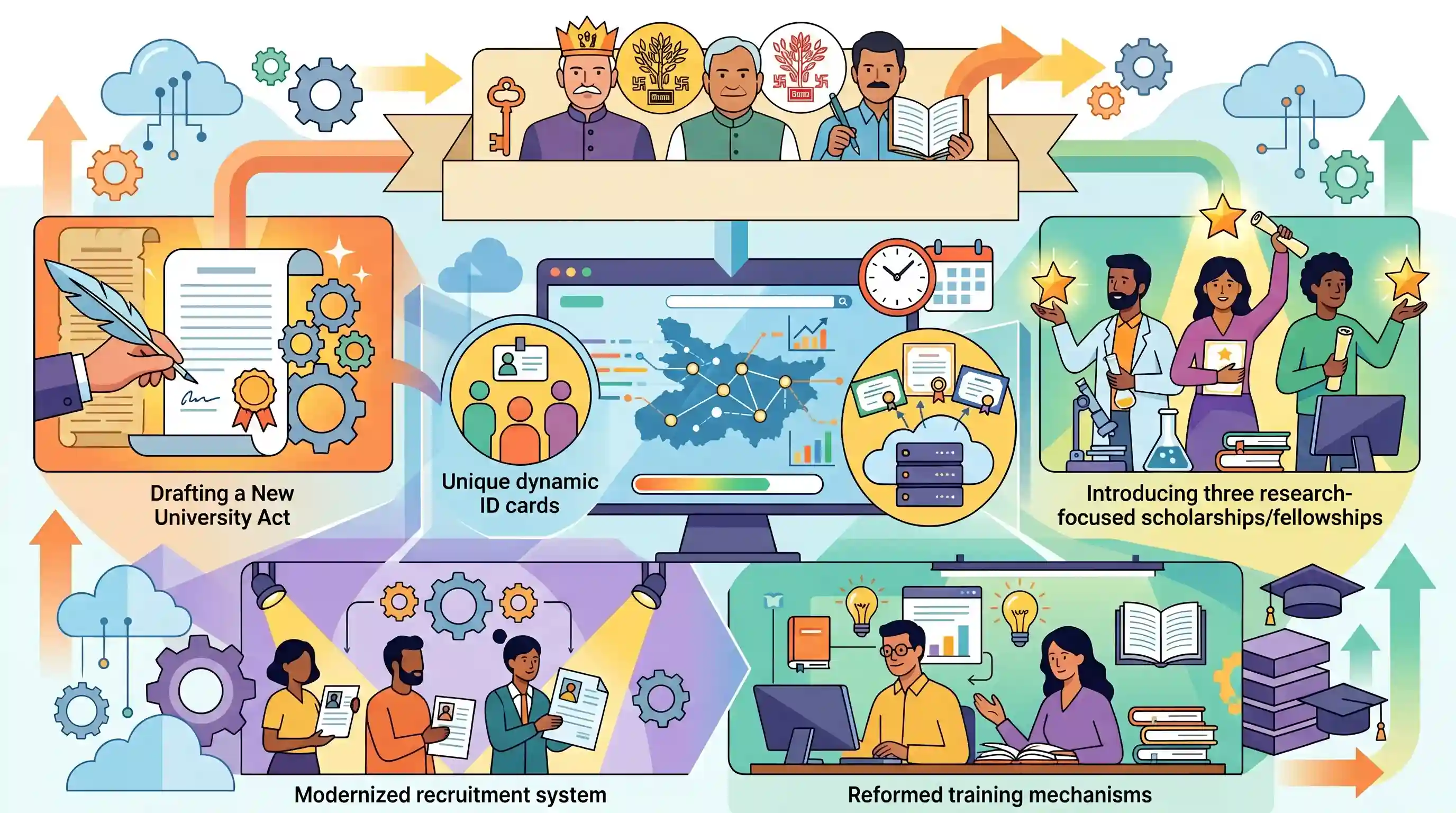
The Bihar government, led by Governor-cum-Chancellor Syed Ata Hasnain, Chief Minister Samrat Choudhary, and Higher Education Minister Sanjay Singh, is undertaking sweeping higher education reforms. Key proposals include drafting a New University Act, introducing three research-focused scholarships/fellowships, completing the full rollout of the 'Samarth' digital platform by late 2026, implementing NEP 2020 portals like APAAR and NAD, and reforming teacher recruitment and training mechanisms across state universities.
Key Points
- The Bihar government, under the chairmanship of Governor-cum-Chancellor Syed Ata Hasnain, is considering drafting a New University Act after reviewing administrative frameworks across 15 states and central universities.
- Three new research-centric financial support schemes are set to be introduced: the Chancellor's Postdoctoral Fellowship, the Chief Minister's Research Grant Scheme, and the Chief Minister's Research Scholarship Scheme.
- All 26 modules of the 'Samarth' digital governance platform—covering admissions, academics, finance, and administration—are mandated to be fully implemented across state universities by December 31, 2026.
- A centralized recruitment mechanism will be used to hire contractual Assistant Professors across 211 newly established government degree colleges in Bihar.
- Under NEP 2020 guidelines, educational databases and student identification systems such as APAAR (One Nation One Student ID), INFLIBNET, and the National Academic Depository (NAD) are being actively integrated.
- To enforce administrative discipline, routine staff and teacher transfers will strictly take place only in June, with exceptional off-season cases requiring direct approval from the Governor-cum-Chancellor.
- Teacher training centres established under the Madan Mohan Malaviya Teacher Training Scheme at Patna and Muzaffarpur universities are being fortified.
Important Terms
National Education Policy (NEP) 2020

A comprehensive national policy launched to transform India's educational system, emphasizing multidisciplinary learning, flexible academic pathways, digital integration, and increased public spending from primary to higher education levels.
UPSC context
GS Paper II: Social Sector/Education. Tests structural, pedagogical, and governance reforms aimed at human resource development.
APAAR (Automated Permanent Academic Account Registry)
A unique 12-digit student identification system under India's 'One Nation, One Student ID' initiative, digitally linking academic records, credits from the Academic Bank of Credits, and co-curricular achievements.
UPSC context
GS Paper II: E-governance and Education. Tests digital public infrastructure (DPI) applications, learner mobility, and student data privacy debates.
Samarth digital platform
An open-source, cloud-based e-governance ERP suite by the Ministry of Education that digitizes and automates administrative, academic, financial, and student lifecycle processes across Indian higher education institutions.
UPSC context
GS Paper II: Governance and Education. Tests the role of technology in institutional transparency, resource planning, and paperless administrative efficiency.
Madan Mohan Malaviya Teacher Training Scheme
A comprehensive UGC capacity-building initiative that restructures existing training centres to provide continuous professional development, training, and NEP 2020 orientation for higher education faculty across India.
UPSC context
GS Paper II: Government Schemes and HRD. Tests targeted efforts to elevate teacher quality, leadership skills, and institutional educational standards.
New University Act (proposed)
A proposed state legislative framework in Bihar designed to modernize, simplify, and bring transparency to state university administration by incorporating best practices from central universities and other states.
UPSC context
GS Paper II: Federalism and State Legislations. Tests state-level regulatory overhauls, university governance reforms, and academic decentralization.
Chancellor's Postdoctoral Fellowship
A newly proposed academic research initiative in Bihar aimed at providing financial support to advanced scholars, fostering a high-quality research culture, and preventing brain drain within state universities.
UPSC context
GS Paper II: Education and HRD policies. Tests institutional support systems for R&D, innovation incentives, and state-level higher education investments.
Prelims Trap
The Governor acts as the Chancellor of state public universities by virtue of an explicit provision in the Constitution.
The Governor acts as Chancellor under specific state statutes/legislative acts, not the Constitution. Hence, the Governor is not constitutionally bound by ministerial advice in university decisions.
Static Concepts Connected
What is the legal basis of the Governor's role as Chancellor of State Universities?
- Statutory Foundation: The Governor's ex-officio role as Chancellor is created by specific state university laws (statutes), not the Indian Constitution.
- Discretionary Power: As Chancellor, the Governor acts in an independent statutory capacity and is not bound by the aid and advice of the Council of Ministers.
- Sarkaria Commission Recommendation: The Sarkaria Commission recommended that the Governor should not be automatically appointed as Chancellor to prevent political controversies.
What are APAAR, NAD, and Samarth under India's digital education framework?
- APAAR ID: A voluntary 'One Nation, One Student ID' launched under NEP 2020 to track academic progress, transfer credits, and degrees digitally.
- National Academic Depository: A 24x7 online storehouse of academic awards (degrees, marksheets) to prevent forgery and facilitate instant verification.
- Samarth Portal: An open-source, cloud-based Enterprise Resource Planning (ERP) suite for university governance designed under NMEICT.
Cross-Topic Patterns
Federalism & State University Control
State bills attempting to replace Governors as Chancellors with Chief Ministers reflect ongoing Center-State friction and legislative disputes over executive overreach in education.
DPI in Social Sector Governance
Integrating APAAR with DigiLocker and the Academic Bank of Credits showcases the application of Digital Public Infrastructure to streamline student mobility and academic verification.

Polity 2026 is likely to test the constitutional vs statutory limits of the Governor's discretionary powers as ex-officio Chancellor.
Linked PYQs · 2
Linked PYQs · 2
- 2024-IBPSC_PRELIMSGS1
In April, 2020 the Bihar Education Department started the following program through DD Bihar
- 2025BPSC_PRELIMSGS1
Which of the following is NOT one of the components under the YUVA framework of the Bihar Startup Policy 2022?
