Bihar Agricultural Contingency Plan: Monsoon Deficit and Kharif Sowing
Source:hindustan-times ↗
Why It Matters
The contrasting agricultural fortunes of North and South Bihar due to monsoon variations is a core geographical concept for BPSC. Understanding government interventions like contingency crop planning and diesel subsidies is crucial for questions on Bihar's economy and disaster management.
Summary
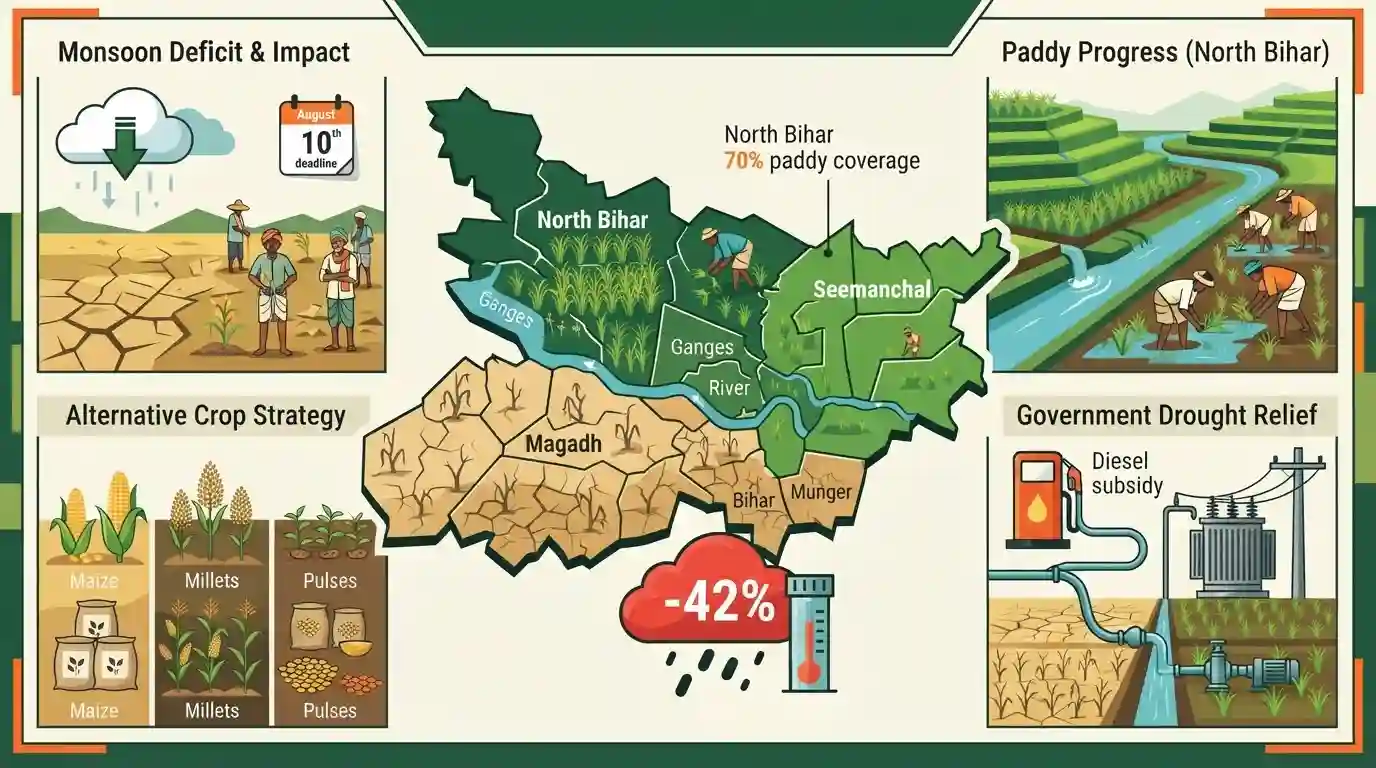
Facing a 42% deficit in monsoon rainfall, the Bihar government is drawing up an agricultural contingency plan for districts struggling with Kharif sowing, primarily in the Magadh and Munger divisions. If paddy transplantation does not improve by August 10, the state will distribute seeds for alternative, short-duration crops like maize, millets, and pulses. While the statewide paddy coverage is around 70%, driven by strong performance in North Bihar and the Seemanchal region, South Bihar districts like Jamui and Gaya are experiencing severe drought-like conditions. Immediate relief measures include a diesel subsidy for irrigation and uninterrupted daytime power supply to farm feeders to mitigate the impact of the dry spell.
Key Points
- Bihar has recorded a 42% monsoon rainfall deficit from June 1 to July 30, severely hampering Kharif season sowing.
- While overall state paddy transplantation stands at 70%, districts in the Magadh and Munger divisions are facing drought-like conditions with extremely low coverage (e.g., Jamui at 11%, Gaya at 25%).
- The Bihar Agriculture Department is preparing a contingency plan to be implemented after August 10, promoting alternative crops like maize, minor millets, pulses, and oilseeds if the dry spell continues.
- To aid farmers, the government is providing a diesel subsidy for irrigation and ensuring uninterrupted power supply to agricultural feeders from 6 am to 6 pm.
- In stark contrast to South Bihar, districts in the Seemanchal region (like Kishanganj) have achieved 100% paddy transplantation due to better rainfall.
Important Terms
Crop Contingency Plan

A localized agricultural strategy recommending alternative crops, seed varieties, and farming practices to minimize yield losses during weather aberrations like delayed monsoons or droughts.
UPSC context
GS 3 (Agriculture, Disaster Management). Highlights climate-resilient agriculture and institutional preparedness for weather-related extreme events.
Diesel Subsidy Scheme
A financial assistance initiative in Bihar providing per-acre cash subsidies to farmers, offsetting the fuel costs of running diesel-powered irrigation pumps during drought-like conditions.
UPSC context
GS 3 (Farm Subsidies). Tests knowledge of direct state interventions for mitigating irrigation costs and managing agricultural drought impacts.
India Meteorological Department (IMD)
The principal government agency under the Ministry of Earth Sciences responsible for weather forecasting, meteorological observations, seismology, and early warnings for severe weather events.
UPSC context
GS 1 (Geography) & GS 3 (Disaster Management). Central to topics on monsoon tracking, climate patterns, and national early warning systems.
Kharif Crops
Crops typically sown at the onset of India's southwest monsoon (June-July), such as paddy, maize, and millets, making them highly dependent on seasonal rainfall.
UPSC context
GS 1 & GS 3 (Cropping Patterns). Tests understanding of India's seasonal agriculture, monsoon dependency, and regional cropping geography.
Short-duration Crops
Fast-maturing crop varieties deployed as alternative contingency options when delayed monsoons shorten the available agricultural growing window, minimizing the risk of total crop failure.
UPSC context
GS 3 (Agriculture). Important for climate adaptation strategies, demonstrating how farmers mitigate risks during monsoon deficits.
Prelims Trap
During monsoon deficit years, the entirety of Bihar experiences severe drought conditions, leading to complete Kharif failure.
Bihar has high spatial monsoon variability. North Bihar/Seemanchal often receives adequate rainfall or floods, while South Bihar simultaneously experiences severe drought.
Static Concepts Connected
What are District Agriculture Contingency Plans (DACPs)?
- Nodal Agencies: Prepared jointly by ICAR-CRIDA (Central Research Institute for Dryland Agriculture) and State Agricultural Universities.
- Core Objective: They provide location-specific technological interventions to manage weather aberrations like droughts, floods, and extreme heat.
- Mitigation Strategy: Recommends shifting to short-duration crop varieties, altering seed rates, or changing cropping systems entirely (e.g., paddy to millets).
How are input subsidies (diesel, power) classified under WTO's Agreement on Agriculture?
- Amber Box: Input subsidies for power, diesel, and fertilizers fall under the trade-distorting Amber Box, subject to 'de minimis' limits.
- S&DT Exemption: Article 6.2 of AoA allows developing countries to exempt input subsidies given to low-income or resource-poor farmers from reduction commitments.
Cross-Topic Patterns
Climate Change driving Crop Diversification
Frequent El Niño-induced monsoon deficits are organically accelerating state-led shifts from water-intensive paddy to climate-resilient Nutri-cereals (Shree Anna) and short-duration maize.
The Energy-Water-Agriculture Nexus
Providing uninterrupted power and diesel subsidies to combat drought temporarily saves Kharif yields, but deeply exacerbates India's long-term groundwater depletion crisis.

Expect a multi-statement question linking spatial monsoon variability, ICAR's contingency crop shifts (millets), and input subsidies.
Linked PYQs · 5
Linked PYQs · 5
- 2025BPSC_PRELIMSGS1
Most of the Bihar comes under which of the following climate type?
- 2025BPSC_PRELIMSGS1
Which of the following is a Kharif crop?
- 2024-EBPSC_PRELIMSGS1
Munger Hilly region is a part of which of the following physiographic region?
- 2023BPSC_PRELIMSGS1
Gold is found in which of the following districts of Bihar?
- 2024-EBPSC_PRELIMSGS1
What is the contribution of agriculture in the Gross Domestic Product (GDP) of Bihar?
