Bihar Governor Indicates New Higher Education Bill in Assembly
Source:uni-india ↗
Why It Matters
The interaction between the State Executive (Governor) and State Legislature, especially regarding bills and state university governance, is highly critical for BPSC Prelims. Understanding the historical context of the governorship in Bihar, constitutional limits on bill returns, and current state-level educational policies are primary syllabus themes.
Summary
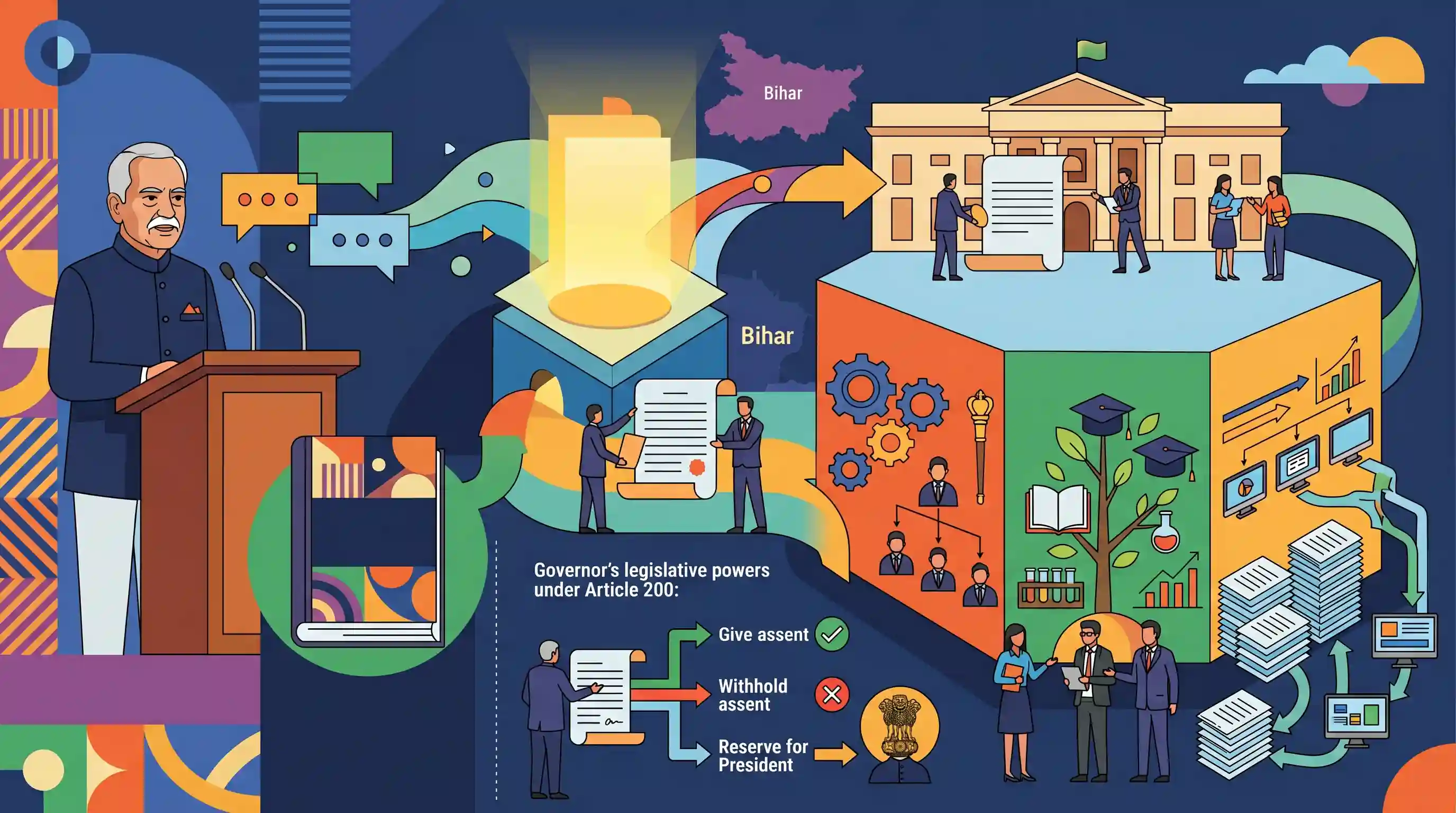
Bihar Governor Lt Gen (Retd.) Syed Ata Hasnain indicated that the state government is preparing to table a new higher education reform bill in the upcoming session of the Bihar Legislative Assembly. Speaking at a book release function for 'Kashyap Ka Jeevan Aur Darshan' authored by Rajendra Prasad Sharma, the Governor emphasized that the bill is the result of detailed study and deliberations designed to overhaul the governance, academic quality, and administration of state universities.
Key Points
- Bihar Governor Lt Gen (Retd.) Syed Ata Hasnain announced that the state government plans to introduce a new Higher Education Bill in the upcoming session of the Bihar Legislative Assembly.
- The proposed legislation aims to reform governance, administrative quality, and academic standards in state universities and higher educational institutions.
- The announcement was made during the official book release of 'Kashyap Ka Jeevan Aur Darshan', authored by Rajendra Prasad Sharma, which focuses on social harmony and national integration.
- Under the Indian Constitution (Article 200), the Governor holds the power of assent over bills passed by the State Legislature, and also acts as the Chancellor of state-run universities, giving them a key role in educational administration.
Important Terms
Bihar Higher Education Bill

A proposed state legislation introduced in 2026 to simplify, modernize, and digitize higher education governance in Bihar by overhauling the existing framework based on central university standards.
UPSC context
GS Paper II (Education & Governance). Tests knowledge of state-level education policy reforms, administrative streamlining, and federal center-state alignment.
Article 200 of the Constitution of India
A constitutional provision empowering the State Governor to grant assent, withhold assent, or reserve a bill passed by the state legislature for the President's consideration, or return it for reconsideration.
UPSC context
GS Paper II (Polity). Tests center-state relations, legislative process, and constitutional limits on the Governor's powers.
Ex-Officio Chancellorship
A statutory role designating State Governors as heads of state public universities, granting them independent powers to appoint Vice-Chancellors and inspect university administration, distinct from their standard constitutional role.
UPSC context
GS Paper II (Polity and Governance). Tests federal tensions, governor's discretionary powers, and university administrative reforms.
Bihar Legislative Assembly
The lower house of Bihar’s legislature (Vidhan Sabha), comprising elected representatives responsible for enacting state-level laws, approving budgets, and holding the state executive accountable.
UPSC context
GS Paper II (State Legislature). Tests knowledge of state legislative machinery, procedures, and lawmaking functions.
Bihar State Universities Act, 1976
The principal state legislation establishing and regulating state-level public universities in Bihar, outlining guidelines for academic governance, faculty recruitment, and administrative structures.
UPSC context
GS Paper II (Governance and Education). Important for understanding state-level higher education legal frameworks and structural overhauls.
National Education Policy (NEP) 2020
A comprehensive national framework designed to overhaul India's education system, promoting multi-disciplinary studies, flexible academic pathways, digital integration, and regional language instruction.
UPSC context
GS Paper II (Social Sector/Education). Tests policy implementation, structural reforms in primary to higher education, and center-state developmental cooperation.
Samarth Portal
An open-source, cloud-based digital enterprise resource planning platform developed by the Ministry of Education to automate and streamline academic, administrative, and financial processes across Indian universities.
UPSC context
GS Paper II (e-Governance/Education). Tests knowledge of ICT in governance, digitization of academic services, and enhancing administrative transparency.
United News of India
A prominent Indian news agency established in 1959, providing multilingual news feeds in English, Hindi, and Urdu to major publications across India.
UPSC context
GS Paper I/II (Media/Governance). Relevant for understanding the history of Indian print media, information broadcasting, and the role of press agencies.
Prelims Trap
The Governor acts as State University Chancellor under constitutional authority and must follow the Council of Ministers' aid and advice in this capacity.
The Chancellorship is a statutory role created by state legislation, not a constitutional mandate. Hence, the Governor acts independently and is not bound by Article 163 advice.
Static Concepts Connected
What is the legal status of a Governor acting as a State University Chancellor?
- Statutory Origin: The role is created by state legislation, not by the Constitution, meaning the mandate is statutory rather than constitutional.
- Independent Discretion: While acting as Chancellor, the Governor is not bound by the aid and advice of the state cabinet under Article 163.
- Punchhi Commission: Recommended stripping Governors of statutory Chancellorships to prevent political controversies and protect the dignity of the office.
What are the Governor's options under Article 200?
- Four Alternatives: The Governor can assent to a bill, withhold assent, return it for reconsideration, or reserve it for the President's consideration.
- No Timeline: The Constitution specifies no strict deadline for assent, only directing the Governor to return non-money bills 'as soon as possible'.
Cross-Topic Patterns
Cooperative Federalism + University Governance
State attempts to replace Governors with Chief Ministers as Chancellors reflect ongoing Centre-state friction over control of academic institutions.
Article 200 + Judicial Activism
Supreme Court’s active interpretation of 'as soon as possible' limits the Governor's pocket veto, reshaping the dynamics of state-level lawmaking.

A multi-statement question may test the statutory vs constitutional distinction of the Chancellorship alongside Article 200 timelines.
Linked PYQs · 4
Linked PYQs · 4
- 2024-EBPSC_PRELIMSGS1
By which time Governor has to return an ordinary bill to the concerned State Legislature for reconsideration?
- 2023BPSC_PRELIMSGS1
Who among the following was the first Governor of Bihar?
- 2025BPSC_PRELIMSGS1
What is the primary objective of Bihar’s Mission Daksh?
- 2018BPSC_PRELIMSGS1
Among the States of India, Bihar's rank in terms of lowest literacy rate (2011 Census) is
