Bihar Zero Tolerance Policy and Naya Savera Campaign on Trafficking
Source:theprint ↗
Why It Matters
This article is highly relevant for BPSC Prelims and Mains (GS Paper 2) as it details key state-level governance initiatives—such as Naya Savera 3.0, Mission Vatsalya, and Vidhi Palak Yuvak—aimed at protecting vulnerable sections (women and children), improving social justice, and addressing structural challenges like outmigration through employment generation.
Summary
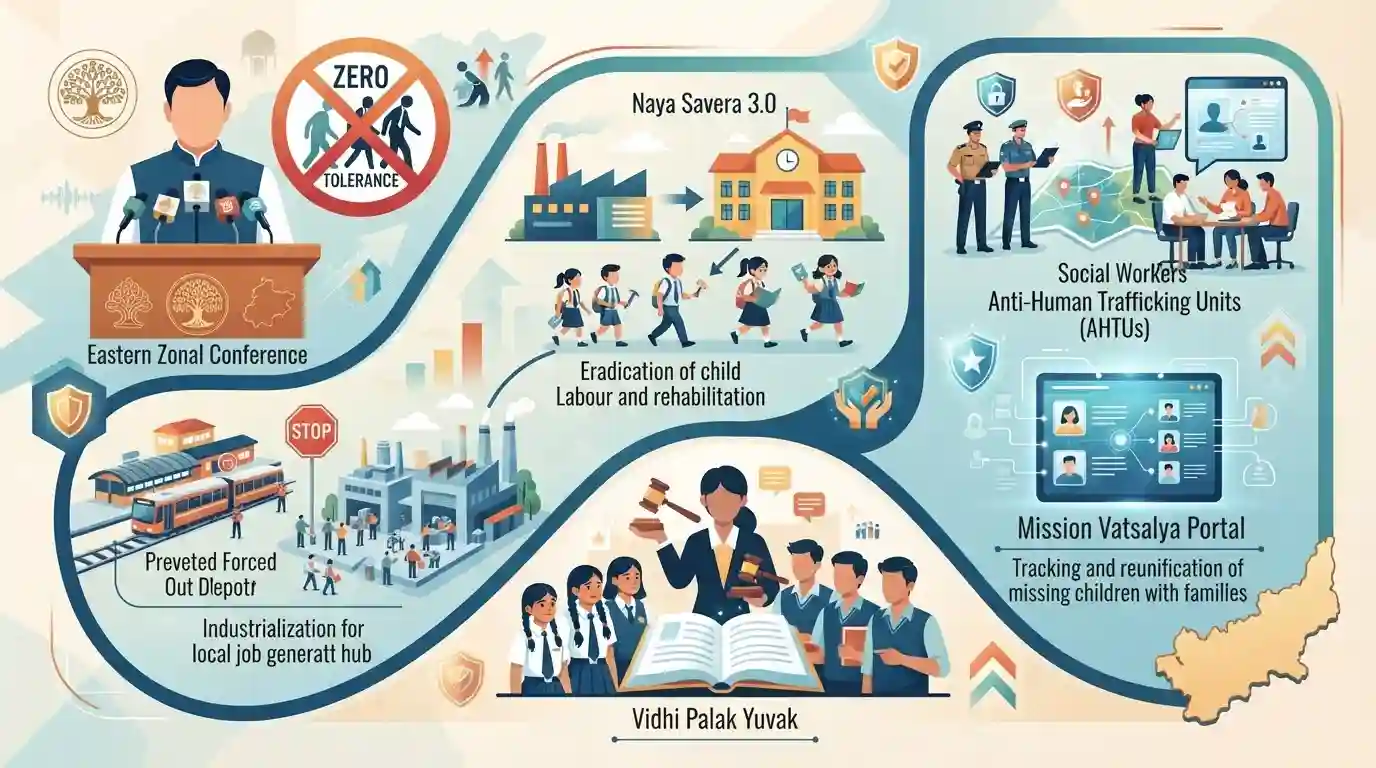
Bihar Deputy Chief Minister Samrat Choudhary highlighted the state government's zero-tolerance policy on human trafficking at the Eastern Zonal Conference-cum-Consultation on Missing Children. He underscored the importance of the 'Naya Savera 3.0' campaign, which is dedicated to eradicating child labour and rehabilitating trafficking victims. The government is also prioritizing industrialization to generate local employment and prevent forced outmigration, which often leads to trafficking. Operational mechanisms like Anti-Human Trafficking Units (AHTUs) and the Mission Vatsalya portal are actively deployed for enforcement and tracking. Additionally, the 'Vidhi Palak Yuvak' campaign aims to build legal awareness among students in schools and colleges.
Key Points
- The Bihar government maintains a strict zero-tolerance policy toward human trafficking and child labour.
- The state's 'Naya Savera 3.0' campaign focuses on awareness, rescue, and rehabilitation of trafficking and child labour victims.
- To tackle the root causes of trafficking, the government is promoting industrialization to create local employment and curb outmigration.
- The Mission Vatsalya portal is actively utilized for tracking missing children, and Anti-Human Trafficking Units (AHTUs) are functional across the state.
- The 'Vidhi Palak Yuvak' campaign has been launched in educational institutions to spread awareness about constitutional and legal rights among the youth.
Important Terms
Naya Savera 3.0

A Bihar government campaign to eradicate child labour and human trafficking. It focuses on awareness, rescuing victims, and prioritizing their rehabilitation through skill development, employment, and social reintegration.
UPSC context
GS Paper 2 (Social Justice). Tests awareness of state-specific models and interventions combating child exploitation and human trafficking.
Mission Vatsalya
A centrally sponsored scheme and integrated digital portal by the Ministry of Women and Child Development. It ensures care, protection, and rehabilitation for vulnerable children, consolidating platforms like TrackChild and Khoya-Paya.
UPSC context
GS Paper 2 (Welfare Schemes). Evaluates knowledge of national frameworks for child protection, juvenile justice, and institutional care.
Vidhi Palak Yuvak
A legal awareness campaign by Bihar Police for school and college students. It educates youth about legal rights, POCSO, anti-dowry laws, cyber security, and human trafficking to foster civic responsibility.
UPSC context
GS Paper 2 (Governance). Highlights grassroots community policing initiatives aimed at building legal literacy and a crime-free society.
Anti-Human Trafficking Units (AHTUs)
Specialized district-level law enforcement task forces established with Ministry of Home Affairs assistance. They are mandated to prevent trafficking, rescue victims, prosecute traffickers, and coordinate rehabilitation efforts with welfare bodies.
UPSC context
GS Paper 2 (Governance) & Paper 3 (Internal Security). Tests institutional mechanisms tackling organized crime and human trafficking.
Prelims Trap
"Mission Vatsalya is a Central Sector Scheme administered by the Ministry of Home Affairs."
Mission Vatsalya is a Centrally Sponsored Scheme (not Central Sector) implemented by the Ministry of Women and Child Development (MWCD), not the MHA.
Static Concepts Connected
How does the Constitution protect against human trafficking and child labour?
- Article 23: Prohibits traffic in human beings, begar, and similar forced labour. Any contravention is an offence punishable in accordance with the law.
- Article 24: Strictly prohibits the employment of children below the age of 14 years in factories, mines, or any other hazardous employment.
- Article 39(e) & (f): Directs the state to ensure that children are given opportunities to develop in a healthy manner and are protected against exploitation.
What is the structure and funding mechanism for Anti-Human Trafficking Units (AHTUs)?
- Establishment: Integrated law enforcement task forces established at the district level and within border guarding forces like the SSB and BSF.
- Nirbhaya Funding: The central government provides financial assistance for setting up and upgrading these units using the Nirbhaya Fund.
- Integrated Mandate: They act as a convergence point for police, NGOs, and child protection bodies to rescue and rehabilitate victims effectively.
Cross-Topic Patterns
Distress migration and vulnerability loop
Lack of local industrialization drives distress rural outmigration, making informal workers highly susceptible to debt bondage and trafficking networks in destination states.
Porous borders and internal security linkages
Bihar's porous border with Nepal necessitates SSB involvement in Anti-Human Trafficking Units (AHTUs), connecting social justice to internal security and border management challenges.

Expect a prelims statement mixing Mission Vatsalya's MWCD mandate with MHA's Nirbhaya-funded AHTUs, testing nodal ministry clarity.
Linked PYQs · 5
Linked PYQs · 5
- 2020BPSC_PRELIMSGS1
Bihar Government launched a new scheme 'Satat Jivikoparjan Yojana' in August 2018. The objective of this scheme is
- 2025BPSC_PRELIMSGS1
What is the primary objective of Bihar’s Mission Daksh?
- 2020BPSC_PRELIMSGS1
'Operation My Saheli' launched in September 2020 aims
- 2024-IBPSC_PRELIMSGS1
A British Citizen staying in India can not claim right to
- 2025BPSC_PRELIMSGS1
The constitution of India provides for reasonable restrictions on Fundamental Rights but reasonableness must keep in mind that: 1. The restrictions must be necessary for the protection of the rights of others. 2. The restrictions must be proportionate to the end sought. 3. The restrictions must be reasonable in the light of the circumstances. 4. The restrictions must be in the public interest.
