Bihar Cabinet Approves Five New Private Universities and Teacher Rules
Source:economictimes ↗
Why It Matters
The decision involves multiple highly factual, district-specific and governance-related policies of the Bihar state government (including private universities, town planning amendments, teacher transfer regulations, and MoUs with Microsoft/ASI). These are directly tested in BPSC Prelims, which frequently questions local schemes, administrative appointments, state geographic routes, and infrastructure loans.
Summary
The Bihar Cabinet, chaired by Chief Minister Samrat Choudhary, approved several major policy, infrastructure, and administrative decisions in June 2026. Key clearances include the establishment of five new private universities, the introduction of a portal-based teacher transfer system under the Bihar State Teacher Transfer Rules 2026, a Rs 1 lakh crore loan framework with HUDCO for 11 greenfield satellite townships, Rs 5,000 crore for tourism infrastructure, land allocation to the Isha Foundation in Munger for a cultural-tourism complex, ex officio designations for urban planning authorities, and technology-preservation MoUs with Microsoft and the Archaeological Survey of India (ASI).
Key Points
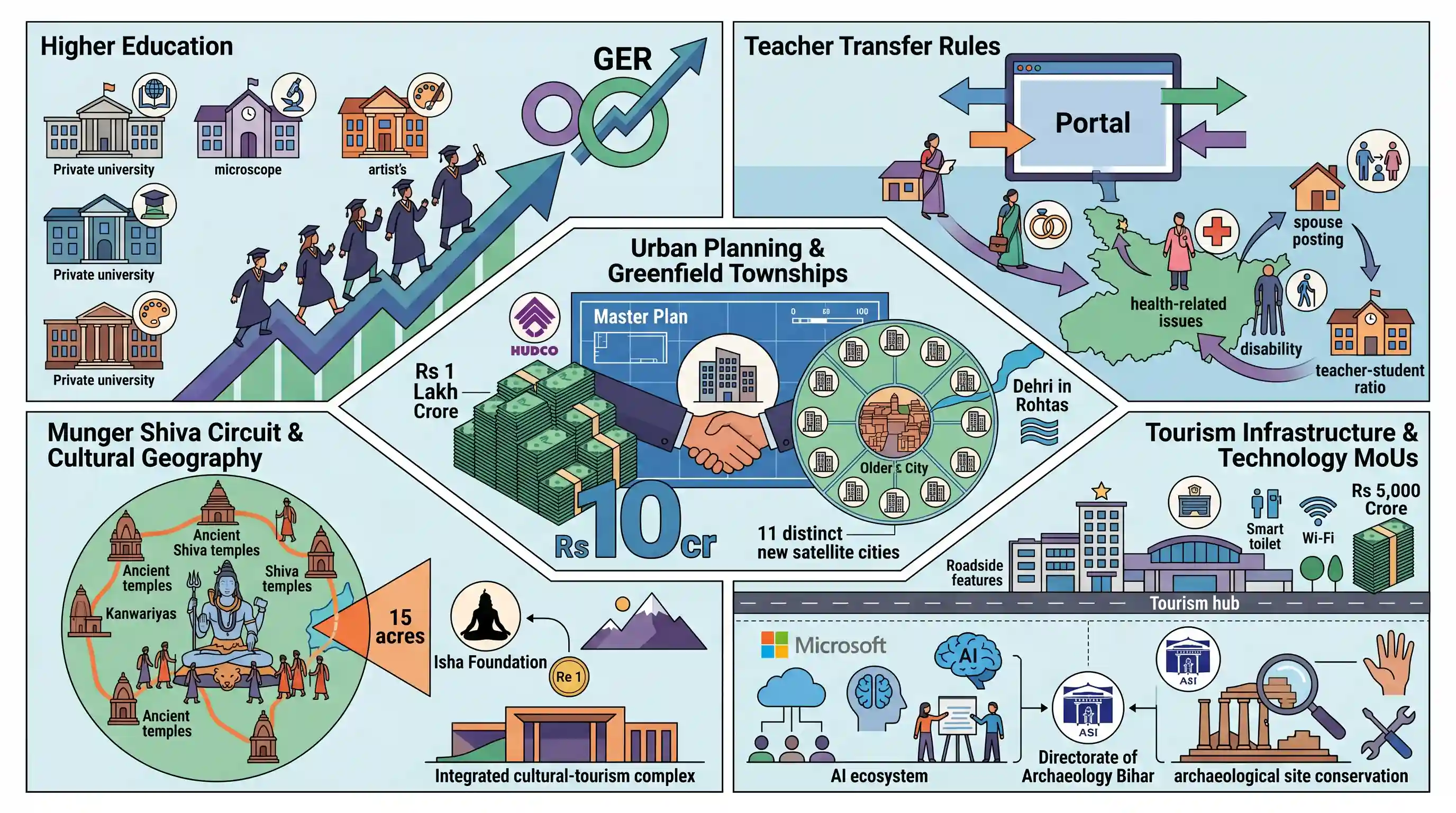
- Establishment of 5 new private universities approved: Shangza University (Madhubani), B G University (Daraudha, Siwan), S A University (Ashok Nagar, Nawada), Himalaya University (Patna), and Seetyog University (Aurangabad) to boost the Gross Enrolment Ratio (GER) in higher education.
- Approved 'Bihar State Teacher Transfer Rules, 2026': A portal-based transfer system. Humanitarian transfers permitted for female teachers from home panchayat to a nearby panchayat within the same block, and for male teachers from home block to a nearby block within the district.
- Greenfield Townships & HUDCO Funding: Rs 1 lakh crore approved for developing 11 greenfield satellite townships via a long-term loan from HUDCO, paving the way for an MoU with HUDCO.
- Tourism Infrastructure Boost: Up to Rs 5,000 crore approved for the Bihar State Tourism Development Corporation Limited via HUDCO and other institutions with a state guarantee to develop star hotels, Wi-Fi zones, water ATMs, roadside amenities, and smart parking.
- Cultural & Tourism Complex in Munger: Granted 15 acres and 1 decimal of land at Mouza Gazipur, Tarapur (Munger) to Isha Foundation/Isha Yoga Centre for 99 years at a token rate of Rs 1. Tarapur is historically significant and is part of the Munger Shiva Circuit on the Kanwariyas' path.
- Urban Planning Amendments: Amended the Bihar Urban Planning and Development Rules, 2014, making the Divisional Commissioner the ex officio Chairman and the District Magistrate the ex officio Vice-Chairman of the Planning Area Authority.
- Judicial Inquiry Commission: Approved the constitution of a commission headed by a retired Patna High Court judge to investigate the police encounter death of Bharat Bhushan Tiwari in Bhojpur district.
- Administrative & Tech MoUs: Approved MoU with Archaeological Survey of India (ASI) for conserving and maintaining national monuments in Bihar, and an MoU with Microsoft India to develop an Artificial Intelligence (AI) ecosystem in Bihar.
- Court Buildings: Granted administrative approval for the construction of new court buildings in four districts: Siwan, East Champaran, Begusarai, and Nawada.
Important Terms
Bihar State Teacher Transfer Rules, 2026

A state policy regulating the digital, portal-based transfer of over 5.5 lakh government school teachers, prioritizing merit, teacher-student ratios, and humanitarian grounds like medical issues and spouse postings.
UPSC context
GS Paper II: Governance and education; tests administrative transparency, digitalization of public services, and state welfare initiatives.
Greenfield Satellite Township Project
A major planned urban expansion initiative to establish 11 new townships on undeveloped land in Bihar, financed through HUDCO using a 55:45 land-sharing model with local farmers to mitigate city congestion.
UPSC context
GS Paper III: Urbanization and infrastructure; tests planned urban development models, land pooling mechanisms, and public-private finance.
Housing and Urban Development Corporation Limited (HUDCO)
A premier public sector enterprise under India's Ministry of Housing and Urban Affairs that provides long-term techno-financial funding for housing and large-scale urban infrastructure projects across states.
UPSC context
GS Paper III: Infrastructure financing; tests knowledge of key public financial institutions driving regional development and housing policies.
Isha Foundation
A prominent spiritual and social non-profit organization founded by Sadhguru Jaggi Vasudev, recently allocated 15.01 acres in Munger, Bihar on a 99-year lease for a cultural and tourism complex.
UPSC context
GS Paper I: Culture and Society / GS Paper III: Tourism; tests NGO participation in public heritage and spiritual tourism development.
Munger Shiva Circuit
A designated religious tourism corridor connecting sacred Shaivite pilgrimage sites in Bihar, focused on improving amenities and connectivity for Kanwariya pilgrims along historical and cultural routes.
UPSC context
GS Paper I: Art, Culture, and Geography; tests mapping of cultural landscapes, religious corridors, and state tourism infrastructure projects.
Archaeological Survey of India (ASI)
An attached agency of India's Ministry of Culture responsible for archaeological research, scientific excavations, and the preservation and conservation of thousands of designated monuments of national importance.
UPSC context
GS Paper I: Indian Heritage and Culture; tests institutional framework, statutory mechanisms, and policies governing national monument conservation.
Prelims Trap
HUDCO is a statutory regulatory body established by an Act of Parliament under the Ministry of Housing and Urban Affairs.
HUDCO is a government company incorporated under the Companies Act, 1956, and registered as a housing finance/NBFC with the RBI, not a statutory regulatory body.
Static Concepts Connected
What was the Tarapur Massacre of 1932 during the Civil Disobedience Movement?
- Historical Context: Happened on February 15, 1932, in Tarapur (Munger, Bihar) when patriots attempted to hoist the national flag at the local police station.
- Colonial Brutality: Colonial police opened fire, killing 34 freedom fighters, making it one of the largest colonial massacres after Jallianwala Bagh.
- State Commemoration: The government of Bihar officially commemorates February 15 every year as 'Shahid Diwas' to honor the martyrs.
How is the Archaeological Survey of India (ASI) structured and governed?
- Administrative Status: An attached office under the Ministry of Culture, founded in 1861 by Alexander Cunningham, its first Director-General.
- Statutory Backing: Governed primarily by the Ancient Monuments and Archaeological Sites and Remains (AMASR) Act, 1958, and the Antiquities and Art Treasures Act, 1972.
Cross-Topic Patterns
Urban Expansion + Debt Sustainability
Large-scale off-budget borrowing (like Bihar's Rs 1 lakh crore HUDCO loan) for greenfield satellite townships tests municipal debt sustainability and state-guaranteed fiscal liabilities under FRBM limits.
Cultural Heritage + Tourism Economy
Leveraging spiritual corridors (Shiva Circuit) and land grants to private spiritual trusts highlights a shift towards public-private convergence in regional tourism and cultural geography.

Integration of regional freedom struggle events like the 1932 Tarapur Massacre into Modern History MCQs is a rising UPSC trend.
Linked PYQs · 4
Linked PYQs · 4
- 2025BPSC_PRELIMSGS1
What is the primary objective of Bihar’s Mission Daksh?
- 2024-EBPSC_PRELIMSGS1
Munger Hilly region is a part of which of the following physiographic region?
- 2020BPSC_PRELIMSGS1
Bihar Government launched a new scheme 'Satat Jivikoparjan Yojana' in August 2018. The objective of this scheme is
- 2024-EBPSC_PRELIMSGS1
In which of the following years the Bihar state Hydroelectric power corporation was established?
