TRE-4 Exam Reform: Single-Phase Teacher Recruitment and Expert Panel
Source:new-indian-express ↗
Why It Matters
Highlights systemic reforms and ad-hoc committees created by the state to tackle exam leaks and transparency issues, which directly aligns with governance and accountability topics in state services exams.
Summary
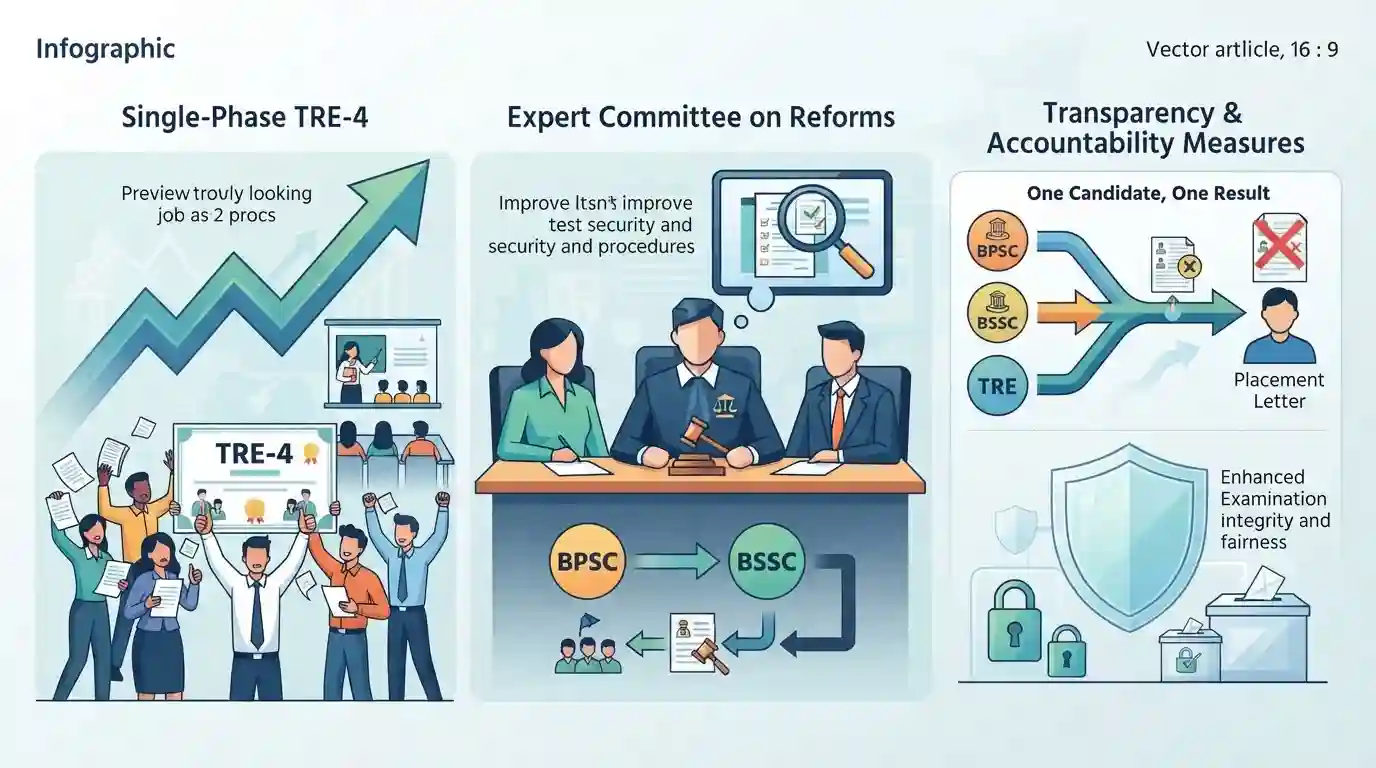
In response to demands from job aspirants, the Bihar government has decided to conduct the fourth phase of the Teacher Recruitment Examination (TRE-4) in a single phase instead of two tiers. To address broader concerns about examination integrity and transparency, a three-member Expert Committee on Examination Reforms has been constituted under a retired Patna High Court judge. This committee will evaluate current practices, suggest measures for smooth conduct across major state exams (like BPSC and BSSC), and consider issues like the 'one candidate, one result' policy.
Key Points
- The Bihar government announced that the 4th phase of the Teacher Recruitment Examination (TRE-4) will be held as a single-phase exam, abandoning the preliminary and main exam structure.
- An 'Expert Committee on Examination Reforms', headed by a retired Patna High Court judge, was formed to ensure transparency and suggest improvements across various competitive exams.
- The committee will review exams conducted by the BPSC, BSSC, and others, including sub-inspector recruitments and the Bihar Eligibility Test (BET).
- It is also tasked with exploring student demands such as implementing a 'one candidate, one result' rule and addressing grievances regarding exam malpractices.
Important Terms
Teacher Recruitment Examination (TRE-4)

The fourth phase of Bihar's major teacher hiring drive conducted by BPSC for over 32,000 posts. Responding to aspirant protests, the state government recently transitioned it to a single-phase examination.
UPSC context
GS Paper 2 (Education/Governance). Crucial for evaluating Bihar's employment initiatives, educational reforms, and recruitment transparency.
Expert Committee on Examination Reforms
A newly formed panel chaired by a Patna High Court judge, established by the Bihar government to overhaul recruitment processes, ensure transparency, and resolve aspirant grievances across state exams.
UPSC context
GS Paper 2 (Governance/Probity). Relevant to state administrative reforms, institutional accountability, and anti-corruption measures.
Bihar Public Service Commission (BPSC)
The constitutional state body responsible for conducting civil services and large-scale recruitment exams, such as TRE-4 and the 70th CCE, to appoint eligible candidates to Bihar government posts.
UPSC context
GS Paper 2 (Constitutional Bodies). Important for questions on the autonomy, functions, and ongoing reforms of state public service commissions.
Bihar Staff Selection Commission (BSSC)
A state recruiting agency conducting exams for subordinate and non-gazetted posts. It is currently under government mandate to issue and strictly follow timely examination calendars to ensure recruitment transparency.
UPSC context
GS Paper 2 (Governance/Institutions). Tests understanding of state-level recruitment mechanisms, public employment efficiency, and systemic reforms.
Patna High Court
The highest judicial institution in Bihar. Its sitting or retired judges are often tapped to lead independent administrative oversight panels, such as the new Expert Committee on Examination Reforms.
UPSC context
GS Paper 2 (Judiciary/Governance). Highlights the judiciary's role in providing credible oversight and resolving state administrative disputes.
Prelims Trap
The Chairman and members of the BPSC are appointed and removed by the Governor of Bihar.
While the Governor appoints the Chairman and members of a State Public Service Commission (Article 316), they can only be removed by the President of India (Article 317).
Static Concepts Connected
What are the key Constitutional provisions for State Public Service Commissions?
- Constitutional Articles: Part XIV of the Constitution (Articles 315 to 323) deals with the composition, appointment, and removal of SPSC members.
- Appointment Authority: The Chairman and members are appointed by the Governor of the State under Article 316.
- Removal Authority: They can only be removed by the President of India on grounds of misbehaviour after a Supreme Court inquiry (Article 317).
What are the recent foundational initiatives in Bihar's education sector?
- BPSC TRE: Large-scale recruitment of teachers through BPSC to regularize staff and improve the state's pupil-teacher ratio.
- Mission Daksh: A targeted state scheme providing special foundational literacy and numeracy classes to academically weak students in primary schools.
- e-Shikshakosh Portal: A unified digital portal implemented by the Bihar government for real-time monitoring of school attendance and infrastructure.
Cross-Topic Patterns
Exam Reforms & Anti-Paper Leak Laws
Bihar's internal committee aligns with the national focus on exam integrity, reflecting the Centre's recent Public Examinations (Prevention of Unfair Means) Act, 2024, to curb paper leaks and malpractices.
TRE & Reaping Demographic Dividend
Large-scale teacher recruitments (TRE) directly address Bihar's human capital formation, a necessary foundation for turning its high youth population into a productive demographic dividend.

Expect a polity question linking BPSC's constitutional mandate (Articles 315-323) with state governance reforms and committee formations.
Linked PYQs · 2
Linked PYQs · 2
- 2025BPSC_PRELIMSGS1
What is the primary objective of Bihar’s Mission Daksh?
- 2018BPSC_PRELIMSGS1
The Chairman of the State Public Service Commission is appointed by
