Bihar Emphasizes Early Warning Systems for Zero Casualty Goal
Source:patnapress ↗
Why It Matters
Disaster management and climate resilience are vital themes for Bihar, which experiences recurring floods, drought, and severe lightning. This article highlights the institutional and technical steps being taken, including local initiatives like the Safe Friday campaign and the BODHI platform, to build grassroots level preparedness and achieve zero-casualty targets.
Summary
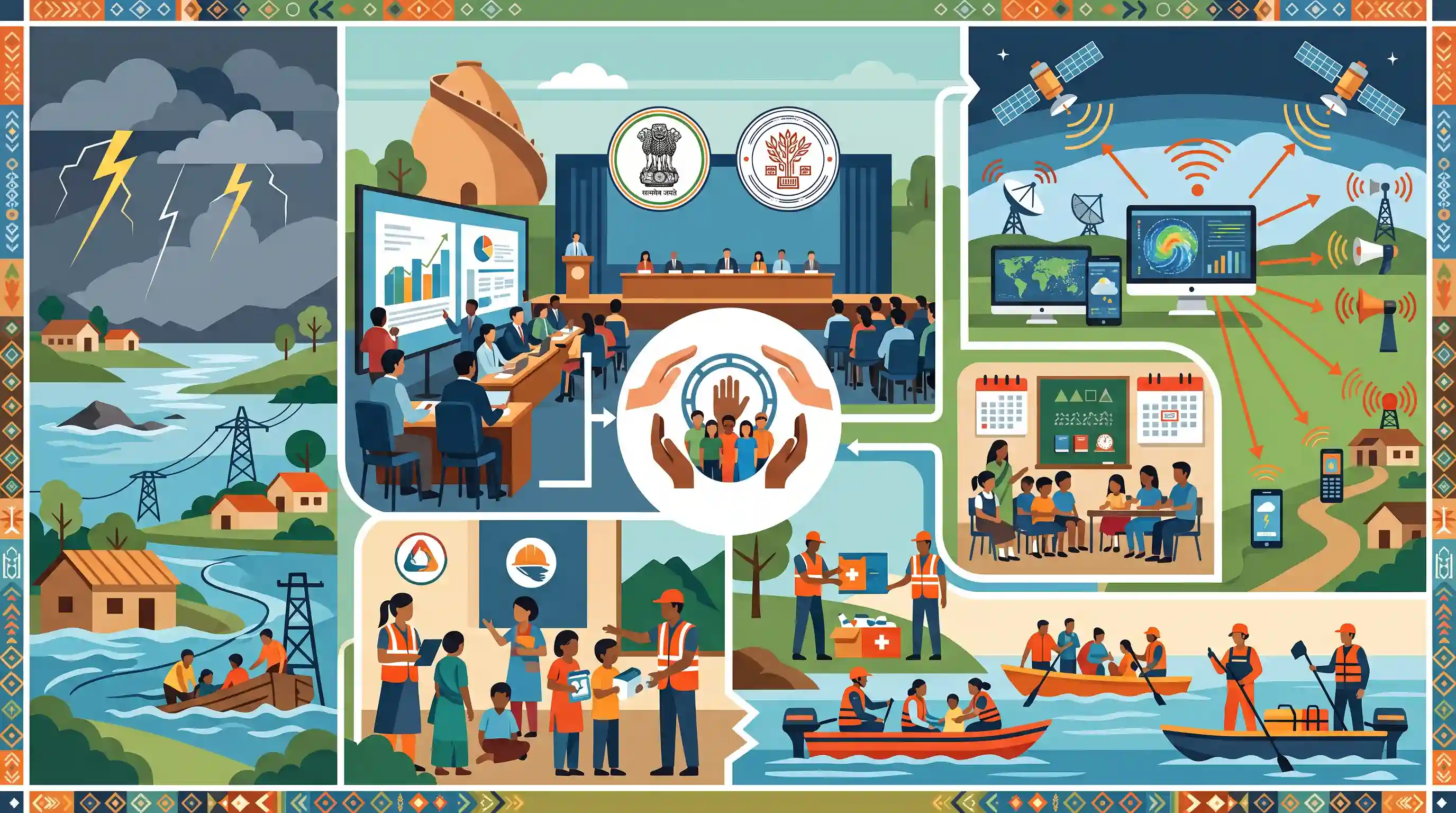
The Bihar State Disaster Management Authority (BSDMA) and the National Institute of Disaster Management (NIDM) organized a joint state-level workshop in Patna focused on strengthening disaster risk reduction and preparedness. The event emphasized achieving a 'Zero Casualty' goal through early warning systems, the BODHI forecasting platform, local initiatives like the Safe Friday campaign, and active mobilization of Aapda Mitras, NDRF, and SDRF against recurring hazards like floods and lightning in Bihar.
Key Points
- A state-level workshop on Disaster Risk Management was jointly organized by BSDMA and NIDM at Sardar Patel Bhawan, Patna, aiming to achieve 'Zero Casualty' during natural hazards.
- Bihar Governor emphasized the role of community awareness, robust early warning systems, regular training, and strengthening District Emergency Operation Centres (DEOCs).
- Disaster Management Minister Ratnesh Sada inaugurated the workshop, highlighting how climate change has increased the intensity of natural hazards, making disaster risk reduction a shared public responsibility.
- BSDMA Vice-Chairperson Udaykant Mishra advocated for a permanent NIDM training and capacity-building center in Bihar and highlighted local initiatives like the Safe Friday campaign and safety drives for brick kiln workers.
- Technical presentations covered key areas including disaster financing under the Disaster Management Act, lightning protection, hospital fire safety, and forecasting through the BODHI platform.
Important Terms
Disaster Management Act

A landmark 2005 Indian legislation establishing a robust legal and institutional framework for proactive disaster preparedness, mitigation, and response at national, state, and district levels.
UPSC context
GS Paper III (Disaster Management). Tests understanding of India's statutory frameworks, emergency preparedness, and the shift from relief to prevention.
National Disaster Management Authority (NDMA)
The apex statutory body under the Ministry of Home Affairs, chaired by the Prime Minister, responsible for formulating policies, plans, and guidelines for national disaster response and risk reduction.
UPSC context
GS Paper III (Disaster Management). Evaluates knowledge of national institutional machinery, policy execution, and mitigation guidelines for natural or man-made crises.
National Institute of Disaster Management (NIDM)
A premier statutory institute under the Ministry of Home Affairs tasked with capacity building, professional training, human resource development, research, and policy advocacy for disaster resilience.
UPSC context
GS Paper III (Disaster Management). Analyzes capacity-building institutions, research-driven risk mitigation, and central administrative structures.
Aapda Mitra scheme
A Central Sector Scheme implemented by the NDMA that identifies and trains grassroots community volunteers as first responders in disaster-prone districts for basic relief and rescue.
UPSC context
GS Paper III (Disaster Management & Schemes). Assesses community-based disaster risk management (CBDRM) and youth participation in grassroots resilience.
BODHI platform
An ISRO-developed specialized geoportal utilizing earth observation data to visualize hazards and enhance disaster preparedness, resource mapping, and environmental monitoring specifically for Bihar.
UPSC context
GS Paper III (Science & Tech / Disaster Management). Tests application of geospatial technology, satellite imagery, and localized early warning systems.
Bihar State Disaster Management Authority (BSDMA)
A statutory body chaired by the Chief Minister of Bihar, responsible for coordinating regional disaster risk reduction, preparing state disaster management plans, and running grassroots public awareness campaigns.
UPSC context
GS Paper III (Disaster Management). Examines federal governance, state-level institutional mechanisms, and region-specific disaster mitigation protocols.
Prelims Trap
Aapda Mitra is a Centrally Sponsored Scheme requiring a 60:40 fund-sharing ratio between the Centre and the States.
Aapda Mitra is a 100% Central Sector Scheme under NDMA, meaning it is fully funded by the Central Government without requiring state financial contributions.
Static Concepts Connected
What is the statutory structure and nodal authority of the National Institute of Disaster Management (NIDM)?
- Statutory Basis: Established under Section 42 of the Disaster Management Act, 2005, giving it a statutory mandate.
- Primary Mandate: Acts as the national nodal center for capacity building, human resource development, and training.
- Apex Leadership: The Union Home Minister acts as the President of NIDM's governing body.
What are the primary features and targets of the Sendai Framework (2015-2030)?
- Nature: A voluntary, non-binding agreement where the state holds the primary responsibility to reduce disaster risk.
- Target A: Aims to substantially reduce global disaster mortality by 2030, striving for 'zero casualty' goals.
- Target G: Aims to increase the availability of and access to multi-hazard early warning systems.
Cross-Topic Patterns
Space Tech + Climate Adaptation
Integrating ISRO's earth observation datasets (like BODHI) marks a transition from reactive relief to predictive, technology-driven climate resilience, linking GS-3 Space with GS-3 Disaster Management.
Grassroots Volunteerism + Crisis Response
Empowering community volunteers through Aapda Mitra bridges the critical first-responder gap, showing how decentralized governance (GS-2) directly strengthens local climate disaster adaptation (GS-3).

Mains 2026 may evaluate how community-led schemes like Aapda Mitra combined with spatial forecasting achieve Sendai Target A.
Linked PYQs · 1
Linked PYQs · 1
- 2018BPSC_PRELIMSGS1
In which airport, NDMA conducted a mock drill based on CBRN emergency in April 2018?
