Bihar pension direct benefit transfer and social security hike
Source:timesofindia ↗
Why It Matters
BPSC Prelims frequently asks detailed factual questions regarding social welfare schemes launched or implemented in Bihar, including specific target beneficiary counts, pension amounts (such as the increase from Rs 400 to Rs 1,100), key designated days (like Bihar Pension Day), and administrative leaders involved.
Summary
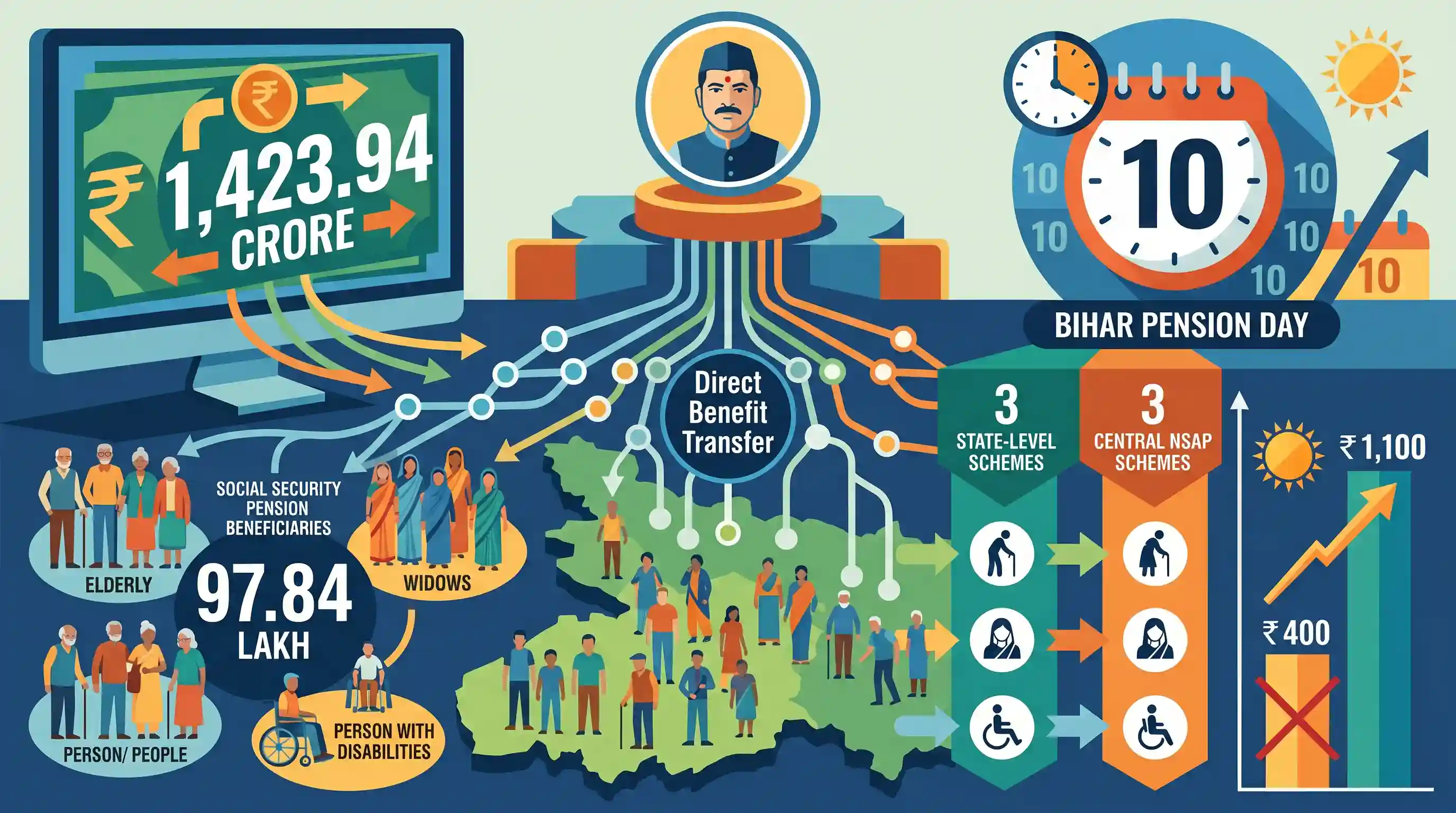
The Bihar Government, led by Chief Minister Samrat Choudhary, transferred Rs 1,423.94 crore to 97.84 lakh social security pension beneficiaries via Direct Benefit Transfer (DBT). Concurrently, the CM declared the 10th of every month as 'Bihar Pension Day' for scheduled transfers. The initiative covers three state-level schemes and three central NSAP schemes, noting that the monthly pension rate has been elevated from Rs 400 to Rs 1,100.
Key Points
- Bihar Chief Minister Samrat Choudhary transferred Rs 1,423.94 crore directly into the bank accounts of 97.84 lakh social security pension beneficiaries through the Direct Benefit Transfer (DBT) system.
- The 10th of every month has been declared as 'Bihar Pension Day', a day on which pension amounts will regularly be transferred to all eligible beneficiaries via DBT.
- The transferred amount covers the June 2026 pension under Bihar's three state social security pension schemes and the May and June 2026 pensions under the three National Social Assistance Programme (NSAP) pension schemes.
- The monthly social security pension in Bihar has been increased from Rs 400 to Rs 1,100, which has brought a substantial improvement in the livelihood of the beneficiaries.
- A special state-wide campaign will be launched to identify and register eligible people who have previously been excluded from these welfare pensions.
- The virtual launch event was attended by high-ranking state officials including Deputy CMs Vijay Kumar Choudhary and Bijendra Prasad Yadav, Social Welfare Minister Shweta Gupta, and Chief Secretary Pratyaya Amrit.
Important Terms
National Social Assistance Programme (NSAP)

A centrally sponsored welfare scheme launched in 1995 under the Ministry of Rural Development, providing financial assistance to BPL elderly, widows, and disabled persons, fulfilling Article 41 of the Constitution.
UPSC context
GS Paper II: Welfare schemes; tests understanding of social security nets, targeted poverty alleviation, and Article 41 directive principles.
Direct Benefit Transfer (DBT)
A governance reform initiative aimed at transferring subsidies, pensions, and welfare benefits directly into beneficiaries' bank accounts, reducing administrative intermediaries, leakages, and delays.
UPSC context
GS Paper II: E-governance and transparency; tests knowledge of technology-driven welfare delivery and leak-proof distribution mechanisms.
Mukhyamantri Vridhajan Pension Yojna
A universal social security old-age pension scheme in Bihar providing financial assistance to elderly citizens aged 60 and above, excluding retired government employees, regardless of caste or income.
UPSC context
GS Paper II: State welfare schemes; tests knowledge of sub-national old-age social security initiatives and elder-care policies.
Laxmibai Social Security Pension Scheme
A state-specific welfare scheme in Bihar providing monthly pension assistance to widowed women aged 18 and above from BPL/economically weaker families with annual incomes below ₹60,000.
UPSC context
GS Paper II: Vulnerable sections; tests understanding of gender-focused state welfare programs and targeted socio-economic support systems.
Bihar Pension Day
An administrative initiative in Bihar designating the 10th day of every month for the streamlined, time-bound, and transparent electronic transfer of social security pensions to beneficiaries.
UPSC context
GS Paper II: Governance and public service delivery; tests knowledge of administrative reforms ensuring accountability and citizen-centric governance.
Prelims Trap
The National Social Assistance Programme (NSAP) is a Central Sector Scheme administered by the Ministry of Social Justice and Empowerment.
NSAP is a Centrally Sponsored Scheme (not Central Sector) and is administered by the Ministry of Rural Development, not the Ministry of Social Justice and Empowerment.
Static Concepts Connected
What is the National Social Assistance Programme (NSAP) and its structural design?
- Origin & Administration: Launched in 1995 as a Centrally Sponsored Scheme under the Ministry of Rural Development.
- Constitutional Link: Fulfills Directive Principles of State Policy under Article 41, which mandates public assistance for old age, sickness, and disablement.
- Core Components: Comprises five schemes: three pension programs (IGNOAPS, IGNWPS, IGNDPS), National Family Benefit Scheme (NFBS), and Annapurna food security scheme.
How do Central Sector and Centrally Sponsored Schemes differ in Indian fiscal federalism?
- Central Sector Schemes: Funded 100% by the Union government and implemented directly by central agencies.
- Centrally Sponsored Schemes: Funded jointly by Centre and States (e.g., 60:40 or 90:10) but implemented entirely by State administration.
Cross-Topic Patterns
Fiscal Federalism and Welfare Burden
State-level top-ups on central schemes like NSAP highlight how states navigate fiscal space to fulfill DPSPs, directly impacting subnational debt-to-GDP ratios.
DBT and Last-Mile Delivery Infrastructure
Fixed-day state DBT cycles test the resilience of regional Digital Public Infrastructure (DPI) and last-mile banking correspondent networks in rural under-banked areas.

Expect questions on the federal sharing architecture of NSAP and the constitutional mandates (Article 41) driving state welfare by 2026.
Linked PYQs · 2
Linked PYQs · 2
- 2018BPSC_PRELIMSGS1
Which of the following is not true about Bihar's Mukhyamantri Kanya Utthan Yojana?
- 2020BPSC_PRELIMSGS1
Bihar Government launched a new scheme 'Satat Jivikoparjan Yojana' in August 2018. The objective of this scheme is
