Withdrawal of NEET Protest Cases: Executive Decision and Legal Process
Source:The Hindu ↗
Why It Matters
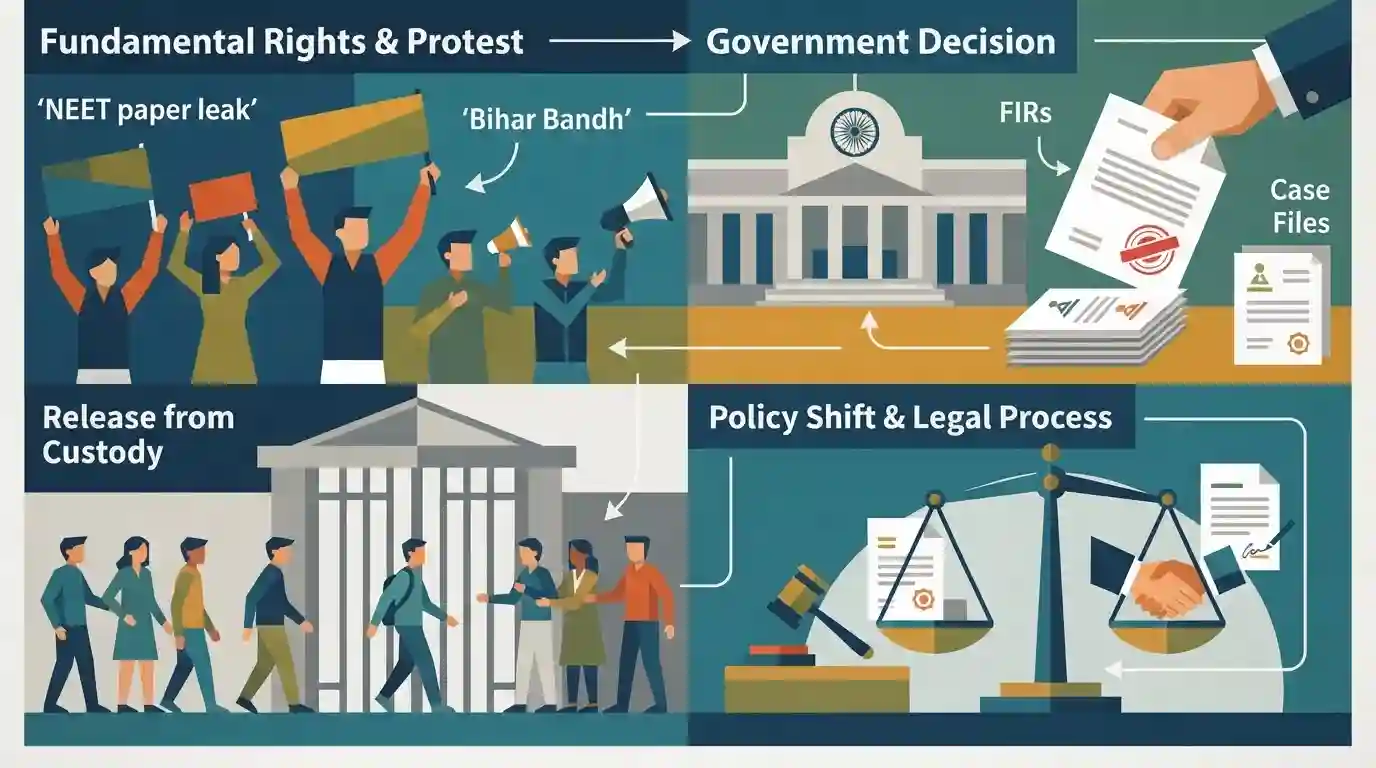
The event highlights the intersection of fundamental rights (the right to protest under Article 19) and the state's executive discretion in withdrawing criminal cases (CrPC/BNSS). It also underscores the socio-political dynamics around the integrity of public examinations in India.
Summary
The Bihar government has announced its decision to withdraw all FIRs and criminal cases filed against individuals who protested the alleged NEET paper leak. The state intends to release those currently jailed for participating in protests, including the 'Bihar Bandh' organized by left-wing student groups like AISA. The move requires formal legal procedures to dismiss show-cause notices and criminal complaints, reflecting a significant policy shift on state handling of student demonstrations.
Key Points
- The Bihar government has decided to withdraw all FIRs and criminal cases lodged against individuals protesting the alleged NEET paper leak.
- The protests notably included a 'Bihar Bandh' led by left-wing student organizations like AISA and supported by various political figures.
- The state administration will initiate formal legal procedures to withdraw criminal complaints, show-cause notices, and secure the release of jailed protesters.
- This decision highlights the use of state executive powers to de-escalate tensions stemming from student demonstrations over competitive examination integrity.
Important Terms
NEET (National Eligibility cum Entrance Test)

A centralized national-level entrance exam conducted by the National Testing Agency for undergraduate medical (MBBS) and dental (BDS) courses in government and private colleges across India.
UPSC context
GS Paper II (Government Policies); tests issues of federalism, public exams integrity, and centralisation in the education sector.
All India Students' Association (AISA)
A left-wing student organization in India, founded in 1990 and affiliated with the CPI(ML) Liberation, active in leading student struggles for democratic campus rights and public education reforms.
UPSC context
GS Paper II (Pressure Groups); tests the role of youth associations and civil society organizations in democratic mobilization.
CPI(ML) Liberation
A communist political party in India, originating from the Naxalbari uprising, that participates in parliamentary democracy and electoral politics while organizing workers, peasants, and student-led mass movements.
UPSC context
GS Paper II (Political Parties); tests understanding of diverse party systems, left-wing ideologies, and political representation in India.
Withdrawal from Prosecution
A legal provision (under Section 321 of CrPC, now Section 360 of BNSS) allowing Public Prosecutors, with court consent, to drop criminal charges on grounds of public policy, executive decisions, or justice.
UPSC context
GS Paper II (Separation of Powers, Criminal Justice); tests the limits of executive discretion, judicial oversight, and rule of law.
State List (Seventh Schedule)
A constitutional list under the Seventh Schedule containing subjects like "Police" and "Public Order," giving state legislatures exclusive jurisdiction to make laws and manage law enforcement under normal circumstances.
UPSC context
GS Paper II (Federal Structure); tests federal division of powers, legislative competence, and state autonomy in law and order administration.
Prelims Trap
The State Government has the absolute executive power to unilaterally withdraw criminal prosecutions under BNSS without judicial or victim oversight.
Case withdrawal requires the Public Prosecutor's application, the court's consent, and, under BNSS Section 360, a mandatory prior hearing of the victim.
Static Concepts Connected
What is the statutory framework for the withdrawal of criminal prosecution?
- Statutory Transition: Section 360 of the Bharatiya Nagarik Suraksha Sanhita (BNSS) governs the withdrawal, replacing Section 321 of the CrPC.
- Judicial Oversight: The application must be filed by the Public Prosecutor or Assistant Public Prosecutor, requiring the explicit consent of the court.
- Victim's Right: Unlike the CrPC, BNSS Section 360 mandates that no court shall allow withdrawal without first giving the victim an opportunity of being heard.
How is the Right to Protest balanced under the Indian Constitution?
- Constitutional Source: Derived from Article 19(1)(a) (freedom of speech) and Article 19(1)(b) (right to assemble peaceably and without arms).
- Reasonable Restrictions: Subject to reasonable restrictions under Articles 19(2) and 19(3) on grounds of public order, state security, and sovereignty.
- Federal Division: Under the Seventh Schedule, 'Public Order' and 'Police' reside in the State List (List II), giving states jurisdiction over protest management.
Cross-Topic Patterns
BNSS Reform vs Executive Discretion
How the transition from CrPC to BNSS curtails absolute executive discretion in withdrawing cases by formalizing the victim's right to be heard during political de-escalations.
Exam Centralization vs State Public Order
Centralized exams (NEET under Union/NTA) creating law-and-order crises handled by state administrations, showcasing asymmetric federalism in public order management.

Mains 2026 may analyze how BNSS Section 360's victim-hearing clause alters state-level political negotiations to withdraw protest cases.
Linked PYQs · 2
Linked PYQs · 2
- 2025BPSC_PRELIMSGS1
The constitution of India provides for reasonable restrictions on Fundamental Rights but reasonableness must keep in mind that: 1. The restrictions must be necessary for the protection of the rights of others. 2. The restrictions must be proportionate to the end sought. 3. The restrictions must be reasonable in the light of the circumstances. 4. The restrictions must be in the public interest.
- 2022BPSC_PRELIMSGS1
Article 300 of the Indian Constitution deals with
