AIIMS Patna Land Allocation and Medical Facility Expansion
Source:uni-india ↗
Why It Matters
Understanding healthcare infrastructure, budget allocations, and major development plans in Bihar is critical for state-specific questions in the BPSC Prelims.
Summary
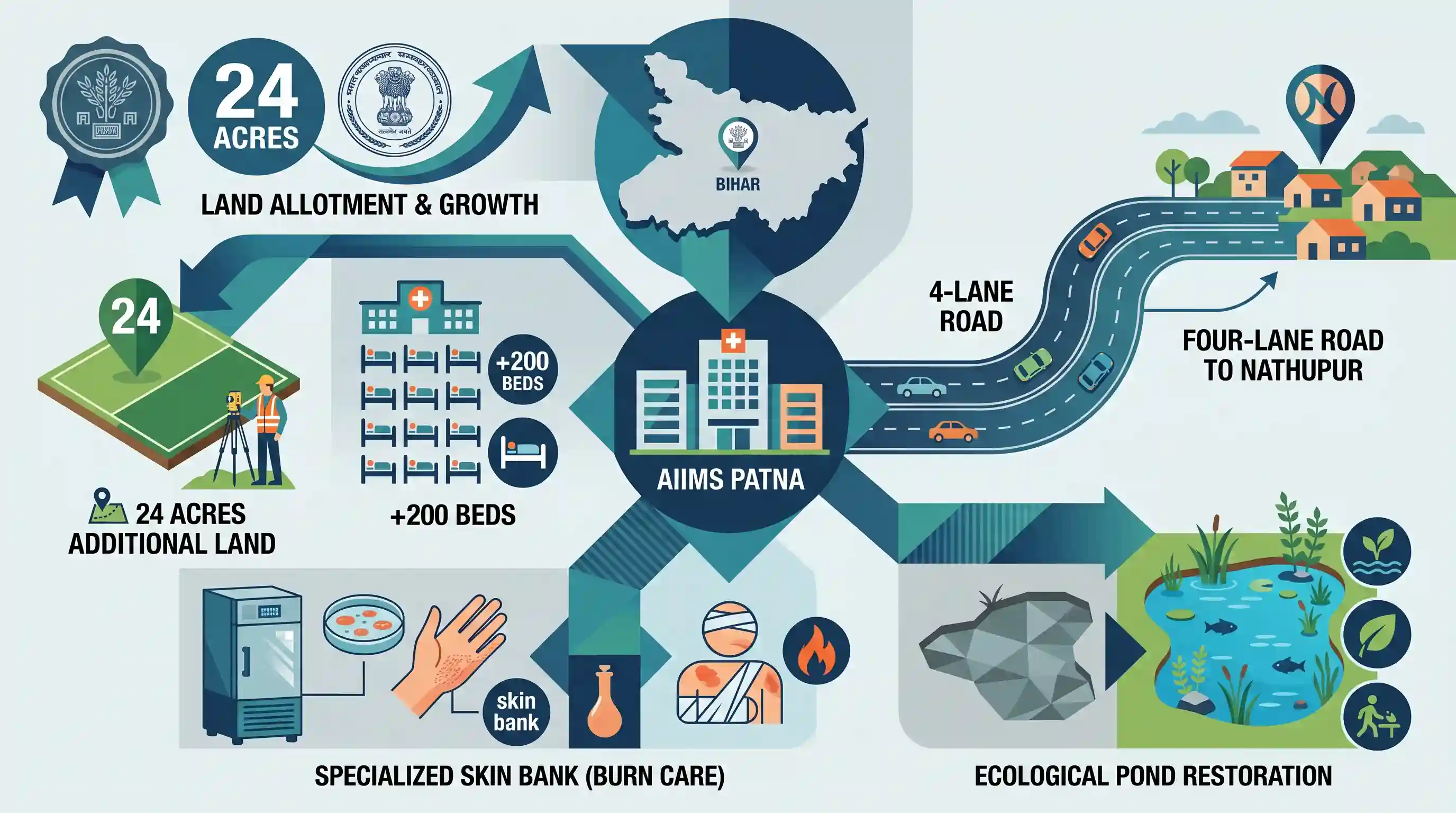
The Bihar Government has announced the allotment of 24 acres of additional land for the expansion of AIIMS Patna. This expansion will add approximately 200 hospital beds, establish a specialized skin storage facility (skin bank) for burn care, build a four-lane connectivity road to Nathupur, and ecologically restore the on-campus pond.
Key Points
- The Bihar Government announced the allotment of 24 acres of additional land for the expansion of AIIMS Patna.
- The expansion project will add approximately 200 new hospital beds, increasing medical care capacity.
- A new four-lane road will be constructed to link AIIMS Patna with Nathupur to ensure smoother and faster physical connectivity.
- A specialized skin storage facility (skin bank) will be established to enhance emergency burn care and skin grafting.
- Key clinical departments like Nuclear Medicine (including PET-CT, SPECT-CT, and Radiopharmacy Lab), Oncology, Anatomy, and OPD were inspected.
- A pond inside the AIIMS campus will be ecologically restored and developed into a public recreational and environmental conservation space.
Important Terms
All India Institute of Medical Sciences

A group of premier autonomous public medical universities in India, designated as Institutes of National Importance, offering advanced tertiary healthcare and clinical training.
UPSC context
GS Paper II: Health Sector Infrastructure. Tests knowledge of public healthcare delivery and top statutory institutes.
Tertiary Healthcare
Highly specialized medical care involving advanced diagnostic support, complex surgical procedures, and super-specialty departments, typically provided by state or national referral hospitals.
UPSC context
GS Paper II: Social Sector and Health. Tests understanding of India's three-tier healthcare delivery system.
Pradhan Mantri Swasthya Suraksha Yojana
A central sector scheme launched in 2003 to correct regional imbalances in affordable tertiary healthcare and upgrade clinical education infrastructure across India.
UPSC context
GS Paper II: Government Policies and Welfare Schemes. Tests understanding of policies addressing health infrastructure disparities.
Institutes of National Importance
A statutory status awarded by an Act of Parliament to premier public higher education institutions in India to develop highly skilled technical and clinical professionals.
UPSC context
GS Paper II: Government Policies & Institutional Frameworks. Tests familiarity with statutory designations of apex institutions.
Skin Bank
A specialized medical facility that harvests, processes, and stores donor skin to serve as biological grafts for patients suffering from severe burns.
UPSC context
GS Paper III: Science & Technology. Tests awareness of biomedical technology and clinical advancements in public health.
Ecological Restoration
The active human practice of helping degraded, damaged, or destroyed ecosystems recover to restore their original ecological health, sustainability, and biodiversity.
UPSC context
GS Paper III: Environment. Tests concepts of conservation, sustainable habitat management, and water-body restoration.
Prelims Trap
The establishment of new AIIMS-like institutions under PMSSY is funded on a cost-sharing basis between the Centre and States.
Setting up new AIIMS is a 100% centrally funded component of PMSSY. Only the upgradation of existing state medical colleges involves center-state cost sharing.
Static Concepts Connected
What are the core components and funding of PMSSY?
- Objective: Aims to correct regional imbalances in affordable tertiary healthcare and expand medical education across India.
- Dual Components: Setting up new AIIMS (100% centrally funded) and upgrading existing state medical colleges (center-state cost-shared).
- Nodal Ministry: Administered directly by the Ministry of Health and Family Welfare.
How do PET and SPECT nuclear imaging technologies differ?
- PET-CT Technology: Uses positron-emitting radiotracers like Fluorodeoxyglucose (FDG) to map metabolic activity, crucial for oncology.
- SPECT-CT Technology: Employs gamma-emitting radioisotopes (e.g., Technetium-99m) to track blood flow and organ physiological function in 3D.
- Resolution Difference: PET provides higher spatial resolution and quantitative biological data compared to the general physiological imaging of SPECT.
Cross-Topic Patterns
Cooperative Federalism in Healthcare
State land-allotment combined with 100% central PMSSY funding demonstrates how Union-State cooperation is structurally essential to address regional tertiary healthcare deficits.
Bio-tissue preservation & NOTTO
The establishment of regional skin banks highlights the intersection of state-level healthcare delivery with national tissue donation regulations under NOTTO.

PMSSY's dual funding design (100% central for new AIIMS vs shared for state college upgrades) is prime for a core polity-health MCQ in 2026.
Linked PYQs · 2
Linked PYQs · 2
- 2024-EBPSC_PRELIMSGS1
Which sector received the highest allocation in the Bihar Budget 2024-25?
- 2019BPSC_PRELIMSGS1
In NITI Aayog's Health Index, 2019, Bihar scored
