Bihar Signs Nuclear Energy Project Investment Deal
Source:power-line ↗
Why It Matters
This development represents a massive shift in Bihar's industrial and energy landscape. A Rs 225 billion nuclear project is unprecedented for the state, making it highly relevant for BPSC Prelims questions on state economy, major MoUs, and clean energy transition.
Summary
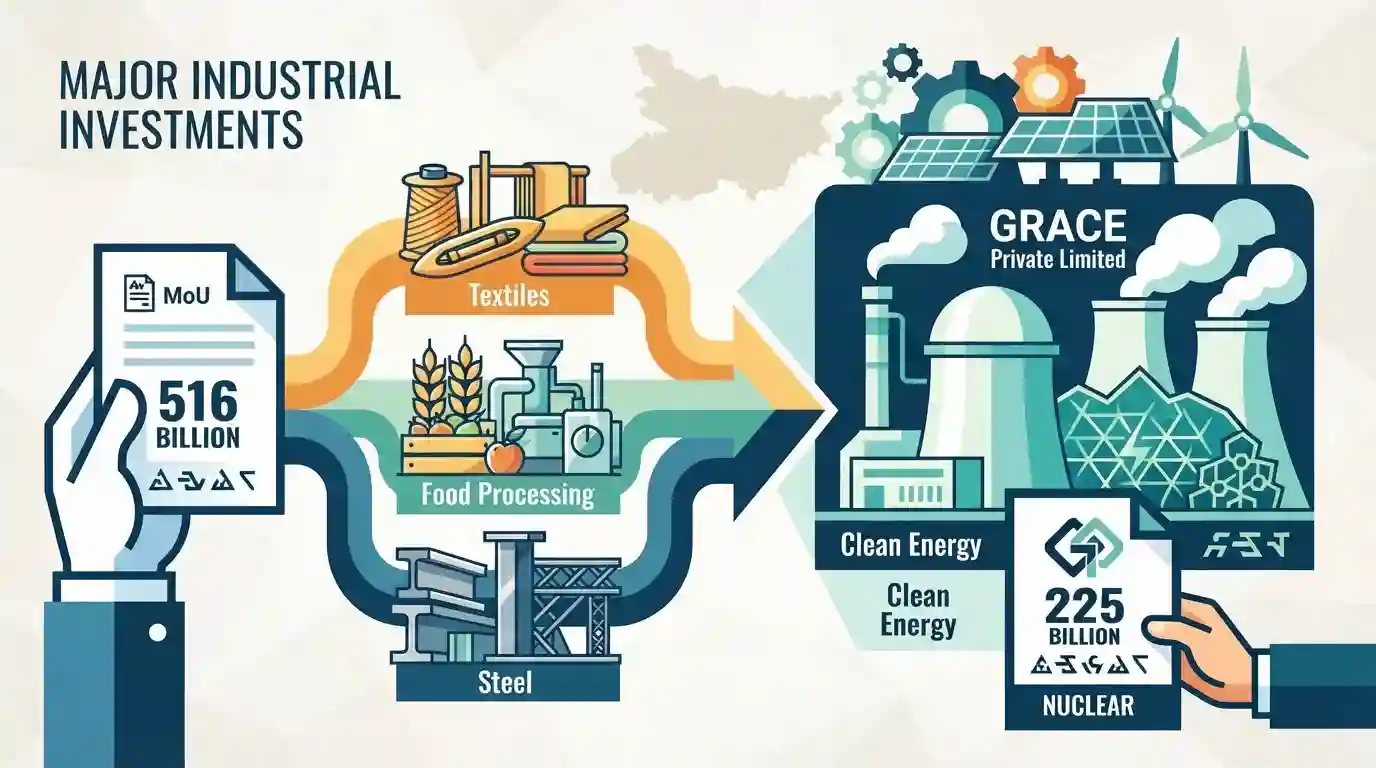
The Bihar government has secured major industrial investments, signing memorandums of understanding (MoUs) totaling Rs 516 billion across diverse sectors including textiles, food processing, and steel. The centerpiece of this investment push is a Rs 225 billion MoU signed with GRACE Private Limited to establish a nuclear energy project, marking a historic step for Bihar's clean energy and infrastructural development.
Key Points
- The Bihar government signed MoUs worth Rs 516 billion across sectors like steel, nuclear energy, textiles, food processing, and pharmaceuticals.
- The most significant investment proposal is a Rs 225 billion nuclear energy project.
- The MoU for the nuclear energy project was signed by Global Renewable Advanced Clean Energy (GRACE) Private Limited.
- This nuclear energy project marks the largest single investment proposal signed under the current initiative, highlighting a shift towards clean energy infrastructure in the state.
Important Terms
Bihar government

State government in eastern India. Signed industrial MoUs worth ₹516 billion across steel, clean energy, and textiles, highlighting a major push to diversify its economy from agriculture to heavy manufacturing and ensure energy security.
UPSC context
GS Paper 3: State Economy & Investment. Tests knowledge of regional development, industrialization efforts, and state-level renewable energy initiatives.
Global Renewable Advanced Clean Energy (GRACE) Private Limited
A private firm that signed an MoU with the Bihar government to develop a ₹225 billion nuclear energy project, representing the state's largest single industrial investment to boost clean, baseload power.
UPSC context
GS Paper 3: Energy & Infrastructure. Highlights private sector involvement in nuclear energy and state strategies for achieving clean energy security.
Prelims Trap
Private entities can now own and operate nuclear power generation plants in India.
Under the Atomic Energy Act, 1962, the Central Government must hold at least a 51% stake in nuclear generation. Private firms are limited to minority JV stakes, EPC, or equipment supply.
Static Concepts Connected
How is private sector participation regulated in India's nuclear power sector?
- Atomic Energy Act: The 1962 Act restricts nuclear power generation to the Central Government or government-owned companies, requiring a minimum 51% government share in any joint venture.
- Private Sector Limits: The private sector cannot independently own nuclear plants; its role is limited to Engineering, Procurement, and Construction (EPC) contracts, equipment manufacturing, and technology provision.
- 2015 Amendment: Amendments to the Act allowed joint ventures specifically between the Nuclear Power Corporation of India (NPCIL) and other Public Sector Undertakings (PSUs), not private corporates.
What are sub-national climate commitments in India's Net Zero pathway?
- National Target: India's 'Panchamrit' pledge at COP26 set an overarching national target to achieve net-zero carbon emissions by the year 2070.
- State-level Ambitions: States are establishing their own accelerated sub-national climate targets. For example, Bihar has partnered with UNEP to achieve carbon neutrality by 2040.
- Federal Climate Action: Decentralized, state-level policy pushes and green infrastructure investments are critical to achieving India's interim goal of 500 GW non-fossil capacity by 2030.
Cross-Topic Patterns
Private capital in strategic sectors
Massive state-level clean energy MoUs signed with private companies will test the boundaries of the Atomic Energy Act's strict restrictions on private ownership and generation in the nuclear sector.
Sub-national climate diplomacy
Bihar's collaboration with UNEP for a 2040 net-zero target showcases direct state-to-international organization partnerships, highlighting the growing trend of competitive sub-national climate diplomacy and decentralized transition planning.

Expect a multi-statement question on the legal limits of private sector participation in nuclear power under the Atomic Energy Act, 1962.
Linked PYQs · 3
Linked PYQs · 3
- 2023BPSC_PRELIMSGS1
The first ‘floating solar power plant’ has been built at which place in Bihar?
- 2018BPSC_PRELIMSGS1
Which type of industries has potentials and prospects in Bihar?
- 2023BPSC_PRELIMSGS1
Bihar Government has planned to make Bihar State ‘pollution-free’ by reducing carbon emissions by which year?
